Why you are still bloated after giving birth and why your body struggles to drain right now
Most postnatal swelling is fluid, not fat, and the pump that drains it is impaired. When to wait, when to call your doctor or midwife, and what helps.
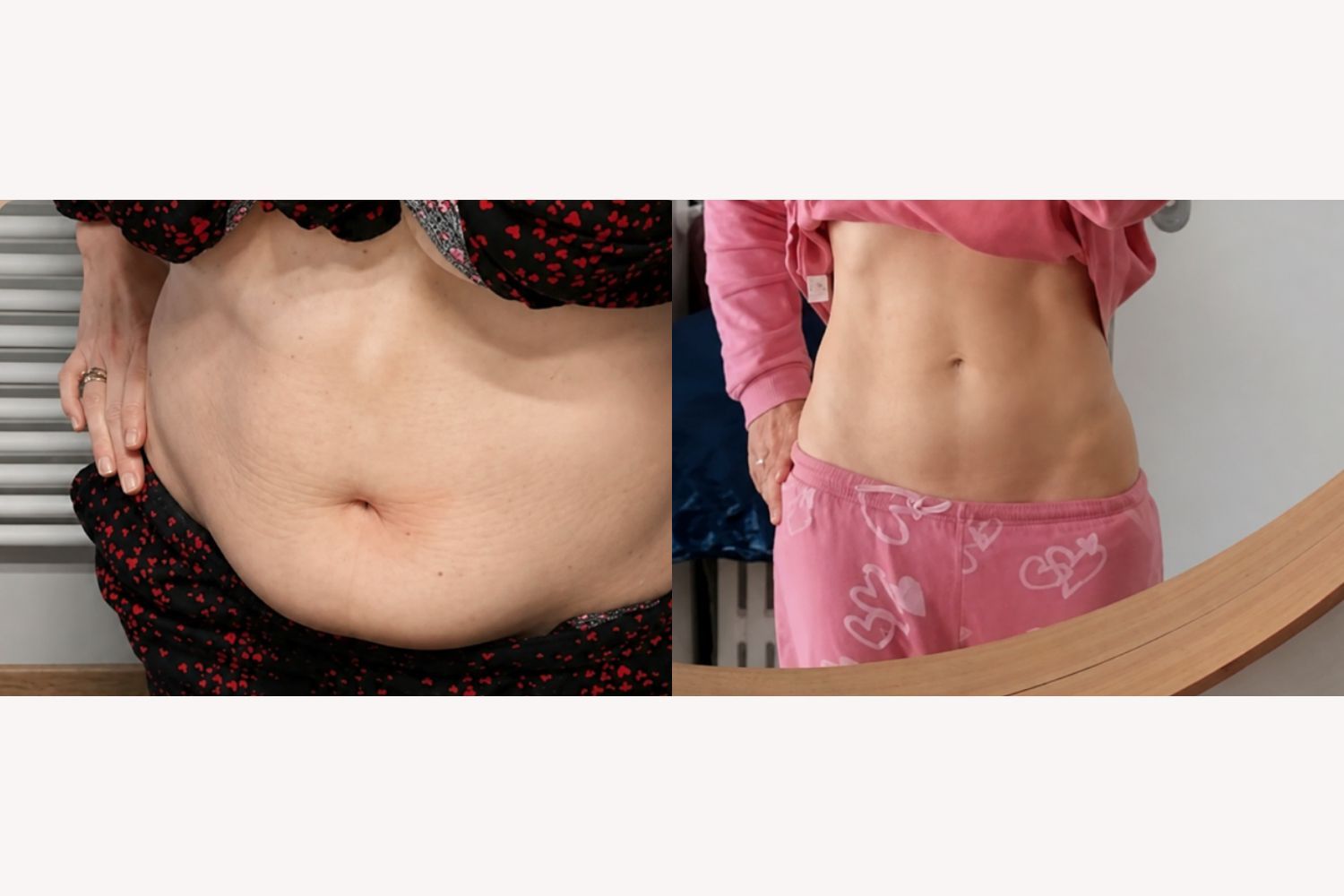
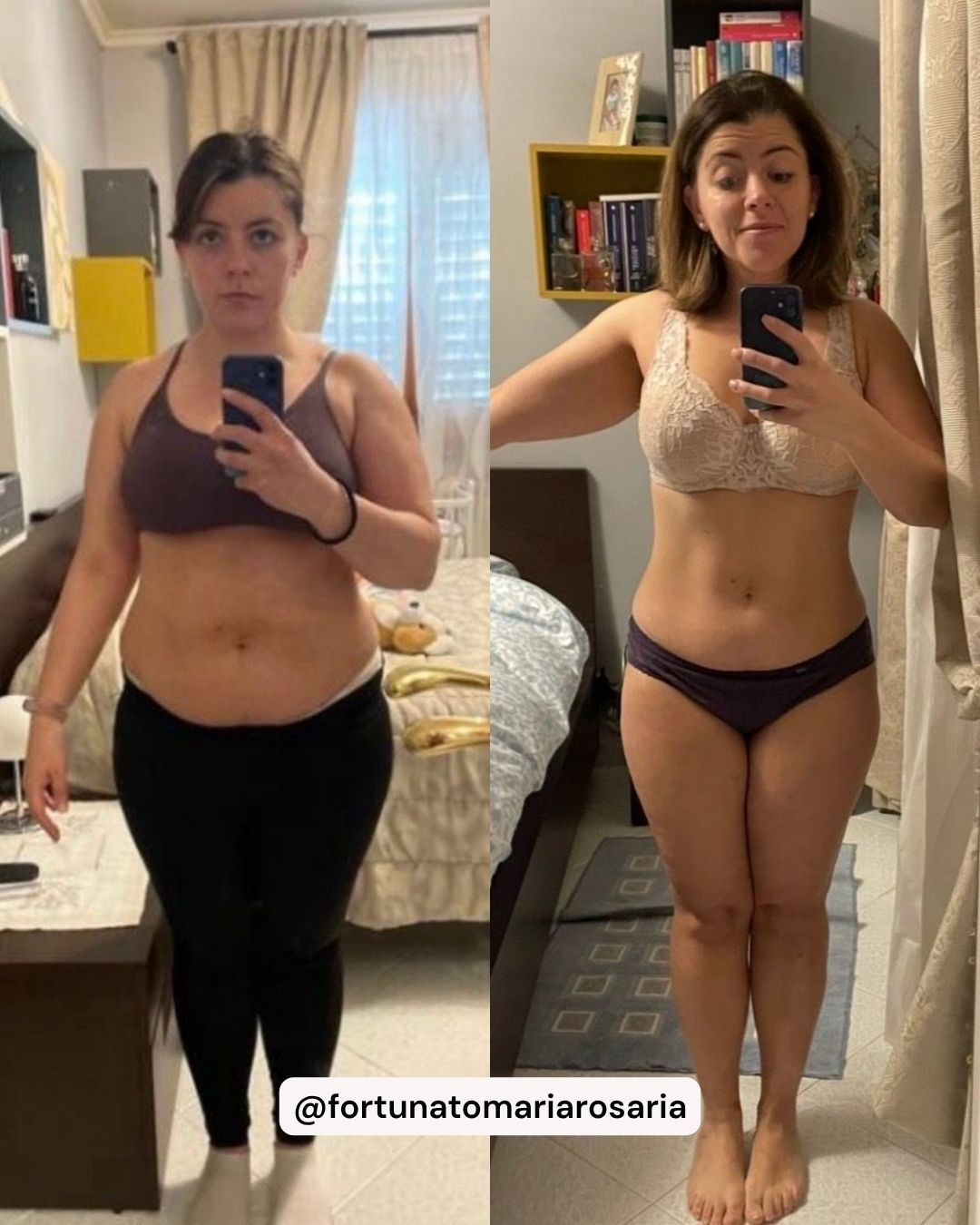
In short: Dora lost 10 kg (1st 8lb) in 14 weeks after giving birth with The Original Lymphatic Drainage Pilates (Pilates Linfodrenante®) and by following the nutrition programme as closely as she could. A significant part of what comes off in the early weeks after birth is not fat, it is fluid: fluid volume rises considerably during pregnancy, and meanwhile the diaphragm has been compressed for months. The result is that your body has more fluid to drain than at any other point in your life, at exactly the moment the pump that drains it is working least well.
Dora’s message opens with a line I wish I had read years ago, back when I still thought some things could not be said out loud:
“After the birth I was happy because I had my daughter, but I didn’t feel 100% in myself physically.”
Both things. In the same sentence.
And it is the most important thing in this whole article, so I will put it first: being happy about your daughter and not feeling good in your body are not a contradiction. You do not have to choose which one to feel, and you do not have to feel guilty about the second because the first is true.

With that said, on to the part that actually helps: why your body is so bloated after giving birth. And in particular why it stays bloated far longer than you expected.
Because the answer is not “give it time”. There is a specific mechanical reason, and knowing it changes what you can do about it.
First: when swelling is not something to wait out
Before anything else, because this matters more than everything below it.
Most postnatal swelling is normal and follows the pattern described in this article: gradual, symmetrical, affecting both legs and often the hands and face, improving slowly week by week.
Some swelling is not that, and needs urgent attention rather than drainage work. Contact your midwife, your GP or NHS 111 straight away if you have:
- Swelling that comes on suddenly, or gets noticeably worse rather than better
- Swelling in one leg only, particularly with pain, tenderness, warmth or redness in the calf
- Swelling with a headache, visual disturbance, pain under the ribs, or feeling generally unwell
- Swelling with breathlessness or chest pain
These can indicate postnatal pre-eclampsia, which can develop after birth and up to six weeks afterwards, or a blood clot, and both need assessing quickly. Postnatal pre-eclampsia in particular catches women out because they assume the risk ended with the delivery.
None of what follows applies to those situations. What follows is about the ordinary, gradual, both-sides swelling that almost every woman has and that almost nobody explains properly.
How much of what you see is not fat
Let’s start here, because hardly anyone says it clearly.
During pregnancy your blood volume rises substantially, and along with it the amount of fluid your body holds in the tissues. That is physiological and it is necessary: it is how your body supports a pregnancy.
Then there is everything added around the birth itself. The fluids given during labour, which in many cases are considerable, particularly with an epidural or a caesarean. And immediately afterwards the hormonal drop, which changes overnight how your body handles sodium and water.
The result is that in the days and weeks after birth your body has far more fluid to clear than normal.
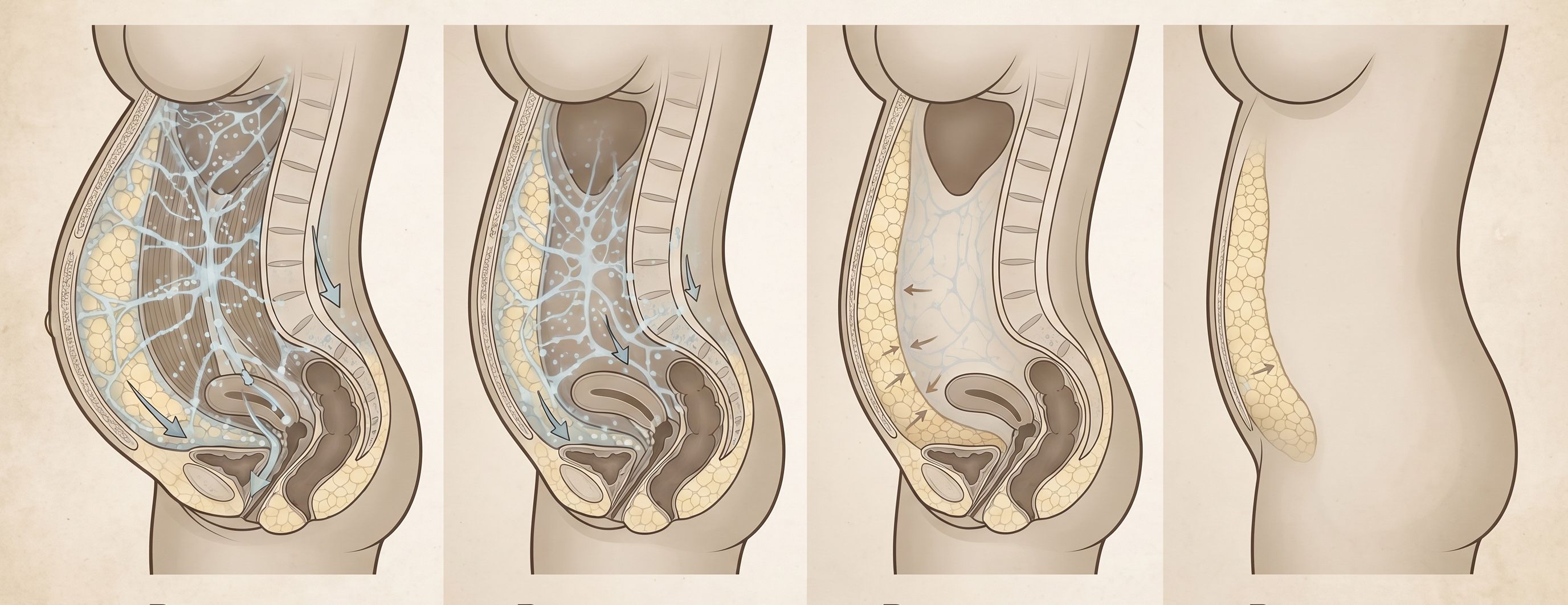
Some of it goes quickly, in the first days, through urine output and the night sweats that many women find startling. But the fluid sitting in the tissues, the fluid that makes your legs feel heavy, your ankles still puffy and your stomach soft and full, that clears far more slowly.
Which is also the good news: a meaningful share of what you see in the mirror two weeks after birth is not fat to lose. It is fluid to drain. And fluid responds much faster than fat does.
And now the real problem: the pump is not working well
Here is the part I think is the most useful in this article, and the part nobody explains.
Your lymphatic system has no pump of its own the way your circulatory system has the heart. Lymph moves through three things only: the contraction of the muscles around the lymphatic vessels, and the movement of the diaphragm when you breathe deeply, and joint mobility.
The thoracic duct, the largest lymphatic vessel in the body, passes directly through the diaphragm. Every deep breath pumps it, drawing lymph up from the lower body.
Now think about what happened to your diaphragm over the last months of pregnancy.
It was pushed upwards and compressed, progressively, for weeks. Your breathing moved higher, became shorter and more chest-led, because there was no room underneath. And after the birth that pattern does not correct itself: your body learned to breathe that way and carries on doing it.
Put the two together.
You have more fluid to drain than at any other point in your life. And the main pump that should be draining it is working worse than at any other point in your life.
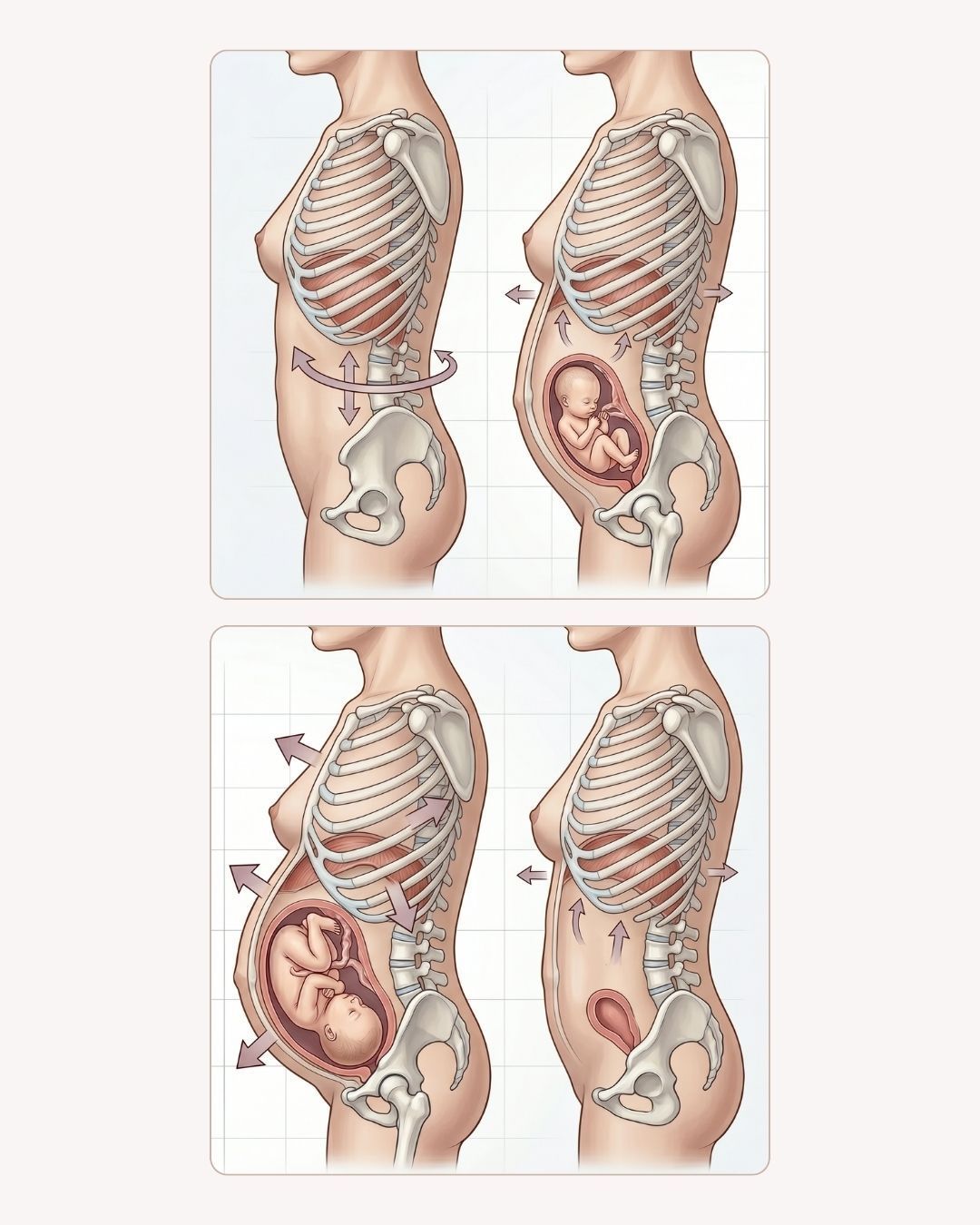
That is why postnatal swelling is so stubborn. It is not that your body is slow or that you simply need to be patient. It is that the clearance mechanism is impaired at precisely the moment of maximum load.
It is also why, after birth, the first work is not your abdomen but your breathing. It is not a relaxation exercise: it is switching the pump back on.
What Dora did
In her words:
In almost two months of Lymphatic Drainage Pilates and, let’s say, diet, I tried to follow your nutrition plan as much as possible, and I’ve changed a lot physically.”
She started on 8 March, and she describes it as “the best present I could have given myself.”
There are two habits she picked up during one of the challenges that are worth looking at closely, because after birth they count for more than at any other time.
-
She drank two litres of water a day
And she says something that struck me: she wants to keep doing it after the challenge ends, “because it makes you feel good.”
Drinking more in order to be less bloated sounds like the opposite of how it should work, and yet it is exactly right. Lymph is largely water: when you are dehydrated it becomes thicker and slower to move. And a body receiving too little water tends to hold on to what it has rather than letting it go.
After birth this counts double, because if you are breastfeeding your fluid requirement is higher again.
-
She did not drink alcohol
Alcohol dehydrates, worsens sleep quality and raises cortisol, and high cortisol drives fluid retention. In the period when you are sleeping less than at any other time in your life, it is the first variable worth removing.
And then the line I liked most, because it describes a healthy relationship with all of this: “Yesterday was a mini off-day. I had an ice cream in the afternoon that I hadn’t had in ages, and pizza in the evening.”
An ice cream and a pizza inside something that is working. That is how you build a thing that lasts.
“I can’t see how much I’ve improved”
And now the part I think every woman should read, because it goes well beyond the postnatal period.
Dora describes a friend repeatedly complimenting her on how she looked. And then she writes this:
“Looking at myself in the mirror every day, I can’t really see how much I’ve improved physically. Whereas the last time she saw me I was eight months pregnant…”
Here is the point: you are the only person in the world who cannot see your own change.
Not out of modesty and not out of insecurity. For a perceptual reason. You look at yourself every day, and every day the difference from yesterday is too small to register. Your brain continuously updates its reference point, so the comparison you are making is always with yesterday’s you, never with the you of three months ago.
Someone who has not seen you for months makes the only comparison that actually counts, and sees all of it at once.
That has two practical consequences, and they matter.
First: do not use the mirror as your measure of progress. It is not a reliable instrument for something that changes slowly. Use a tape measure every four weeks, use your clothes, and take photographs in consistent conditions.
Dora puts it her own way, talking about clothes: “I’m slowly starting to wear things again that I hadn’t worn in ages because they were too tight.” That is data. The mirror is not.
Second: when someone compliments you, treat it as information. Not as kindness. Someone who has not seen you in months is literally measuring something you cannot measure yourself.
The 4 things to take from Dora’s story
-
Much of postnatal swelling is fluid, not fat
And fluid responds far faster.
-
The pump that drains it is impaired right now
The diaphragm has been compressed for months and the breath has stayed high and short. Restoring it is the first job, before the abdomen.
-
Drinking more reduces swelling
It sounds counterintuitive: when you are dehydrated, lymph is thicker and the body holds on to more. If you are breastfeeding, more so.
-
You are the only one who cannot see your own change
The daily mirror is not a measure. A tape measure, your clothes and photographs are.
Where to start
If you have given birth recently, the starting point is Pilates Diastasis & Postpartum: six weeks starting from the breath and rebuilding in the right order. Always after your midwife’s or obstetrician’s clearance.
If your main issue is swelling and heavy legs, Lymphatic Drainage Pilates works on drainage and tone together.
If you have very little time, which is likely with a newborn, Lymphatic Drainage Pilates Express: fifteen minutes a day.
And in the evening, try Light Legs in 10 minutes: legs up against the wall before sleep, which after birth is one of the things that brings relief fastest.
Frequently asked questions
Why am I still bloated after giving birth?
Because fluid volume rises substantially during pregnancy, to which is added the fluid given during labour and the sharp hormonal change after delivery.
Some of it clears quickly in the first days through urine output and sweating, but the fluid held in the tissues clears far more slowly.
On top of that the diaphragm has been compressed for months and breathing has stayed high and short, which reduces the efficiency of the lymphatic pump at exactly the moment there is most fluid to drain.
When is postnatal swelling a reason to seek help?
If it comes on suddenly or worsens rather than improving, if it affects one leg only, particularly with calf pain, tenderness, warmth or redness, or if it comes with headache, visual disturbance, pain under the ribs, breathlessness or feeling unwell.
These can indicate postnatal pre-eclampsia, which can develop up to six weeks after birth, or a blood clot, and both need assessing urgently. Contact your midwife, GP or NHS 111. Ordinary postnatal swelling is gradual, affects both sides and improves slowly.
How long does it take for postnatal swelling to go down?
The first days clear a significant share of fluid through urine output and sweating. Swelling held in the tissues takes weeks, and timings vary considerably depending on the type of birth, how much intravenous fluid was given and how much you are moving.
With daily low-impact movement and good hydration many women notice a clear improvement within a few weeks, but it is gradual.
How much of the weight lost after birth is fluid?
A significant share in the early weeks, which is also why the scale moves faster at first and then slows.
That is worth knowing for two reasons: it stops you expecting the early pace to continue, and it stops you being discouraged when it slows, because at that point a different and slower process has taken over.
Does drinking more water help with postnatal fluid retention?
Yes, counterintuitive as it sounds. Lymph is largely water, and when you are dehydrated it becomes thicker and harder to move; a body receiving too little water also tends to hold on to what it has.
After birth it counts for more, because breastfeeding raises your fluid requirement. Dora drank two litres a day and decided to keep the habit.
Why can’t I see my own progress in the mirror?
Because you look at yourself every day, and the difference from the day before is too small to register.
Your reference point updates continuously, so the comparison is always with yesterday rather than with three months ago. Someone who has not seen you for months makes the only meaningful comparison.
This is why objective measures matter: a tape measure every four weeks, your clothes, and photographs taken in consistent conditions.
If that first line sounded like you, happy about your baby and unhappy in your body, know that those two things can sit together.
Carlotta's insights, straight to your inbox
Just your name and email, unsubscribe anytime.