Why you are still bloated after losing weight. Your body has two problems and dieting only fixes one
Francesca dieted, lost weight, and the bloating stayed. Because fat and fluid need different fixes and her diet only worked on one. What fixed the other.
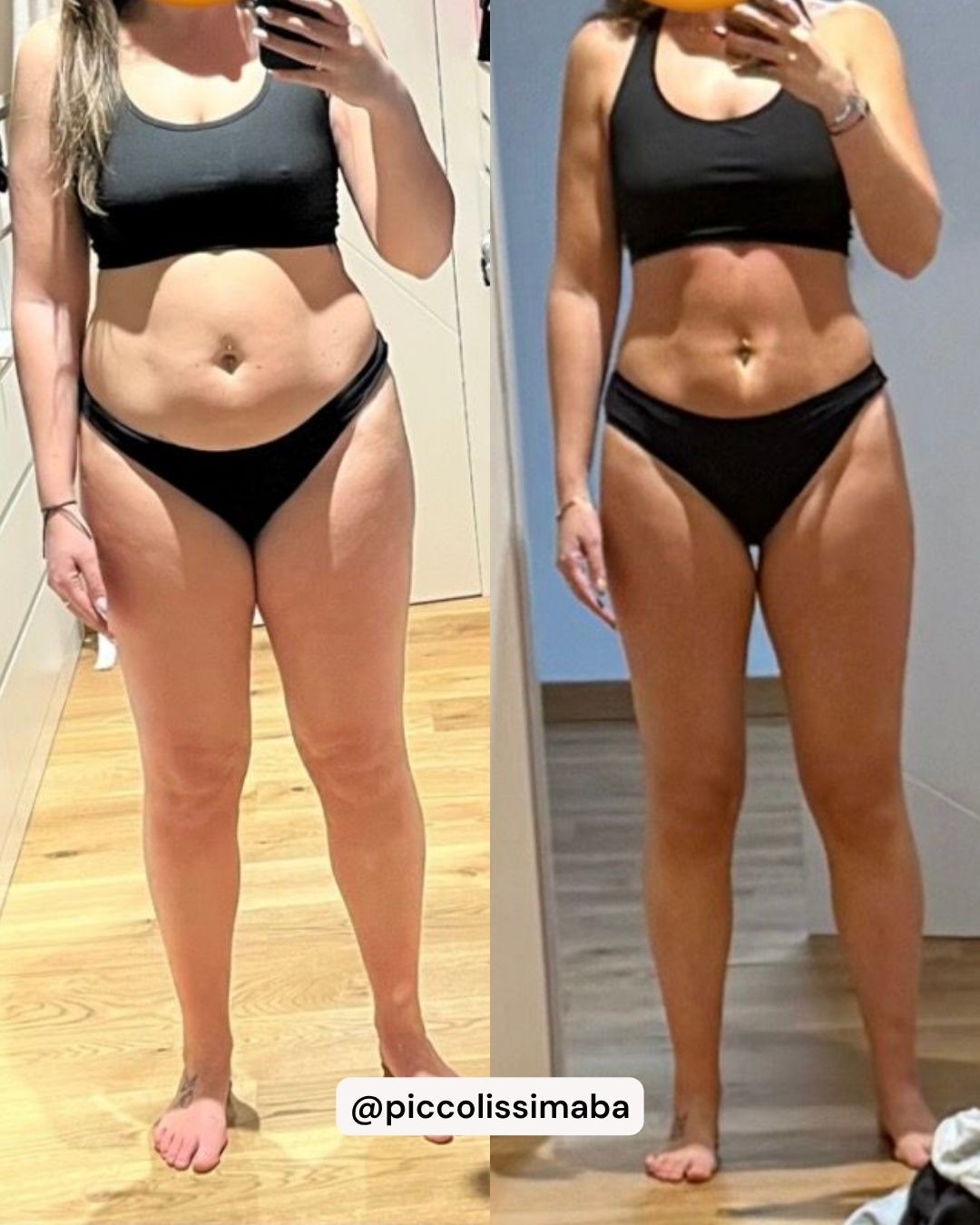
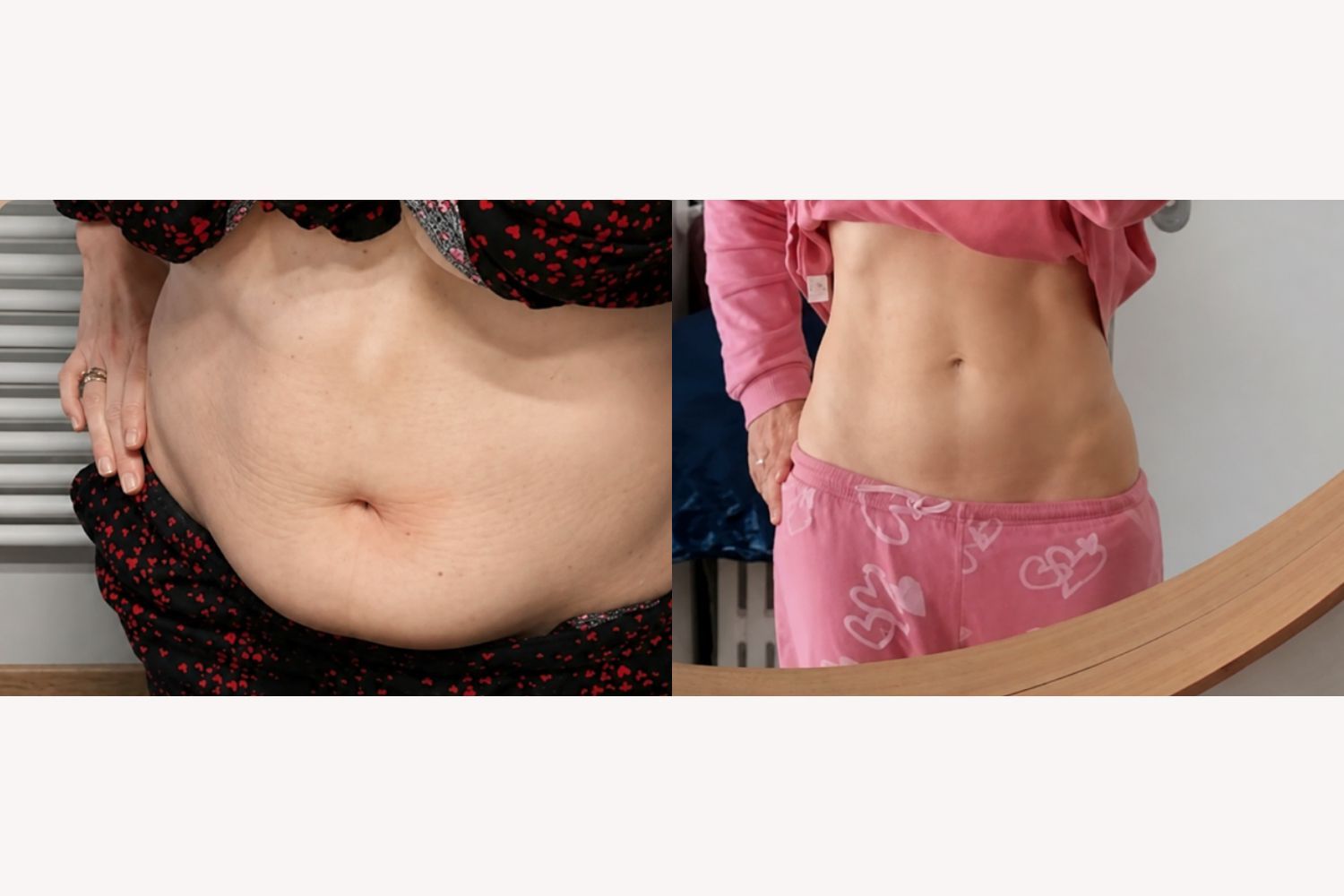
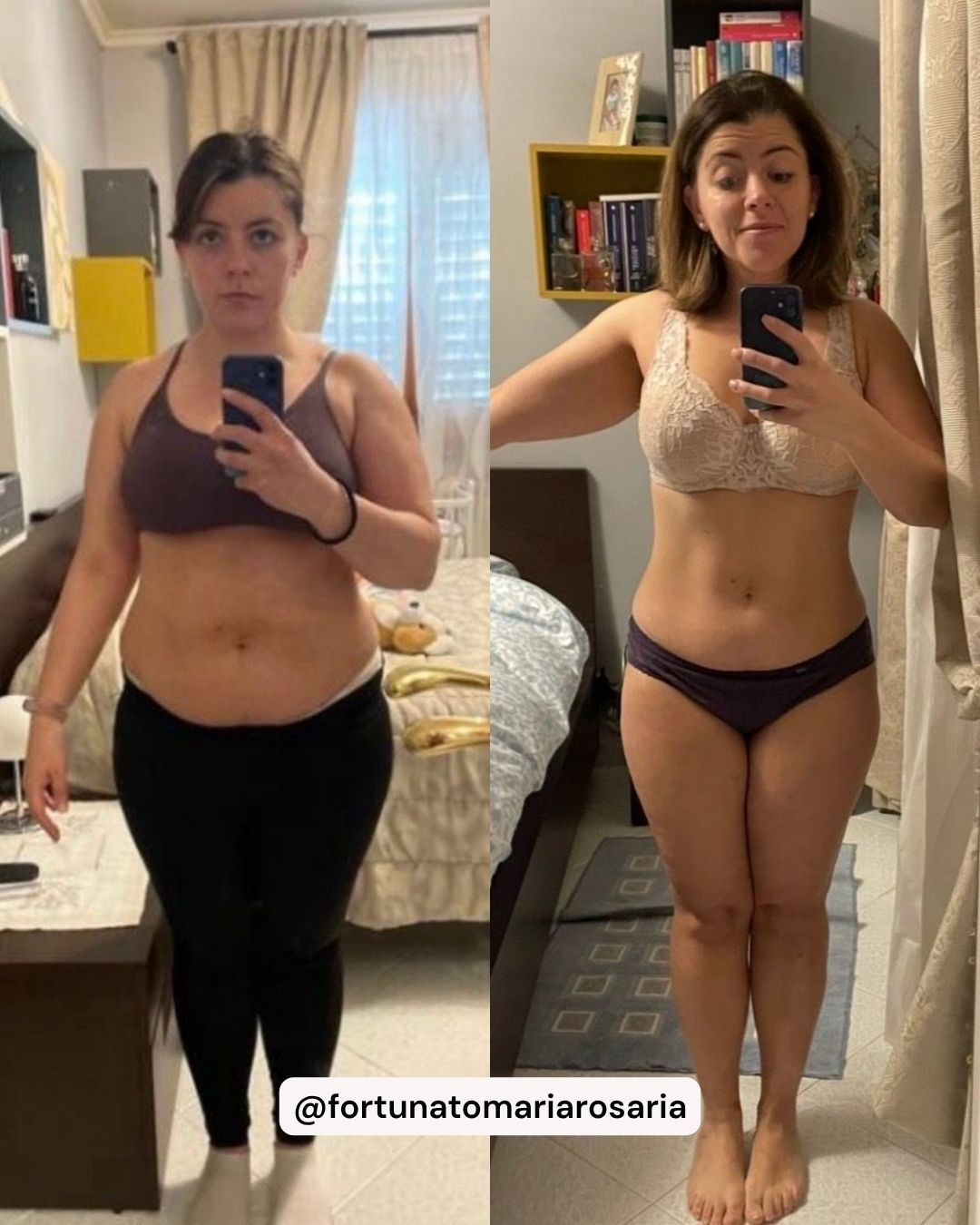
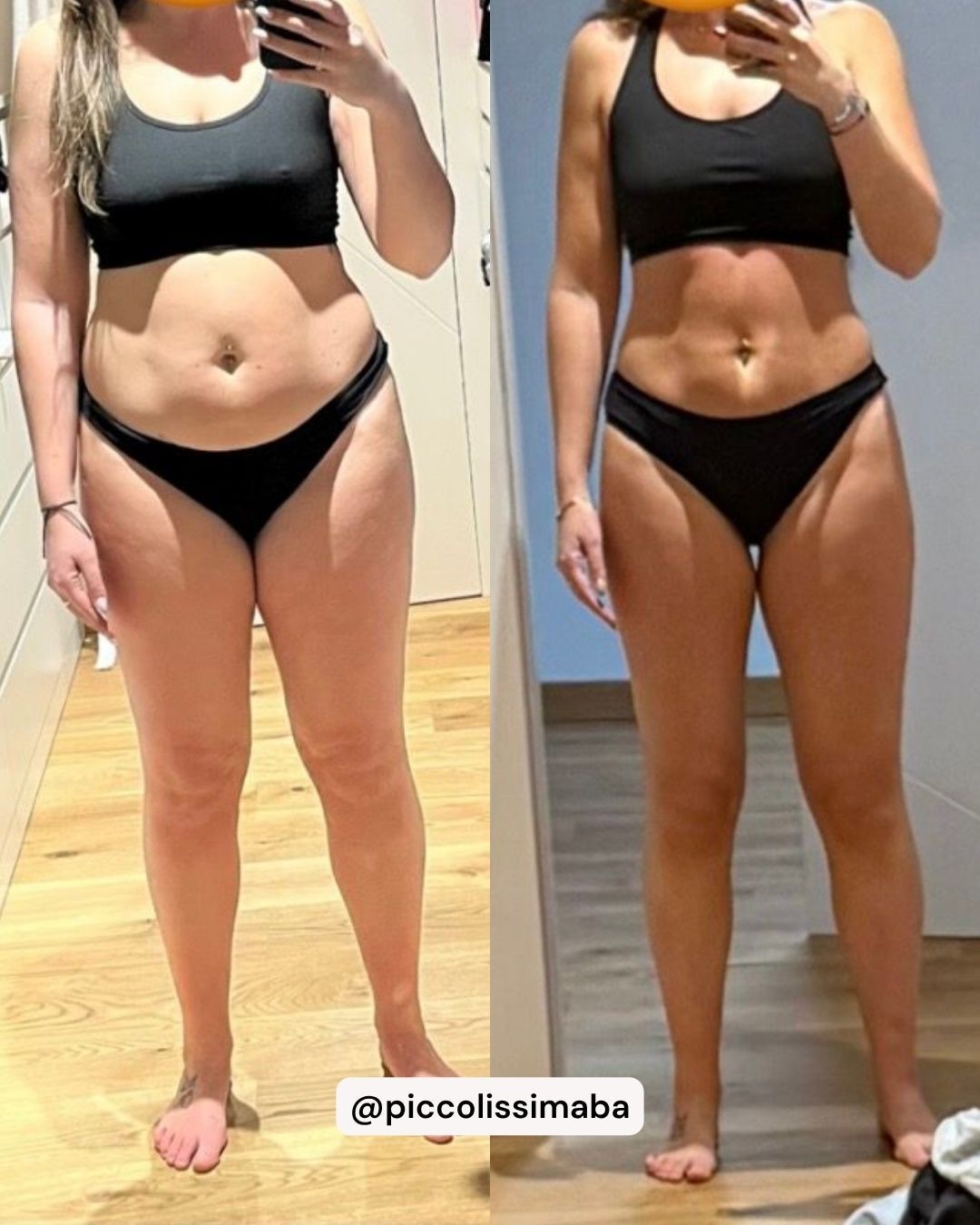
In short: Francesca has three children and had already trained with me back in 2021. After her third baby she stopped for three years. In October she started again with a nutrition plan from her dietitian and Pilates three times a week, following the Sculpt programme for the first two months. The weight came off, but the water retention stayed.
That is why she switched to Lymphatic Drainage Pilates, and the retention improved: because fat and fluid are two different things and they do not respond to the same stimulus.
There is a line in Francesca’s message that moved me, and I am putting it right at the top because it is where everything starts.
“He’s 3 now and he’s started nursery, so I’ve taken some space back for myself. And that space has your name on it.”
Three years.
Three years in which she put all her energy into her third child and his sisters, and in which there was no space for anything else. Then he started nursery, and that space came back.
If you are in the same situation, or you have been, you know exactly what I am talking about.
But the reason I chose to tell Francesca’s story is a different one, and it is a sentence that comes later in her message. A sentence I receive dozens of times a month, always in the same tone of frustration:
“Unfortunately, despite the weight loss, the water retention just won’t leave me.”
That is what I want to talk to you about today.
The starting point: muscles in hibernation
Her words are the most effective description of this state I have read:
“Three pregnancies left me with a fair load of extra kilos to lose, not to mention muscles that had gone completely into hibernation.”
Into hibernation.
Not gone, not destroyed. Asleep.
And that is exactly what happens. After one or more pregnancies, and after years in which the only priority has been the children, the deep muscles stop being recruited. The transverse abdominis no longer activates the way it should, the pelvic floor loses its coordination with the breath, the gluteus medius switches off.
These are not lost muscles. They are muscles waiting for you to call on them.
And the good news is that they wake up faster than you would expect, precisely because you are not building something new: you are reactivating something that was already there.
What she did, exactly
In October, Francesca started again, with two things at once.
A tailored nutrition plan, created by her dietitian.
Pilates three times a week. The first two months on the Sculpt programme.
And she got results. Her words: “my small but significant progress.”
But then came the point where she got stuck. And that is the interesting part.
The weight was coming off. The bloating was not.
Francesca was doing everything right. Nutrition guided by a professional, training three times a week, consistency.
And the weight came off.
But the water retention stayed exactly where it was.
I know that if you are reading this article, you are very likely recognising yourself. It is one of the most frustrating experiences there is, because it feels as though your body is not following the rules. You do everything you are supposed to do, the scale moves, and in the mirror you still look bloated.
So let me tell you the thing nobody explains clearly enough.
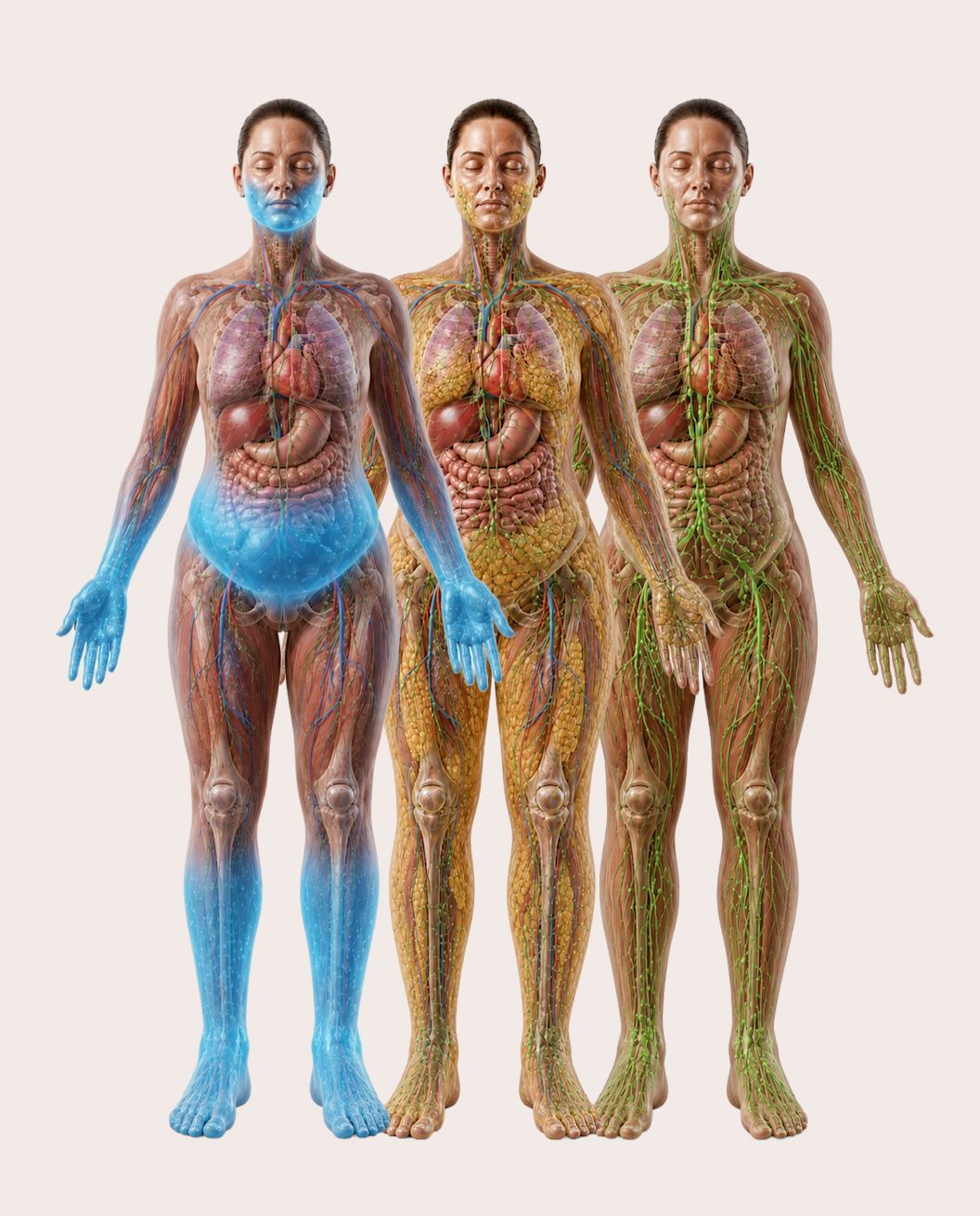
Fat and fluid are two different things. They respond to different stimuli. And they do not go away by the same method.
A calorie deficit acts on fat. It is the right lever, it works, and it is why Francesca’s weight came down.
But on fluid, a calorie deficit has almost no effect. Excess fluid stagnates in the tissues because the lymphatic system cannot drain it. And the lymphatic system does not switch on by eating less.
It switches on through a specific kind of movement.
That is why you can lose weight and still look bloated. You are not doing anything wrong: you are simply using one lever on a problem that needs two.
Why the lymphatic system needs a specific kind of movement
Let me explain the mechanism, because once you understand it everything changes.
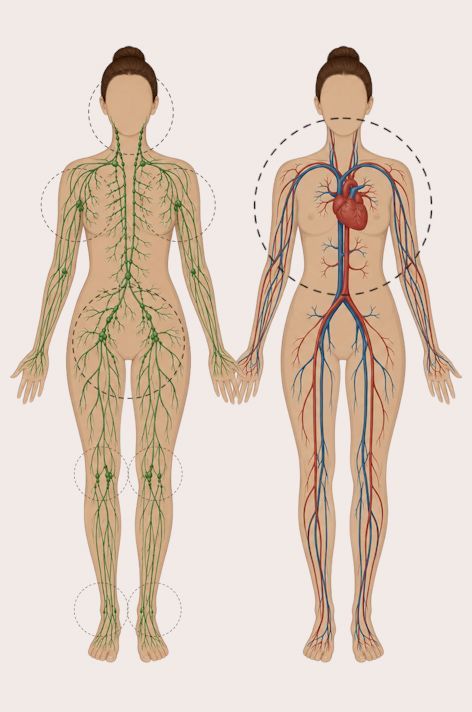
The circulatory system has a pump: the heart. It beats on its own, all day, without you having to do anything.
The lymphatic system does not have one.
Lymph moves thanks to three things: the contraction of the muscles around the lymphatic vessels, breathing, and joint mobility.
When a muscle contracts, it compresses the nearby lymphatic vessels and pushes the lymph forward. When it relaxes, the vessels fill again. It is a pump that only works if you make it work.
And then there is the breath.
The thoracic duct, the largest lymphatic vessel in the body, passes through the diaphragm.
Every time you take a deep breath, the diaphragm lowers and rises, and that movement draws lymph up from the lower body.
It is literally an internal massage you perform with your breathing.
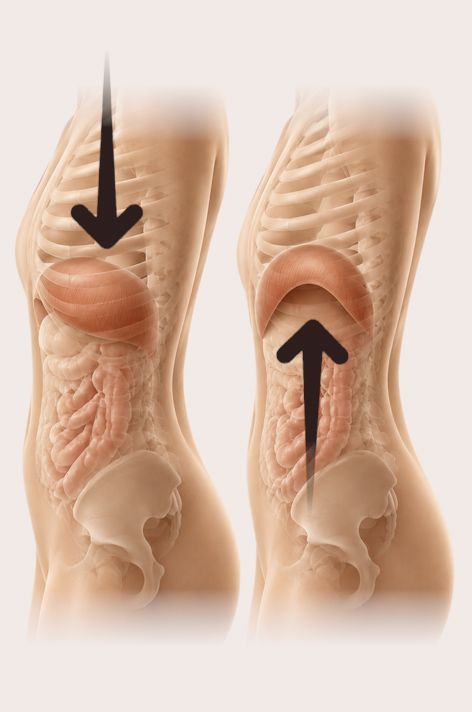
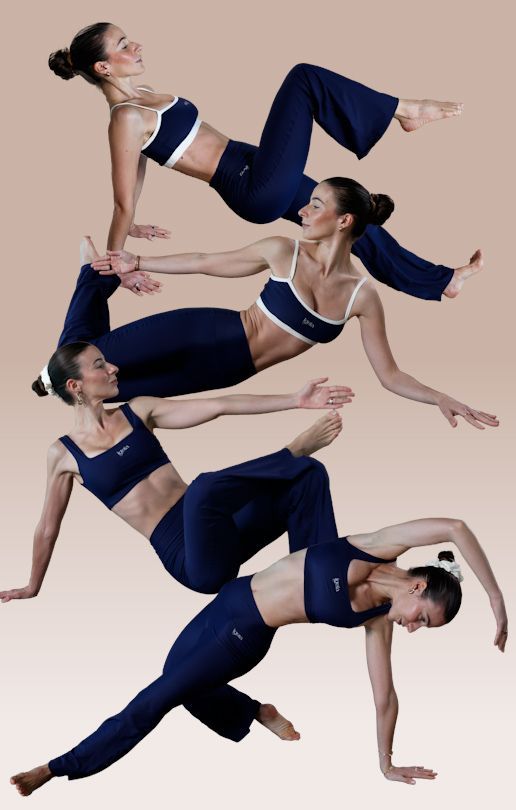
Lymphatic Drainage Pilates comes from exactly this It is not Pilates with a drainage section bolted on: every exercise is built to create that pumping effect, and every movement is coordinated with specific breathing. That is why I always tell you when to inhale and when to exhale.
A workout that tones but does not work on the breath and on drainage will make you lose weight and leave you bloated. Which is exactly what happened to Francesca.
That is why she switched to the Lymphatic Drainage Pilates programme.
And the retention improved.
Not because she started trying harder. Because she added the lever she was missing.
Thirty minutes, and the time that never exists
There is another part of Francesca’s story that deserves space, and it is the line she shared about us:
“I’m always short on time, it’s a constant in my life, but your 30-minute workouts changed my life.”
Three children, one of whom has just started nursery.
Time is not a problem you solve with motivation. With three children the time genuinely is not there, and any programme demanding an hour a day will be abandoned within three weeks. Not through lack of willpower: through arithmetic.
That is why all my programmes are built around sessions that fit inside a real life. Thirty minutes in the full programme. Fifteen minutes in Lymphatic Drainage Pilates Express, which I created for exactly the life Francesca has.
And there is something I want to add, because it matters more than it sounds: for the lymphatic system, moving a little every day is better than moving a lot twice a week. Lymph responds to frequency, not to intensity. So those fifteen or thirty minutes are not a compromise compared with real training. For drainage, they are the better formula.
The 4 things to take from Francesca’s story
-
Losing weight and debloating are two different goals
A calorie deficit acts on fat. Drainage acts on fluid. Francesca only saw the retention improve once she added the second lever.
-
Muscles do not disappear, they hibernate
After years off they reactivate faster than you think, because the body remembers.
-
Thirty minutes is enough, and for drainage it is actually better
Lymph responds to frequency, not to the length of individual sessions.
-
Stopping for three years closes no doors
Francesca trained in 2021, stopped for her third child, then came back. The journey picked up from where she had left it.
If this sounds like you: where to start
- If your main problem is retention and bloating, the right programme is Lymphatic Drainage Pilates, which works on drainage and tone together.
- If you have never done Pilates or you are coming back after a long break, start with Lymphatic Drainage Pilates Beginners: two months to wake up the deep muscles without overdoing it.
- If your obstacle is time, Lymphatic Drainage Pilates Express: fifteen minutes a day.
- If you have given birth recently or still have a diastasis, the starting point is Pilates Diastasis & Postpartum.
Frequently asked questions
Why am I still bloated after losing weight?
Because fat and fluid are two different things and they respond to different stimuli. A calorie deficit acts on fat, but it has almost no effect on excess fluid, which stagnates in the tissues when the lymphatic system cannot drain it.
The lymphatic system does not switch on by eating less: it switches on through muscle contraction and deep breathing.
This is exactly the situation Francesca found herself in, losing weight while the retention stayed, until she added training built to drain.
Is water retention the same as fat?
No. It is fluid stagnating in the tissues because the lymphatic system is not draining efficiently.
This is also why retention can reduce far more quickly than fat: because it responds to movement and drainage, the first changes are often felt within one or two weeks.
Is 30 minutes of exercise enough?
Yes, and for lymphatic drainage it is actually preferable to long, occasional sessions. Lymph responds to frequency more than to intensity, so thirty minutes done regularly is more effective than a very long workout twice a week. If even thirty minutes is too much, fifteen a day works.
Can you start training again after three pregnancies and years off?
Yes. The deep muscles do not disappear, they deactivate: after a long period without training they stop being recruited, but the body remembers the movement pattern and reactivates them faster than you would expect. What matters is starting at the right level rather than at the point where you stopped, and working first on the breath and the deep muscles.
If Francesca’s sentence sounded like yours, the problem is not your effort: it is that you are missing a lever.
Carlotta's insights, straight to your inbox
Just your name and email, unsubscribe anytime.