Water retention. Why you swell, what works, and what does not
Do you feel bloated, and does the scale fluctuate from day to day? Why water retention happens, what really helps reduce it, and what does not work at all.
In short: Water retention is fluid sitting still in the spaces between your cells, not too much water in your body. Which is why drinking less makes it worse rather than better. The factor that weighs most is not what you eat but how much you move, because the lymphatic system has no pump of its own and moves only through muscle contraction and the breath. Drainage supplements act on the water you pass, not on the water that is stuck, which is why the result lasts a day.
You weigh yourself one morning and there are two kilos more than there were two days ago.
That is not two kilos of fat. Nobody gains two kilos of fat in forty-eight hours; it would take around fourteen thousand surplus calories.
It is water. And knowing that rationally does not stop your trousers pulling, your ring sticking, or you looking different in the mirror.
This article explains where that water is, why it stays there, and what genuinely shifts it. Including, and perhaps most importantly, what does not shift it at all, which is nearly everything being sold to you.
First: when swelling needs checking rather than draining
I am putting this at the top because it comes before everything else.
Ordinary water retention is gradual, symmetrical on both sides, worse as the day goes on, better after a night lying flat, and it responds to movement. That is what this whole article is about.
Some swelling is not that, and needs assessing rather than draining. Contact your GP, or NHS 111 out of hours, straight away if you have:
- Swelling that comes on suddenly, or gets worse rather than better
- Swelling in one leg only, particularly with pain, tenderness, warmth or redness in the calf
- Swelling with breathlessness or chest pain, which needs emergency assessment
- Swelling with rapid, significant weight gain, or with reduced urine output
- Breathlessness when lying flat, or that wakes you at night
- Skin that is tight, shiny, hot or painful, or any break in the skin that is not healing
- Swelling that does not improve at all in the morning, after a night’s rest
- Swelling that appeared after starting a new medication
If you are pregnant, swelling alongside headache, visual disturbance or pain under the ribs needs same-day assessment.
These patterns can indicate cardiac, kidney, liver or venous problems, and none of them is resolved by drainage.
If your swelling matches the description at the top, read on.
What water retention actually is
An adult woman’s body is roughly 55% water, held in three places: inside the cells, inside the blood and lymphatic vessels, and in the spaces between the cells.
That last compartment is called the interstitial space, and it is where all of this happens.
Blood reaches your tissues through very fine capillaries, and at that level some of the fluid it carries leaks out between the cells, delivering oxygen and nutrients.
Most of it returns into the venous capillaries.
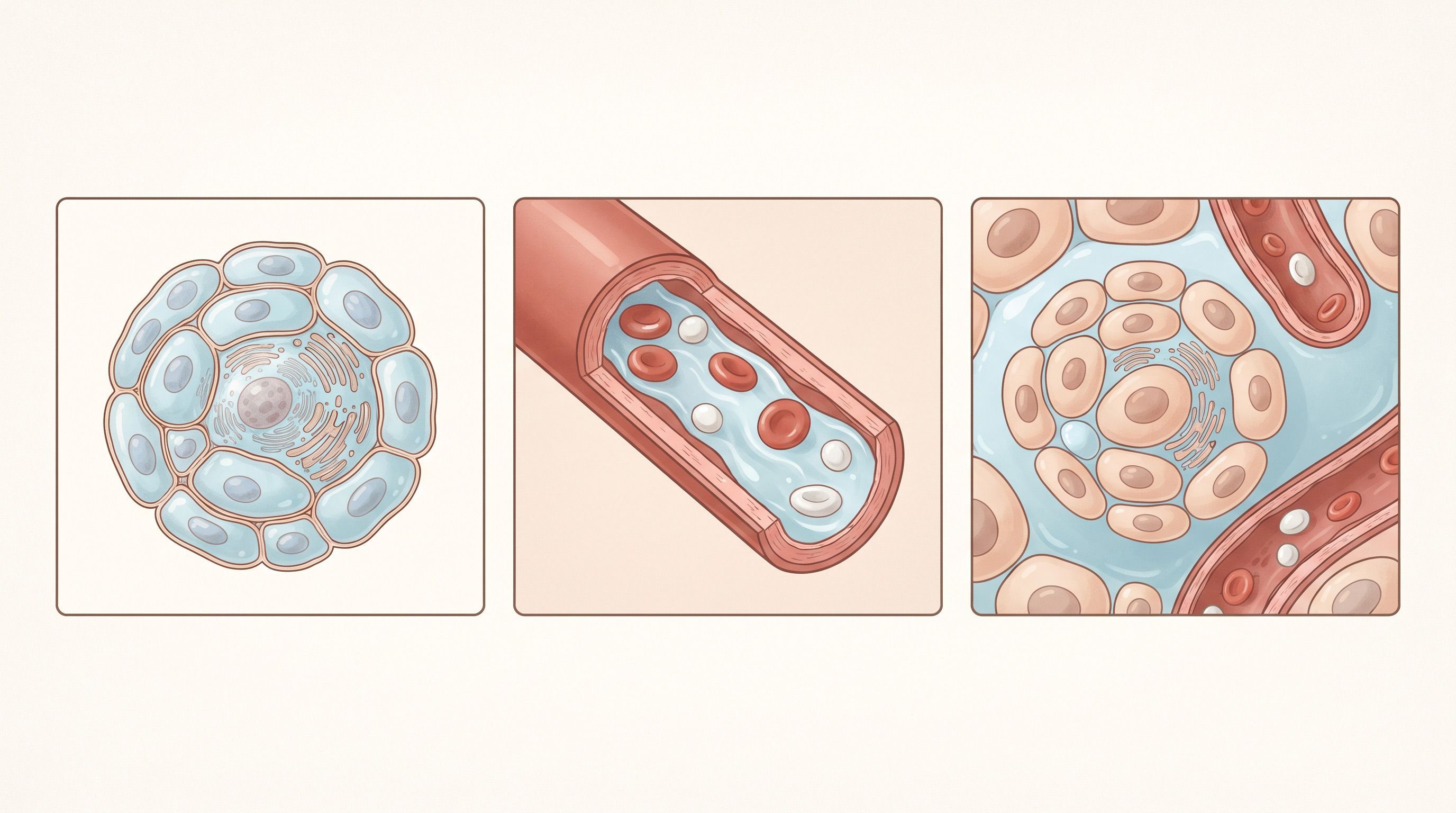
But a proportion stays behind, and to get back into circulation it has to take a different route: the lymphatic system.
Every day your body produces several litres of fluid that has to return that way.
Water retention is what happens when it does not.
It is not a disease and in most cases it is not even a disorder: it is an imbalance between how much fluid leaves the capillaries and how much manages to get back.
Why it is not too much water
And here is the misunderstanding that sends almost everyone the wrong way.
The name suggests an excess of water in the body, and the instinctive conclusion is to drink less.
It is exactly the opposite.
The problem is not the total amount of water, it is where it is. You have fluid sitting in your tissues, and that bears no relation to how much you drink. Quite the reverse.
When you drink too little, your body reads the scarcity as an alarm and activates the mechanisms it uses to hold on to the fluid it has, through antidiuretic hormone and aldosterone, which tells the kidneys to reabsorb sodium and water with it.
On top of that, lymph is largely water: when you are dehydrated it becomes thicker and harder to move.
So drinking less in order to be less swollen produces two effects, both wrong: your body holds more, and your lymph flows worse.
How to recognise water retention
There is no test that certifies it, but the signs are reasonably clear.
The most common signs:
- The mark from your sock elastic staying imprinted
- Rings that fit fine some days and not at all on others
- Swollen ankles and feet by the end of the day
- Heavy legs, particularly in the evening
- Weight swinging by one or two kilos over a few days
- A puffy face or eyelids on waking
- Swollen hands in the morning, with stiff fingers
- A general feeling of heaviness with no obvious cause
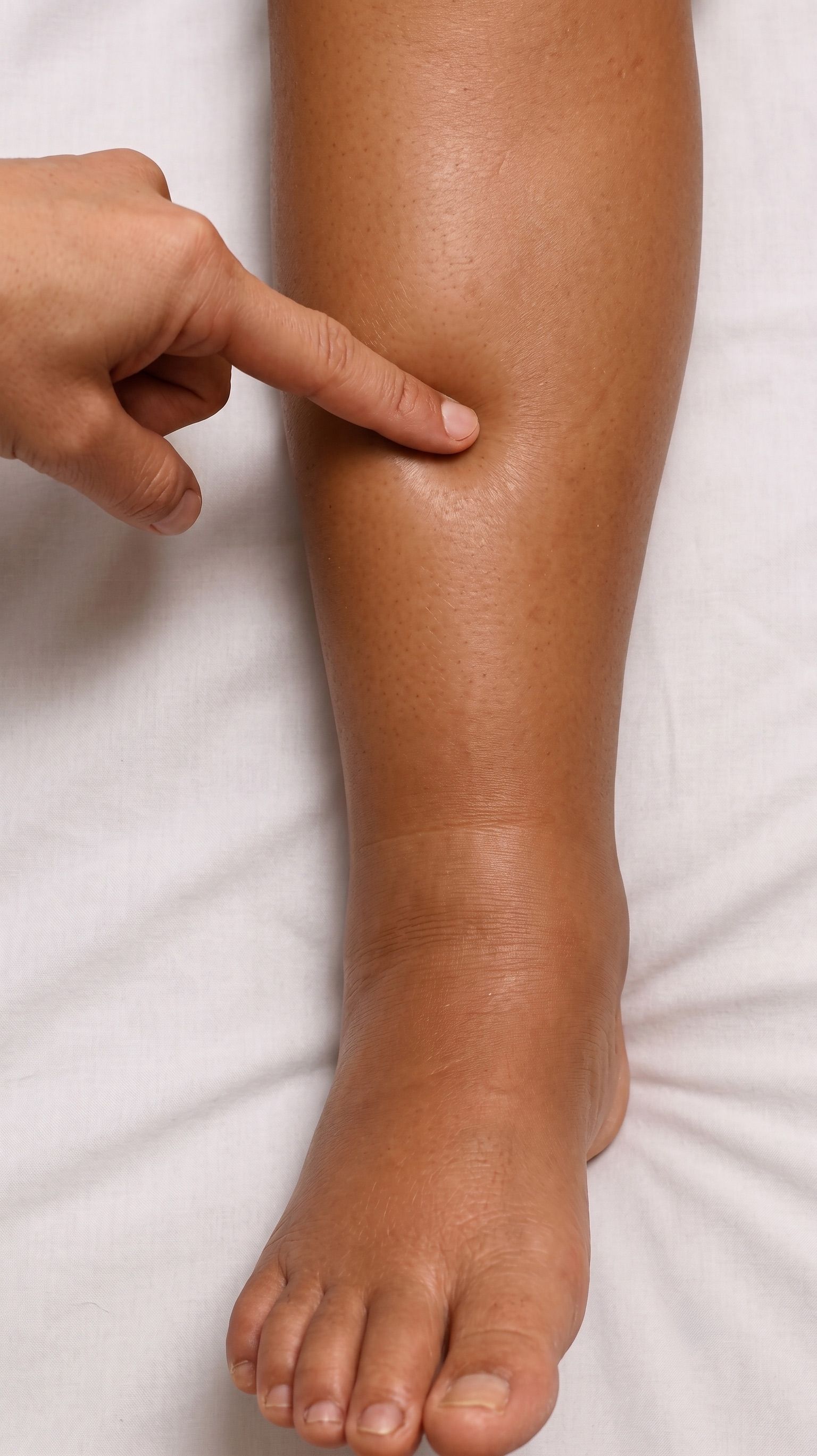
The test you can do right now. Press your thumb into the front of your shin, where the bone sits just under the skin, for five seconds, then lift it off.
If a dent stays behind and takes a few seconds to disappear, that is called pitting, and it is the most reliable sign there is that fluid is sitting in the tissue.
If the dent is deep and slow to fade, or if it appears on one leg only, go back to the section above and get seen.
The most useful tell of all, though, is variability. Fat does not change from one day to the next. Fluid does. If you are very different between morning and evening, between one week of your cycle and another, between winter and summer, what is changing is water.
The causes of water retention
There are many, and they almost always act together. I have put them in order of how much they actually weigh, which is not the order you usually get told.
-
Being sedentary
By some distance the biggest factor, and the one talked about least, because there is nothing to sell you alongside it.
The lymphatic system has no pump of its own the way blood has the heart. Lymph moves through three things: the contraction of the muscles around the lymphatic vessels, the movement of the diaphragm when you breathe deeply, and joint mobility.
Which means lymph moves when you move it, and stops when you stop. Eight hours sitting is not a neutral state: it is eight hours with the engine off.
-
Staying in one position
Whether sitting or standing still. Standing still is worse than sitting: full gravity and no contraction.
-
Excess sodium
The body holds water to keep sodium concentration constant. And sodium is not mainly the salt you add: it is what is hidden in processed food, cured meats, hard cheeses, bread, sauces and ready meals.
-
Dehydration
For the reasons above.
-
Hormones
The cycle and menopause deserve their own section, below.
-
Heat
Vessels dilate and filtration increases. It is why the same legs swell twice as much in July.
-
Chronically high cortisol
Poor sleep and constant stress keep it elevated all day, and cortisol encourages sodium and water retention.
-
Low-grade chronic inflammation
Inflamed tissue holds more fluid, and the inflammatory load depends heavily on what you eat.
-
Certain medications
Some blood pressure medicines, corticosteroids, some anti-inflammatories and some hormonal treatments can contribute. Never stop anything on your own initiative: if you think there is a link, that is a conversation for the doctor who prescribed it.
-
Medical conditions
Thyroid, kidney, heart, liver and venous insufficiency can all cause retention. It is why the section at the top of this article exists.
Water retention, your cycle and menopause
This part applies only to us, and it is the part explained worst everywhere else.
Why you swell before your period
In the second half of the cycle, the luteal phase, progesterone rises and then drops sharply just before your period. Oestrogen fluctuates too.
Progesterone has a mild anti-retention effect, because it competes with aldosterone, the hormone that tells your kidneys to hold sodium and water. When progesterone drops, that competition ends and aldosterone works unopposed.
The result is that in the days before your period a swing of one or two kilos is normal and physiological, and has nothing to do with what you ate.
The most useful practical consequence: stop comparing random days. If you weigh or measure yourself, do it at the same point in your cycle, month against month. Comparing a pre-period day with a post-period one tells you nothing and makes you feel bad for no reason.
What changes in menopause
In menopause the fall in oestrogen changes several things at once: fat distribution shifts towards the abdomen, insulin resistance tends to increase, connective tissue loses elasticity and the microcirculation becomes less efficient.
The result is that retention often changes character: from cyclical and predictable it becomes more constant.
The good news is that the levers stay the same, and that in this phase daily movement pays back even more, because it works simultaneously on retention, on the muscle mass lost with age, and on insulin sensitivity.
Chronic water retention: why it always comes back
This is the real question for anyone who has lived with it for years: why does everything I fix stop working after a fortnight?
The answer is that drainage is maintained, not accumulated.
Muscle accumulates: train for six months, stop for two weeks, and the muscle is still there. Lymph does not. It moves while you move it, and the benefit lasts as long as you keep producing it.
That is not a life sentence, it is a rule of operation. But it has two practical consequences that matter.
- First: anything that works and is then stopped stops working. That applies to drainage sessions, to supplements, to courses of pressotherapy, to all of it. It is not that it “did not work”: it was a push, not a change.
- Second, and this is the one that counts: little and often beats a lot, rarely.
Fifteen minutes every day switches the pump on seven days out of seven. An hour and a half twice a week switches it on twice, and on the other five days fluid sits. The weekly total in the first case is lower and the result is better.
There is also a vicious circle worth knowing about: the longer tissue stays stretched by fluid, the less efficient drainage becomes in that area, and the more fluid accumulates. It is why long-neglected retention becomes harder to shift, and why acting early is worth it.
What does not work, and why they keep selling it to you
Search this topic and look at who answers: clinics, pharmacies, supplement companies. The pages you read are almost all written by someone with a drainage product at the bottom.
It is worth understanding what they actually do.

Drainage supplements
Birch, dandelion, horsetail, pilosella, pineapple, centella. They have a mild diuretic effect, meaning they make you pass more urine.
And here is the point nobody explains: water retention is not water in your bladder, it is water stuck in your tissues. Increasing urine output removes fluid from the bloodstream, not from where it is stuck. And since the body maintains balance between compartments, lowering blood volume tends to draw fluid in and to hold more as soon as you stop.
The number on the scale drops for a day or two. The condition that caused the fluid to sit there is exactly where it was.
Drainage teas
Same principle, with one genuine additional merit: they get you drinking. If a tea in the evening is how you reach decent hydration, keep it by all means. But the benefit belongs to the water rather than the herb.
Over-the-counter diuretics
Here I will be blunt: do not. Real diuretics are serious medicines. They disturb electrolytes, they can produce a rebound effect that worsens retention when you stop, and they mask conditions that ought to be diagnosed. They are for when a doctor prescribes them, for a medical reason.
Detox and cleansing diets
Clearing waste products is the job of the liver and kidneys, which manage perfectly well on their own. Lymph does something different: it collects fluid, proteins and immune cells. There is nothing to detox.
Wraps, mud treatments and saunas
They produce temporary fluid loss. The measurement really does drop, for a few hours. Then it returns.
Drinking less
Makes it worse, for the reasons at the start.
The common thread: they are all passive and they act on the symptom. You do nothing, something is done to you, and the day you stop everything goes back.
One thing that does genuinely work and is often overlooked: graduated compression. Proper compression stockings, the ones with pressure decreasing from the ankle upwards, have a documented effect. These are not slimming gym leggings, they are a medical device, and if you stand for hours at work or travel long distances it is worth discussing with your GP.
What actually reduces water retention
Now the useful part. Seven things, and none of them costs anything.
-
Move every day
First because it weighs most. Every muscle contraction compresses the lymphatic vessels and pushes fluid forward. It does not take an hour: twenty or thirty minutes daily changes the picture more than one long session a week.
-
Break up sitting every hour
Even two minutes of walking. If you cannot get up, twenty calf raises under the desk activate the pump without going anywhere.
-
Breathe deeply
The thoracic duct, the largest lymphatic vessel in the body, passes through the diaphragm: every deep breath creates a draw that pulls lymph up from the lower body. If you breathe into your chest all day, you have one pump out of three.
-
Drink steadily
Small amounts across the day, ideally away from meals. If you drink a lot at once, much of it passes through without being absorbed.
-
Reduce sodium, not table salt
Most sodium comes from cured meats, hard cheeses, bread, ready meals and sauces. Increasing potassium-rich foods, such as leafy vegetables, bananas, potatoes and pulses, helps restore the balance.
-
Sleep
Chronically high cortisol encourages retention, and sleep deprivation is one of the most effective ways to keep it high.
-
Put your feet up
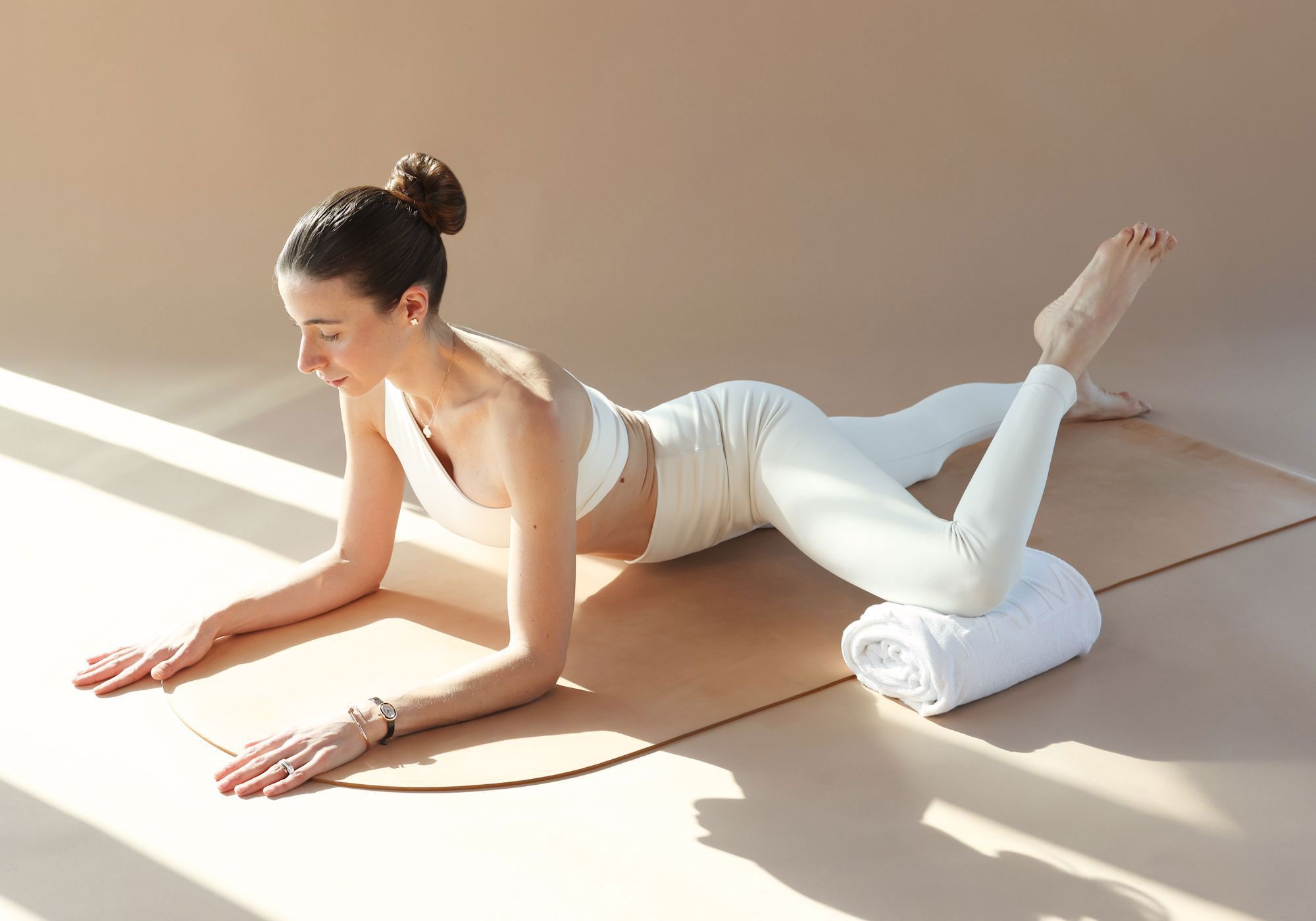
In the evening, legs resting against the wall for five to ten minutes, breathing deeply. You remove gravity from the equation and activate the diaphragm at the same time.
Water retention and Lymphatic Drainage Pilates
Looking at that list, it will be clear why I built the method the way I did: the first three items are exactly what a session does, and the seventh is one of our classes.
Lymphatic Drainage Pilates acts on retention in four ways.
- It opens the lymphatic stations before starting. Every session begins by activating the six points where lymph is filtered, so the body is in a state to drain while it trains, rather than afterwards.
- It pairs every movement with prescribed breathing. I tell you exactly when to inhale and when to exhale, exercise by exercise, because without that coordination only one pump is working. With it, every single repetition does two jobs at once: it contracts the muscle and it pumps the lymph.
- It alternates standing work with inversions, feet above the pelvis, to assist return.
- It can be done every day. And that is the decisive point: with no heavy loading you accumulate neither inflammation nor stress, so daily frequency is sustainable. And since drainage is maintained rather than accumulated, frequency is the variable that determines the result.
Where to start
If you have never done Pilates, start with Lymphatic Drainage Pilates Beginners: two months to build the foundations.
If you already have a practice, the full 6-month programme works on drainage and tone together.
If time is your obstacle, Lymphatic Drainage Pilates Express: fifteen minutes a day.
And in the evening, Light Legs in 10 minutes, with your legs against the wall before sleep.
Frequently asked questions
What is water retention?
It is fluid sitting in the spaces between cells, called the interstitial spaces, instead of returning to circulation through the lymphatic system.
Every day some of the fluid leaving your capillaries stays in the tissues and has to return via the lymphatic route: when that return is less efficient than it should be, fluid accumulates. It is not an excess of water in the body but a problem of where that water is.
What are the symptoms of water retention?
The mark from sock elastic staying imprinted, rings fitting some days and not others, swollen ankles and feet in the evening, heavy legs, weight swinging by one or two kilos over a few days, variable abdominal bloating, a puffy face or hands on waking.
The simplest test is pressing your thumb into your shin for five seconds: if a dent stays and is slow to fade, that is pitting. The most useful sign of all is variability: fat does not change day to day, fluid does.
What causes water retention?
The factor that weighs most is being sedentary, because the lymphatic system has no pump of its own and moves only through muscle contraction and the breath.
Then staying in one position, excess sodium mainly from processed food, dehydration, hormonal changes across the cycle and in menopause, heat, high cortisol from poor sleep and stress, and chronic inflammation.
Some medications and some medical conditions can contribute, and in that case it needs discussing with your doctor.
How do you get rid of water retention?
By moving every day, breaking up sitting every hour, breathing deeply, drinking steadily, reducing sodium from processed food, sleeping enough, and putting your feet up in the evening.
Movement is the main lever because it activates the three natural pumps of the lymphatic system: muscle contraction, the diaphragm, and joint mobility.
What does not work is the passive route: supplements, teas and treatments act on the symptom and the effect returns as soon as you stop.
Does drinking more water help with water retention?
Yes, counterintuitive as it sounds. When you drink too little your body reads the scarcity as an alarm and activates the hormonal mechanisms it uses to hold on to fluid.
On top of that, lymph is largely water and dehydration makes it thicker and harder to move. Better to drink small amounts across the day, ideally away from meals, than large volumes at once.
Do drainage supplements work?
They have a mild diuretic effect, meaning they make you pass more urine. The point is that water retention is not water in your bladder but water stuck in your tissues: increasing urine output removes fluid from the bloodstream, not from where it is sitting, and the body tends to compensate by holding more as soon as you stop.
The number on the scale drops for a day or two while the condition causing the fluid to sit there stays exactly the same. Teas have one additional merit, they get you drinking, but the benefit belongs to the water rather than the herb.
Why do I swell before my period?
In the second half of the cycle progesterone rises and then drops sharply just before your period. Progesterone mildly opposes aldosterone, the hormone that tells your kidneys to hold sodium and water: when it drops, that opposition ends.
A swing of one or two kilos in the days before your period is physiological and has nothing to do with what you ate. The most useful thing is to stop comparing random days: weigh or measure at the same point in your cycle, month against month.
Why does water retention get worse in menopause?
The fall in oestrogen changes fat distribution, reduces connective tissue elasticity and makes the microcirculation less efficient, while insulin resistance tends to increase. Retention often changes character: from cyclical and predictable it becomes more constant.
The levers stay the same, and in this phase daily movement pays back even more because it works on retention, muscle mass and insulin sensitivity at once.
Why does water retention always come back?
Because drainage is maintained, not accumulated. Unlike muscle, which stays even after a break, lymph moves while you move it and the benefit lasts as long as you keep producing it.
It means any effective intervention that is stopped stops working, and that a short daily practice beats a long occasional one: fifteen minutes a day switches the pump on seven days out of seven, an hour and a half twice a week switches it on twice.
How long does it take to debloat?
Fluid responds quickly: lighter legs and less swelling are often felt within one to two weeks of consistent movement and good hydration.
A visible change in photographs generally arrives between the third and fourth week, when clothes start to change too. Changes that hold, such as a more efficient muscle pump, build over months.
Does water retention make you gain weight?
No. Fluid weighs something, so the scale goes up, but it is not fat tissue and it has nothing to do with gaining weight.
A swing of one or two kilos over a few days is almost always water: putting on that much fat would require an enormous calorie surplus and does not happen in forty-eight hours. Which is also why weighing yourself daily tells you very little and creates confusion.
When should water retention be a concern?
When swelling comes on suddenly, affects one leg only particularly with pain, warmth or redness in the calf, comes with breathlessness or chest pain, is accompanied by rapid weight gain or reduced urine output, or does not improve at all after a night’s rest.
Swelling that appears after starting a new medication should also be reported. These patterns need medical assessment rather than a drainage routine.
In short
Water retention is not too much water: it is water in the wrong place, sitting still in the spaces between your cells.
The factor that weighs most is not what you eat but how much you move, because the lymphatic system has no pump of its own and depends entirely on your muscles and your breath.
Which is why almost everything sold to you works for a day: it acts on the water you pass, not on the water that is stuck.
If you move every day, the pump works every day.
Carlotta's insights, straight to your inbox
Just your name and email, unsubscribe anytime.