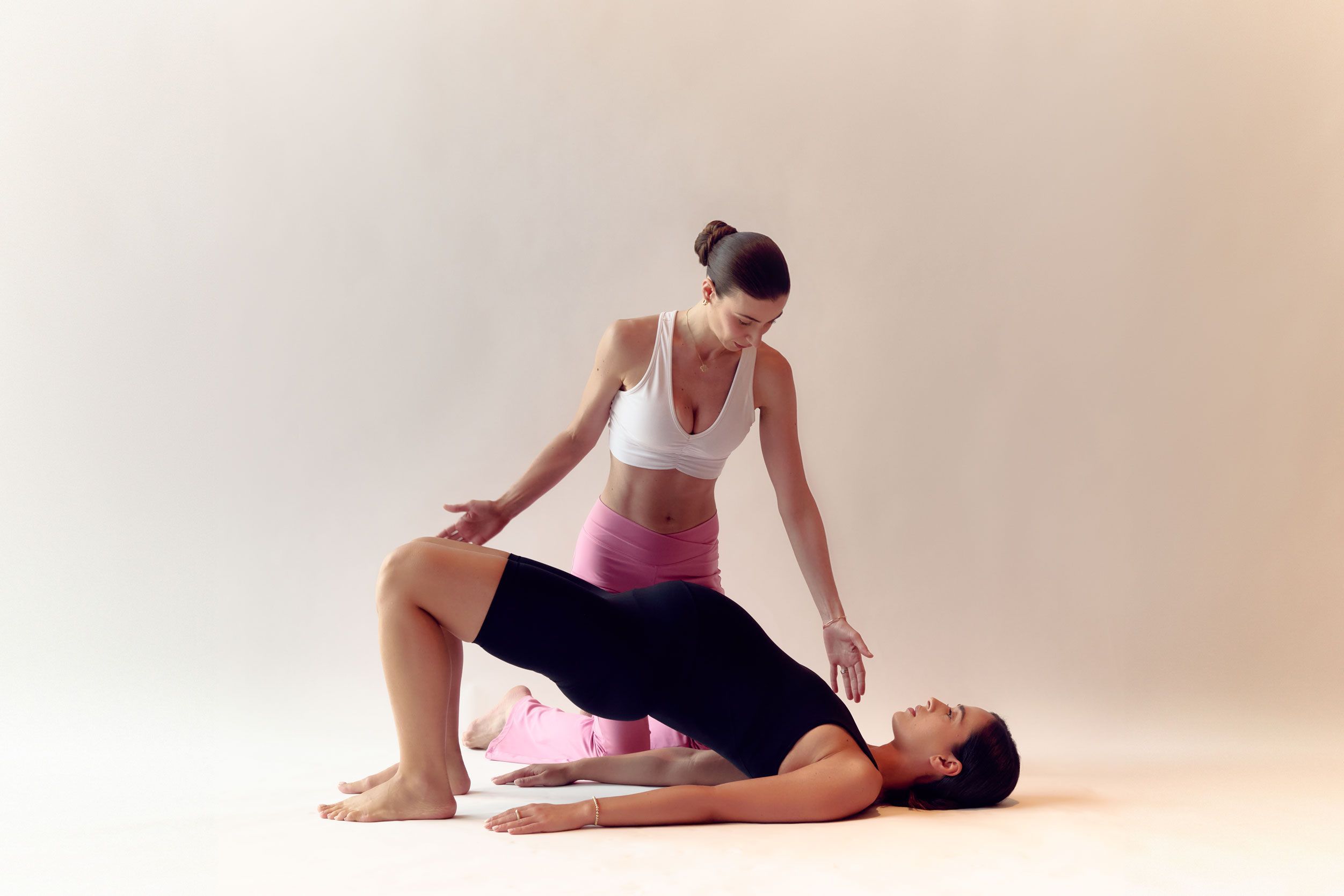
Working out during pregnancy: the 4 body signals you shouldn’t ignore (and what changes with Pilates Linfodrenante®)
I’ve never given birth.
And to be honest, when I think about it, it scares me a little.
I’d like children, of course. But I don’t know if I’m ready yet. Or if I ever will be.
But that’s a conversation for another time.
Today I want to talk to you about working out during pregnancy.
Before creating the Pilates Linfodrenante® Pregnancy Journey, I took two dedicated courses in the United States and spent a long time studying female physiology and how the body changes during this special period. To date, Pilates Linfodrenante® Pregnancy has accompanied more than 6,500 women from the first trimester all the way to birth.
In this article I want to walk you through:
How your body changes during pregnancy
Let’s start with the basics and a bit of physiology.
During pregnancy, a woman’s body changes profoundly. And no, I’m not talking about the belly or generalized swelling.

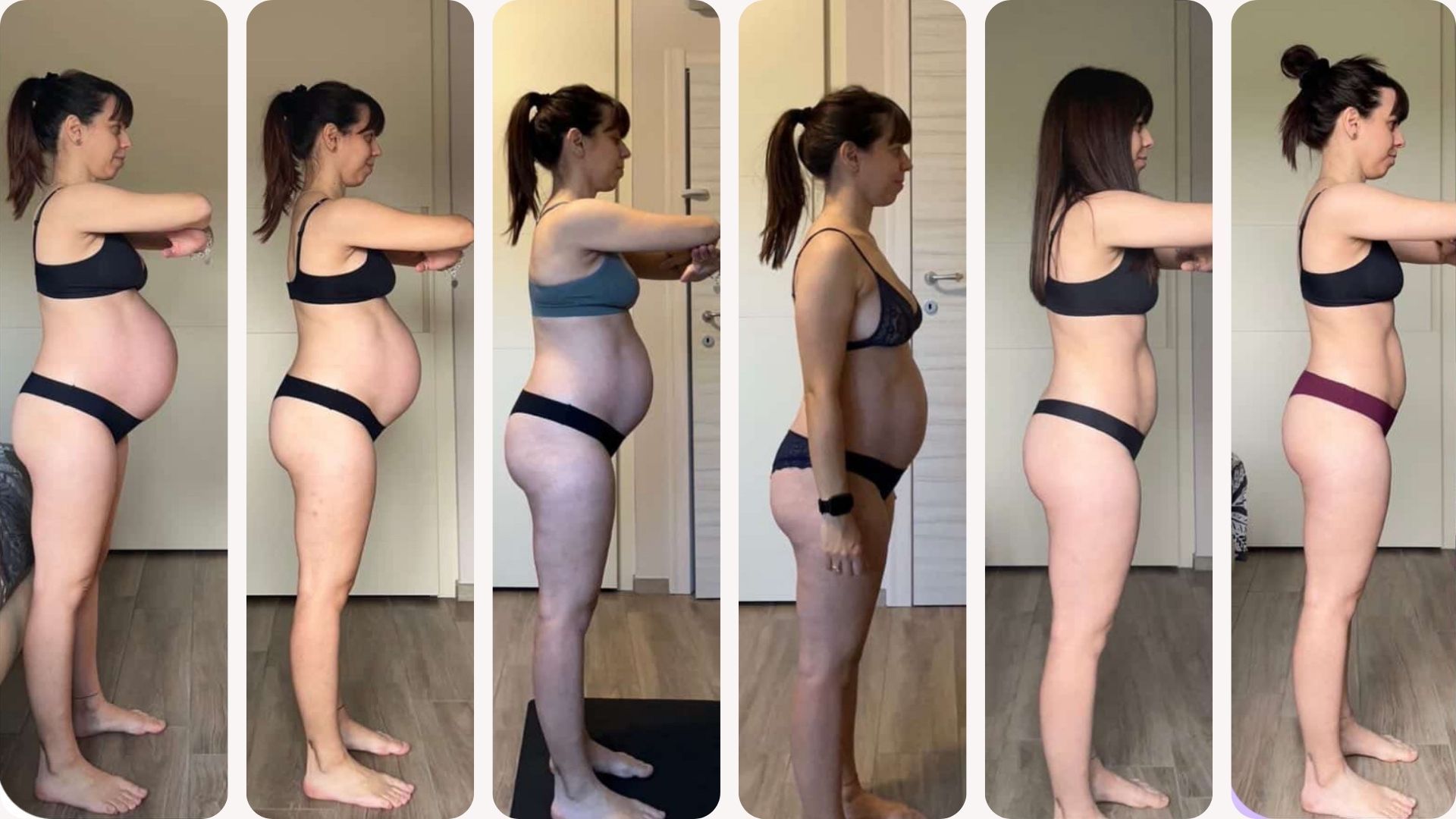
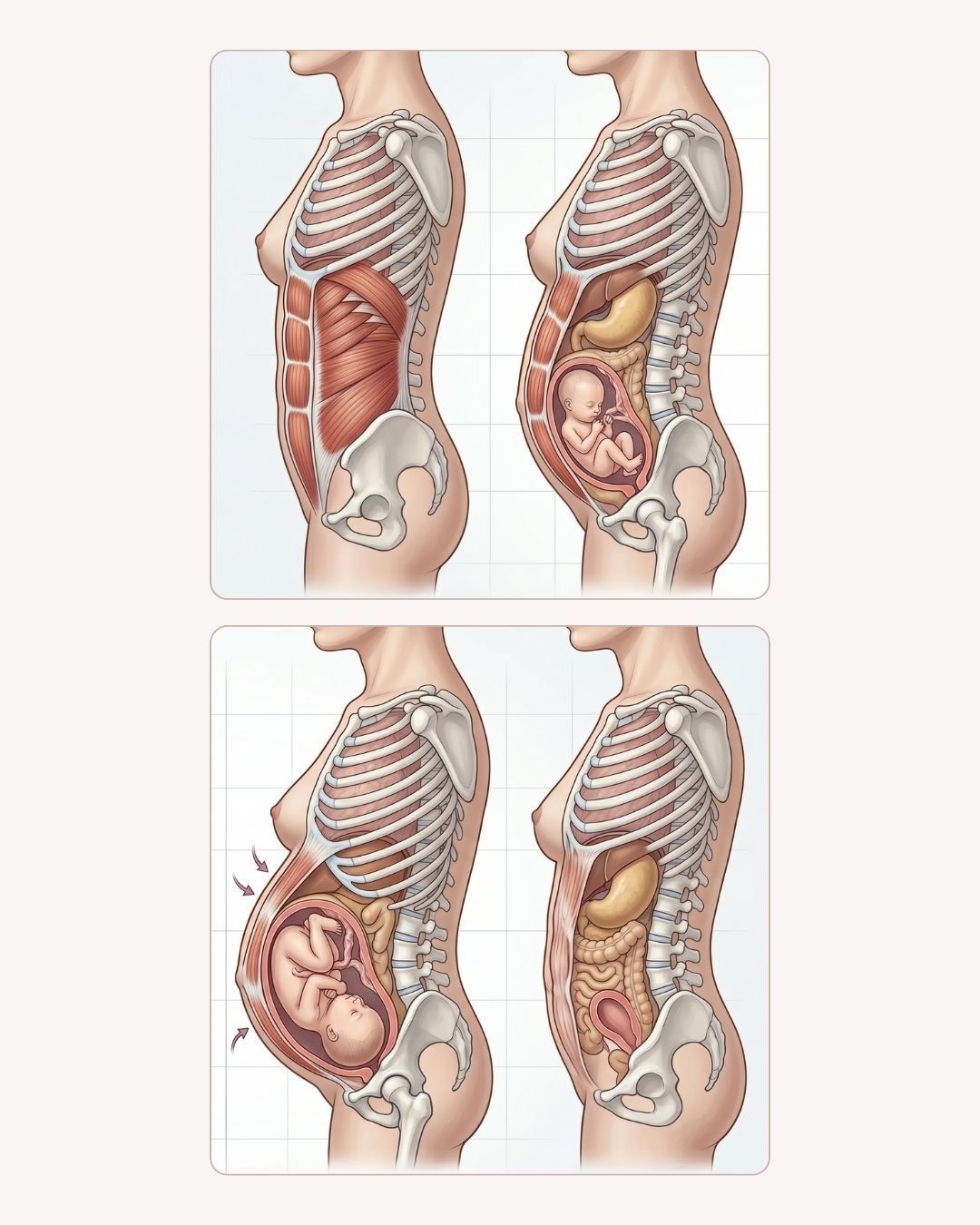
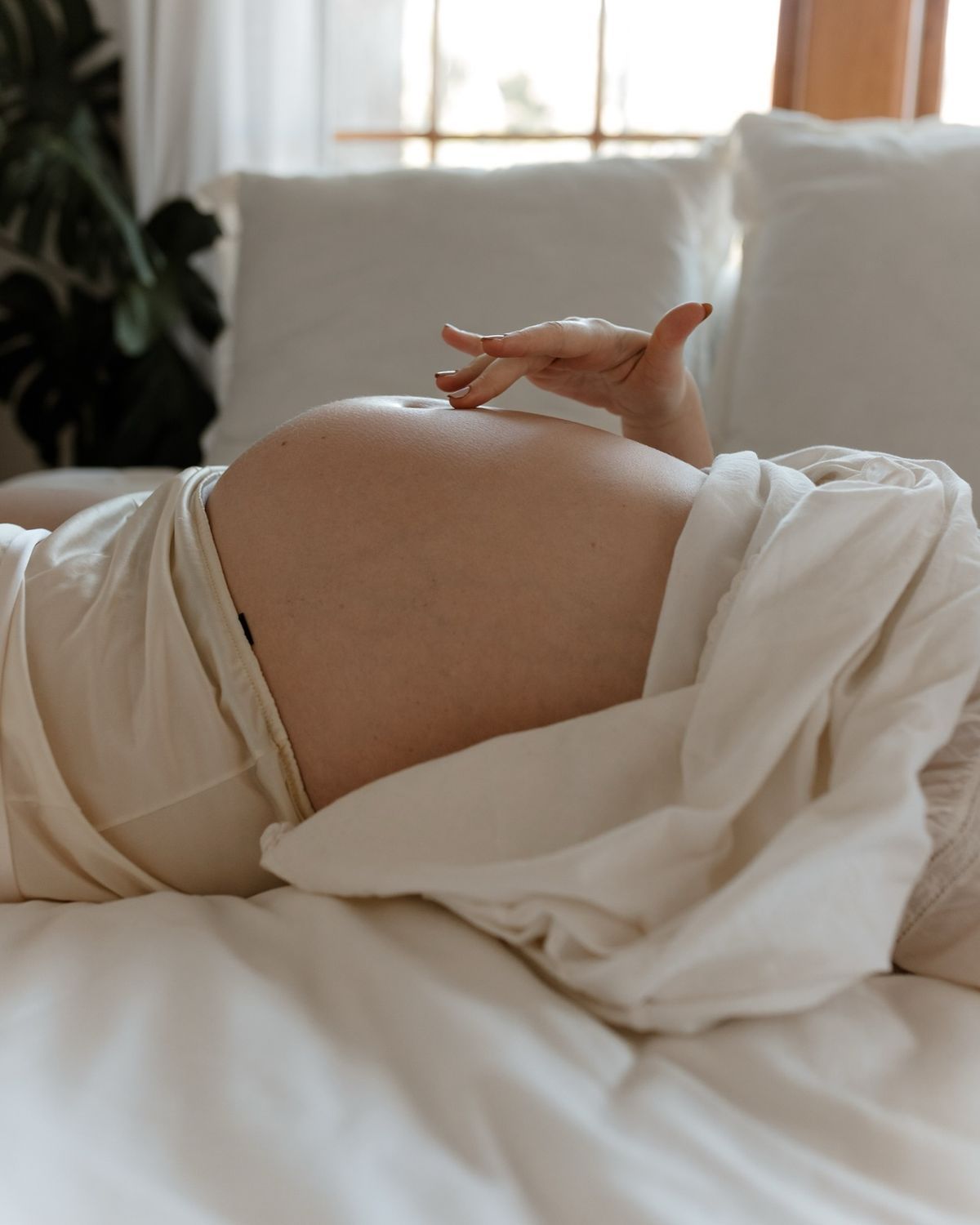
The abdominal wall lengthens significantly
The abdominals are 4 muscles; the deepest is the transverse abdominis and the most superficial is the rectus. The rectus is the one that gives the “six-pack” look.
During pregnancy, the baby grows and the rectus abdominis lengthens to make room. Consider that it stretches by roughly half its total length! Isn’t that incredible?
The further along you get, the more the baby grows, the more rectus abdominis lengthens and can no longer activate the way it used to. It becomes weaker (and that’s completely normal).
At the end of pregnancy, 100% of women have a diastasis.
Don’t believe anyone selling you workouts to “avoid diastasis in pregnancy.” In pregnancy, diastasis is simply physiological. The goal isn’t to prevent it (that’s impossible), but to limit stress on the linea alba to help it heal postpartum.
Here are two studies:
- Mota et al. (2015): 100% of women have a diastasis recti at their due date, and 39% still have it at 6 months postpartum
- Sperstad et al. (2016): 60% of women have a diastasis at 6 weeks postpartum

The ribs widen and posture changes
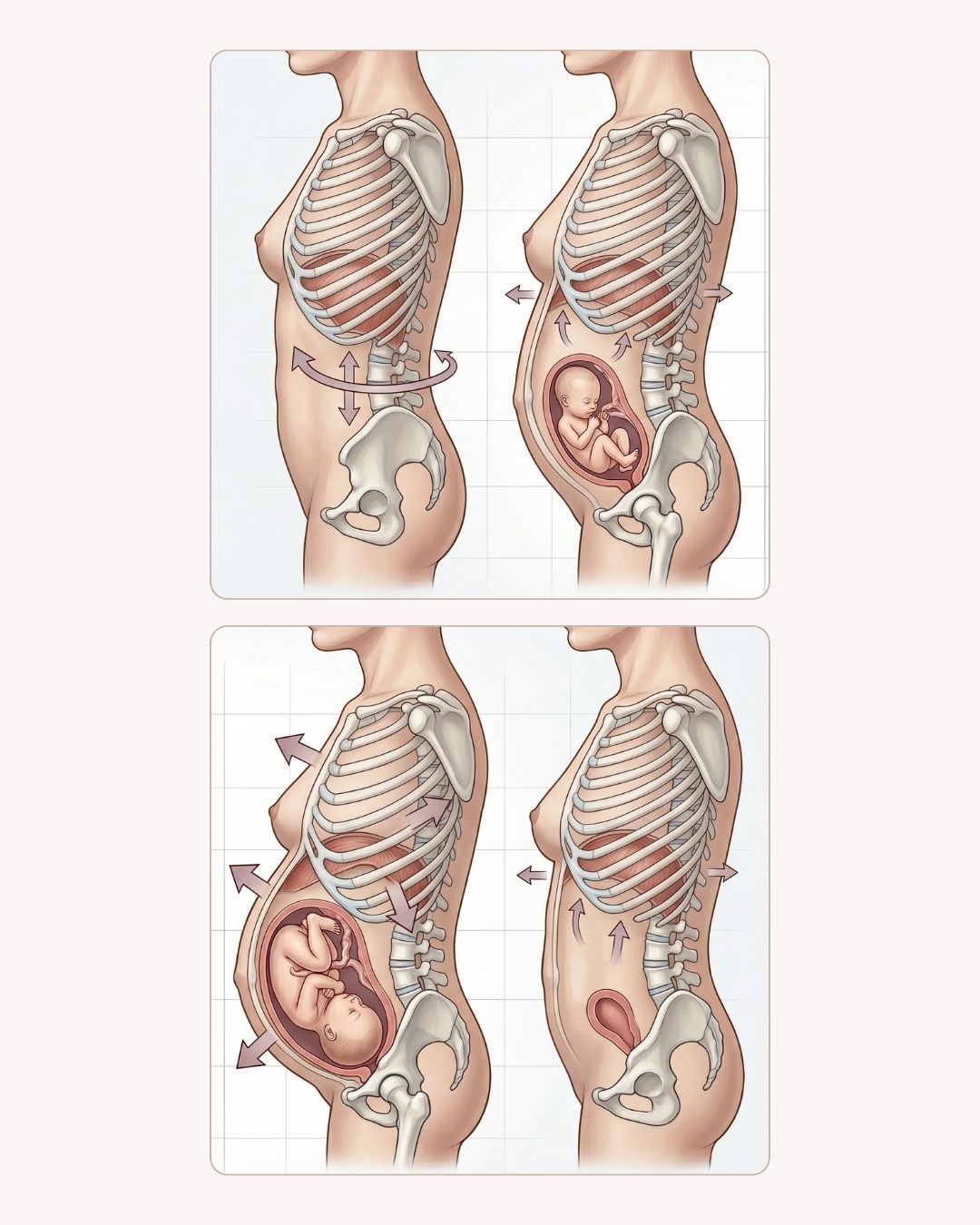
As the belly grows, the body has to create space.
One of the ways it does this is by widening and lifting the rib cage. The ribs become “wider”: that’s why, after giving birth, your waist circumference may be larger than before.
The diaphragm (the breathing muscle located below the ribs) has limited movement, because the baby pushes upward. Breathing 360 degrees (the way we should; we’ll get to it later in the article) becomes difficult.
But that’s not all.
The weight at the front increases (because of the baby), and to keep you standing, the body has to compensate somehow. The lumbar curve increases (you move into what’s called a “sway back” posture) and the head is projected forward.

Hormones relax the ligaments
Our body is magical.
During birth, the cervix dilates up to 10 cm. And to prepare the pelvis for birth, the body releases hormones that relax the ligaments.
But this also means stability can no longer come from the ligaments the way it used to. It has to come from the muscles.
And if the muscles aren’t ready, that’s a problem. Hence the pain at the pubic bone, the sacroiliac joint, the lower back.

The truth
During pregnancy you are not fragile. If anything, it’s perhaps the moment of your life when you’re at your strongest, considering what your body is doing.
But your body has changed, and as a result, many things you used to do can no longer be done the same way (or you risk hurting yourself). Some are trivial, like getting out of bed; others a bit more complex, like working out.
But there’s a solution for everything; you just need to know it.
4 signals to pay attention to
You often ask me: “So which exercises should I avoid during pregnancy?” The reality is that there’s no exhaustive list.
It depends on your body.
There are, however, 4 signals you should watch for.
Doming along the linea alba
Doming is the “loaf-shaped belly”. I talked about it in this reel and also in this one.
Doming isn’t unique to pregnancy: most people have it without even knowing. It means there’s an imbalance among the abdominal muscles: the deep muscles like the transverse abdominis are too weak compared to the superficial ones (the rectus abdominis in particular). It means you’re not managing intra-abdominal pressure properly.
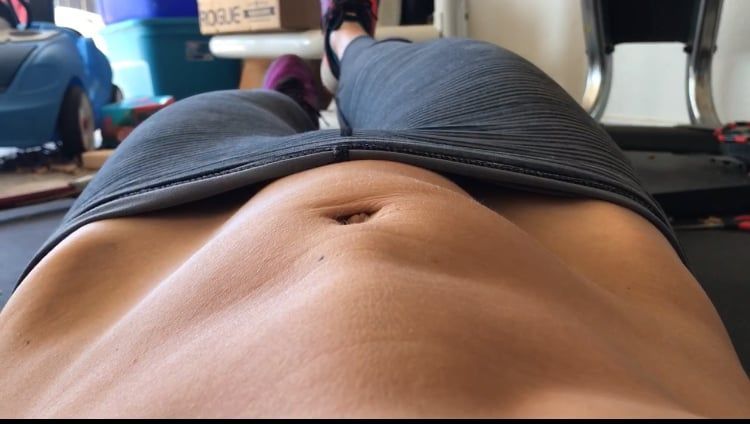
In short: every time you do an abdominal exercise, the internal pressure of your body increases and you’re not managing it well.
Normally, doming doesn’t cause problems, but in pregnancy it can become one. Why?
- intra-abdominal pressure has already changed
- the rectus abdominis is lengthened and weakened
- breathing is compromised
The goal in pregnancy is to reduce doming as much as possible.
In theory it would be better to start working on it before getting pregnant, but unfortunately that’s not the reality for most people.
Careful: doming doesn’t appear only during exercise. Paradoxically, working out is the safest moment, because that’s when you’re paying close attention to it. Doming (as stress on the linea alba) should also be avoided during everyday movements: when you try to sit up out of bed keeping your torso straight, when you pull yourself up off the sofa, when you carry grocery bags, when you lift something heavy off the floor.
What are the risks with doming?
- Pelvic floor problems
- difficulty healing the diastasis postpartum.
No risk to the baby; it’s more a matter of postpartum recovery.
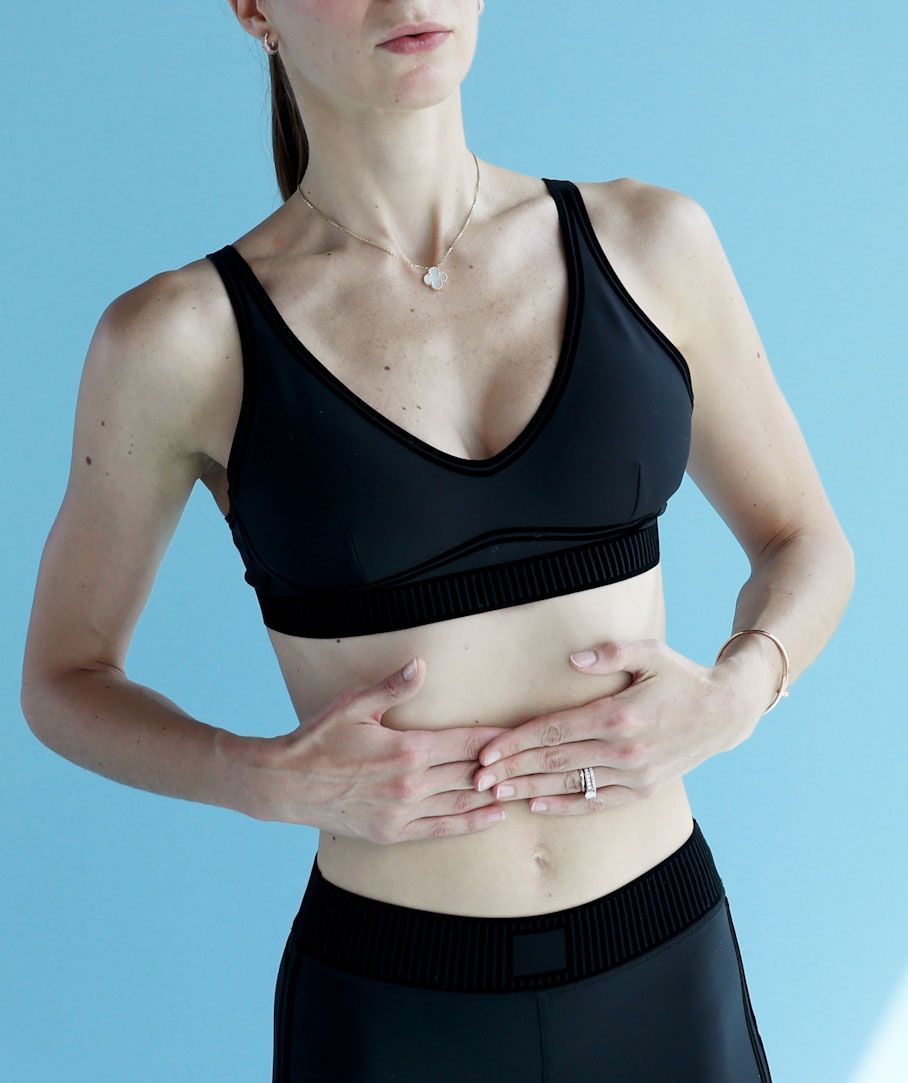
Heaviness or pressure at the pubic bone
If during an exercise you feel heaviness, swelling, or as if something were pushing downward, it’s best to stop the exercise.
Why? Because you’re putting too much pressure on your pelvic floor.
And that can lead to postpartum problems (prolapse, for example).
Bearing down
“Bearing down”: a term I struggle to translate. Literally, it means pushing downward to generate force.
Let me give you an example that’s clearer than a thousand words: picture when you need to go to the bathroom for number 2, but you’re having some difficulty and you push.
There. That’s bearing down.
And it’s exactly what you must avoid during pregnancy. It increases the risk of prolapse, umbilical hernia, and a worsening diastasis.
If you’re wondering how you’re supposed to go to the bathroom during these months, read the next section, where I explain.
Urine leakage
If during an exercise, when you sneeze, or when you laugh, a few drops of pee escape, it’s a signal from your body.
It’s not a case of “it’s normal in pregnancy, it’s the baby pressing”. It’s your pelvic floor telling you that that movement, done that way, at that moment, is too much.
Maybe the pelvic floor is too tight or too weak, but there’s definitely something to work on (and I’d suggest seeing a physical therapist who specializes in the pelvic floor).
What to do if one of these 4 signals appears
The solution is very simple: modify the exercise or the movement.
Don’t stop training. None of these signals is serious for your health or the baby’s, but you do need to find a movement suited to your body at this moment.
The alternatives are:
- make the exercise simpler
- reduce the lever
- reduce the load
- change position.
If you follow my Pilates Linfodrenante® Pregnancy Journey, you’ll notice that substitutions are the order of the day; I always try to choose exercises that generally don’t cause problems, I tell you what to watch out for “live” so you don’t forget (how many times have you heard “the belly doesn’t push outward”? 🤣), and I show you the necessary modifications.
An easy-peasy example? Plank with knees on the floor instead of legs extended.
The principle is always the same: find the version of that movement where the signals don’t appear.
Movements to avoid and how to replace them
Movements requiring excessive effort
When you read this list of movements, you’ll laugh, because you’ll think that many of them… don’t involve excessive effort at all.
I’m sorry to contradict you, but that’s not the case. Your body in pregnancy is a different body. The strategies you used before, the movements you did without thinking, need updating.
Not because you’re fragile, but because you’re different. And you need to respect that, to make postpartum recovery easier.
Here are 3 movements to avoid:
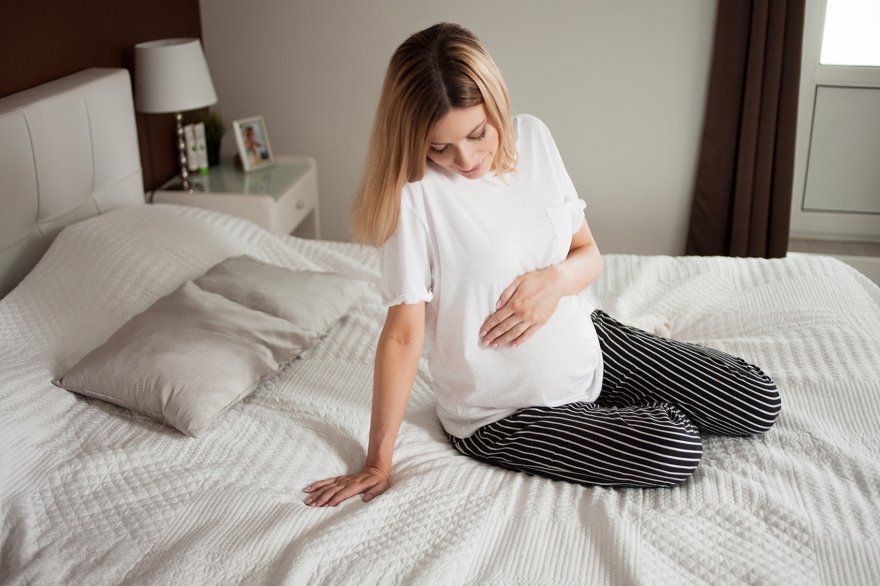
Getting up from bed or the sofa lying on your back, “straight up”
When you’re pregnant, especially in the second and third trimesters, and in the first months postpartum, it’s better to get up from the bed or sofa by
- rolling onto your side
- placing your upper hand in front of your chest
- pushing yourself up by extending that arm
- coming to a seated position.
That way you don’t strain your abdominals (which, as we’ve seen, are weakened) and you don’t worsen the diastasis.
Lifting heavy objects with poor posture
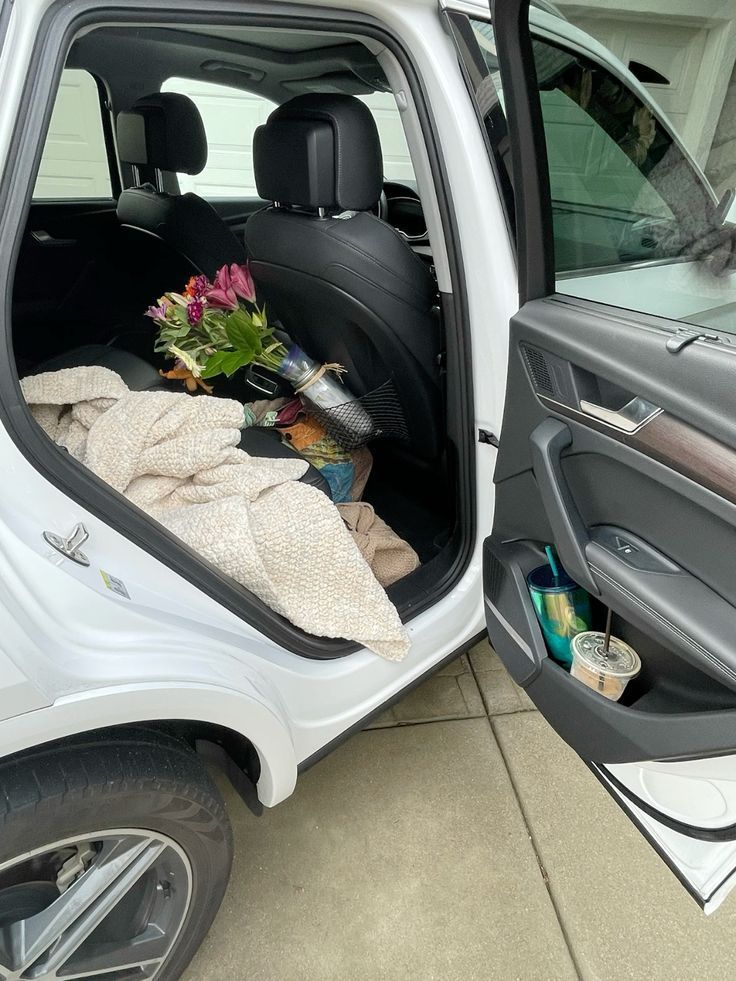
A practical example: you’re sitting in the front seat of the car and you “twist around” to grab something heavy from the back seat. You’re not managing intra-abdominal pressure correctly. You should park, open the back door, and pick up the heavy package.
Avoid any kind of strain in “wrong” positions.
Need to pick something up off the floor? Stand with your feet parallel, hip-width apart (or slightly wider), make sure you’re not rounding your back, push your pelvis back, and lift the heavy object.
Straining during bowel movements
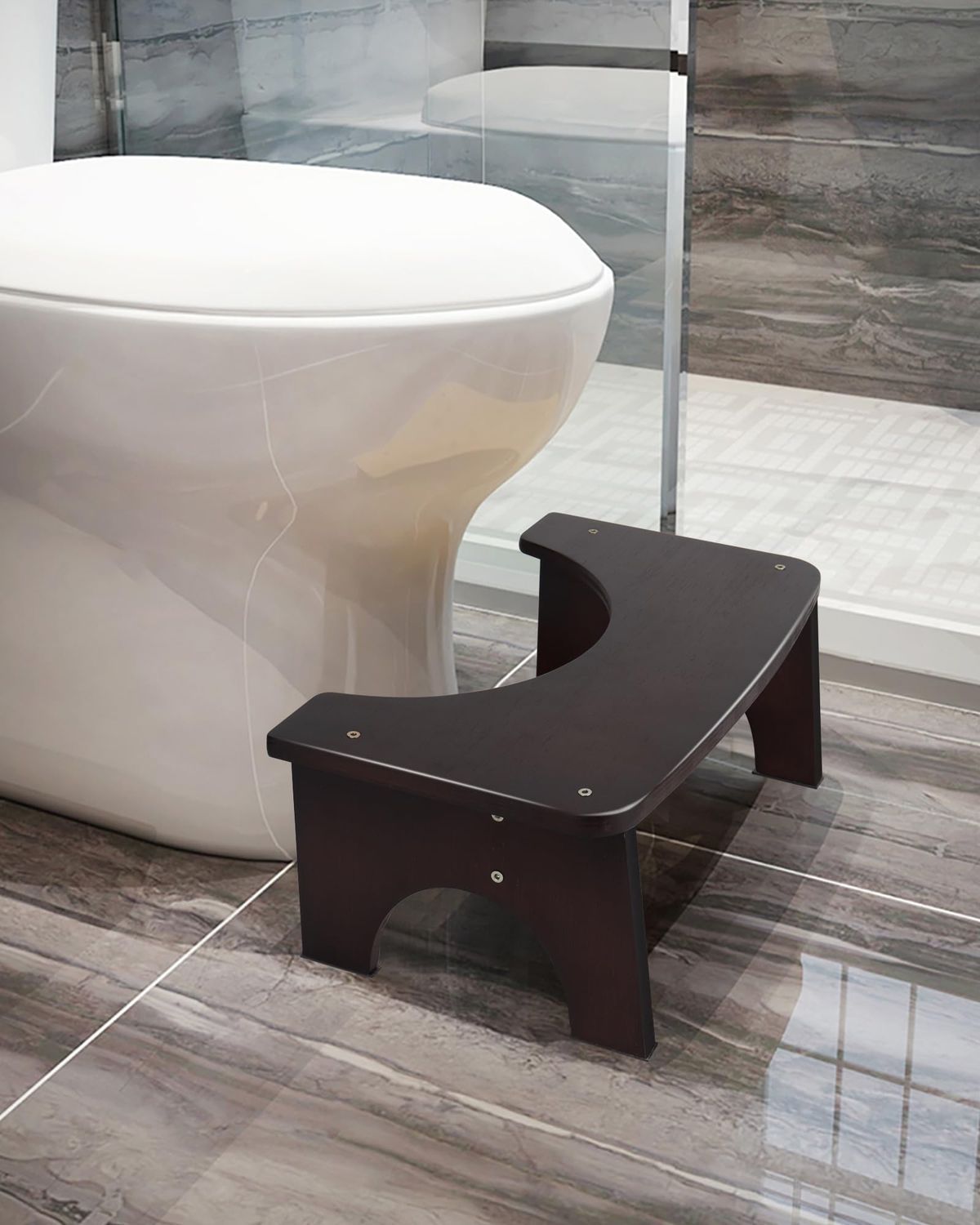
Pregnancy often brings constipation. Constipation leads to pushing during bowel movements. And pushing during bowel movements is one of the main causes of pelvic organ prolapse.
What to do:
- use a footstool under your feet so the position becomes more anatomical
- try to inhale deeply when you go to the bathroom (don’t exhale and push)
- if you really must push, keep your mouth slightly open and make a “haaaaaa” sound, as if you were fogging up a window
Exercises that load the front of the body
Especially from the second trimester onward, it’s best to avoid exercises that heavily load the front of the body against gravity, such as planks and push-ups.
You can still do them with your knees on the floor or on all fours (even simpler).
Exercises and positions lying on your back (supine position)
In the second half of pregnancy (generally considered after week 20, but every case is different), it’s best to avoid lying on your back for long periods.
This applies both to exercises (better to keep your back always slightly inclined) and to everyday positions (for example, avoid lying flat on your back in bed or on the sofa for a long time). The risk is compressing the vena cava, reducing blood flow to the placenta and therefore the oxygen and nutrients reaching the baby.
In my Pilates Linfodrenante® Pregnancy Journey I decided to avoid all supine exercises from the start of the second trimester, to stay on the “safe” side. All exercises are performed on the forearms or with the Birth ball (the giant ball), so you always have support.
5 benefits of Pilates Linfodrenante® in pregnancy
It strengthens the muscles that birth and postpartum will rely on
The most important muscles during pregnancy (and postpartum) are the deep abdominals and the core in general. In particular: the transverse abdominis (the deepest of the abdominal muscles), the obliques (internal and external), the pelvic floor, the diaphragm, the glutes and hip external rotators, and the multifidus.
I know, lots of strange names, but you don’t need to know them all to “do things right.”
Simply picture them as the muscles that support the spine, hold the pelvis in position, and protect the organs.
Here’s what they do, one by one:
- A strong transverse abdominis helps you carry the baby’s weight without overloading the lumbar area. It’s like an internal corset wrapping the whole abdomen.
- The obliques help you stabilize the pelvis, rotate the torso, and distribute internal pressure in a balanced way, preventing it all from landing on the midline (and therefore on the diastasis).
- The diaphragm is the breathing muscle. It works together with the pelvic floor. Together they control the pressure inside the abdomen. When the diaphragm moves well, the pelvic floor works well too.
- A pelvic floor that is strong yet able to relax is essential. The strength serves you postpartum, to avoid urinary incontinence and prolapse. But for labor, what matters most is the ability to release: the pelvic floor has to know how to open and let the baby through. Being toned isn’t enough; it also has to know how to relax.
- The glutes are often forgotten, but they’re extremely important. When the glutes don’t work well, other muscles (like the deep hip rotators) compensate, and this increases pelvic floor tension. Strong glutes mean less load on the pelvic floor and less pelvic pain.
- The multifidus stabilizes the spine and reduces postural pain, especially in the lumbar area (which, as we’ve seen, gets compressed in pregnancy).
And then there’s breathing. Breathing 360 degrees (expanding not just your belly, but your sides and back too) will help you recover from the diastasis faster postpartum and improve your posture throughout pregnancy.
In Pilates Linfodrenante® Pregnancy we work on each of these muscles in a specific, targeted way. The first two weekly sessions are more general toning, while the third is specifically for posture, breathing, and pelvic floor release.
It reduces pain and swelling
In pregnancy, the body retains far more fluid than usual. Blood volume increases, progesterone rises, and the lymphatic system is “slower.”
This translates into:
- Swollen legs and swollen ankles (especially in the second and third trimesters)
- General heaviness in the evening
- Swollen hands (you know when your rings struggle to come off?)
- A puffy face in the morning
Pilates Linfodrenante® actively works on drainage through opening the lymphatic stations (the Big Six), inversion exercises (modified for pregnancy), diaphragmatic breathing, and specific leg movements for venous and lymphatic return (while avoiding creating inflammation).
If you’d like to understand in more detail how lymphatic drainage works, I wrote “DIY lymphatic drainage: the 6 points to activate every morning in 2 minutes.” In pregnancy, the techniques are adapted, but the principle is the same.
It prepares you mentally for birth
Every week begins with a meditation session, with breathing exercises and positive affirmations to prepare yourself mentally for birth.
Phrases like:
- Everything will be okay
- I am a brave woman
- I have complete trust in myself
- My body knows what to do
- I embrace my body’s changes
They help you prepare mentally and physically for birth. To trust yourself, your body, and the mother you’ll become.
And you can use the breathing techniques in the delivery room to relax.
It improves mobility, teaches you to coordinate breath with movement, and to let the pelvic floor go
By working on mobility, it also helps with the typical pains of pregnancy: lower back pain (especially from the second trimester), neck pain that worsens with the change in posture, hip and pelvic pain, sciatica.
The Pilates Linfodrenante® breathing techniques become an ally during labor.
Learning to coordinate your breath with movement, to breathe deeply during a contraction, to relax the pelvic floor at the right moment: these are all things you train, session after session, throughout pregnancy, and you’ll find them incredibly useful when it’s time to give birth.

Benefits for the baby, too
Regular physical activity during pregnancy, according to ACOG guidelines (American College of Obstetricians and Gynecologists), is associated with:
- lower risk of gestational diabetes
- better maternal weight management
- reduced risk of preterm birth.
Moreover, mothers who trained often report better mood, better sleep, and less anxiety.
And of course all of this has a positive impact on the baby too, both during pregnancy and in the first months of life.
When to consult your gynecologist before starting
I want to be clear on this: before starting any training program in pregnancy, talk to your gynecologist. Even if the workout seems “gentle” and even if, like Pilates Linfodrenante® Pregnancy, it was designed specifically for this phase of a woman’s life. Every pregnancy is unique, and only your doctor can give you the green light for physical activity.
Be especially careful in cases of:
- High-risk pregnancy (threatened miscarriage, placental abruption, placenta previa, etc.)
- Pre-existing conditions (diabetes, hypertension, heart problems, autoimmune diseases)
- Recurrent miscarriages
- Twin or multiple pregnancy
- Gestational diabetes or pre-eclampsia
- Bleeding during pregnancy
- Severe anemia
And in any case, if during a session you notice any of these symptoms, stop immediately and contact your doctor:
- Abdominal or pelvic pain
- Bleeding
- Loss of amniotic fluid
- Regular contractions
- Dizziness, intense shortness of breath
- Severe headache
How the Pilates Linfodrenante® Pregnancy Journey works
Pilates Linfodrenante® Pregnancy includes 3 sessions a week: 2 of 30 minutes each and one 15-20 minute session of mobility and breathing. It’s structured to accompany you week by week, adapting the workload and the exercises to the week you’re in. Nothing is left to chance.
During sessions, make sure to drink enough and train in a cool room.
What it includes:
- Sessions adapted to each trimester
- Specific work on the pelvic floor, deep abdominals, and posture
- Lymphatic drainage to reduce swelling and retention
- Breathing techniques to prepare for birth
Since launch, more than 6,500 women have successfully followed the Journey.
Frequently asked questions
Can I start Pilates Linfodrenante® Pregnancy even if I’ve never done Pilates before?
Yes. The Journey is structured to be accessible even to complete Pilates beginners.
Can I continue the Journey up to the day of birth?
Most women continue up to 38-40 weeks (with sessions that grow gentler and gentler). Some gynecologists advise against intense activity in the very last weeks. Talk to yours. The Journey includes adapted sessions up to 40+ weeks.
Can I start in the first trimester or should I wait for the second?
You can start in the first trimester if your pregnancy is physiological and you have your doctor’s green light.
The first-trimester sessions are designed to be gentle and to help reduce nausea and tiredness.
And after the birth?
In the app you’ll find the Pilates Diastasis and Postpartum Journey, designed for recovery after birth. You start once your gynecologist gives you the go-ahead, generally at the 40-day check-up.
What should I avoid during pregnancy?
High-impact sports (running, jumping, contact sports), workouts requiring long periods lying on your back (especially after week 20), and heavy lifting without supervision.
None of these activities is part of Pilates Linfodrenante® Pregnancy.
What should I pay attention to?
During sessions, make sure to drink enough and train in a cool room.
How do I know if it’s too much for me?
The golden rule for training in pregnancy is the “talk test”: you should be able to speak in full sentences during every exercise.
If you feel short of breath or can’t talk, the intensity is too high and I’d suggest stopping.
In pregnancy the goal is never to push hard; it’s to do quality movement that prepares the body for birth and postpartum, while avoiding the swelling and discomfort typical of pregnancy.
If I feel unwell one day, can I skip the session?
Of course! In pregnancy, even more than when you’re not pregnant, listening to your body is essential.
Nothing happens if you skip one (or more) sessions.
In short
Working out during pregnancy is good for you, for the baby, and for birth preparation. But it has to be done with a specific approach, not with just “any” routine adapted on the fly.
Pilates Linfodrenante® Pregnancy combines the benefits of classic Pilates (strength, posture, breathing) with lymphatic drainage, which becomes especially important when the body is managing 50% more fluid than normal.
But remember to always keep your gynecologist’s approval and listening to your body as your absolute priorities.
