Creatine for women: is it really that good? My experience and what the studies actually say
Does creatine benefit women or cause bloating? Carlotta shares her experience and explores its benefits, water retention and what the science says.
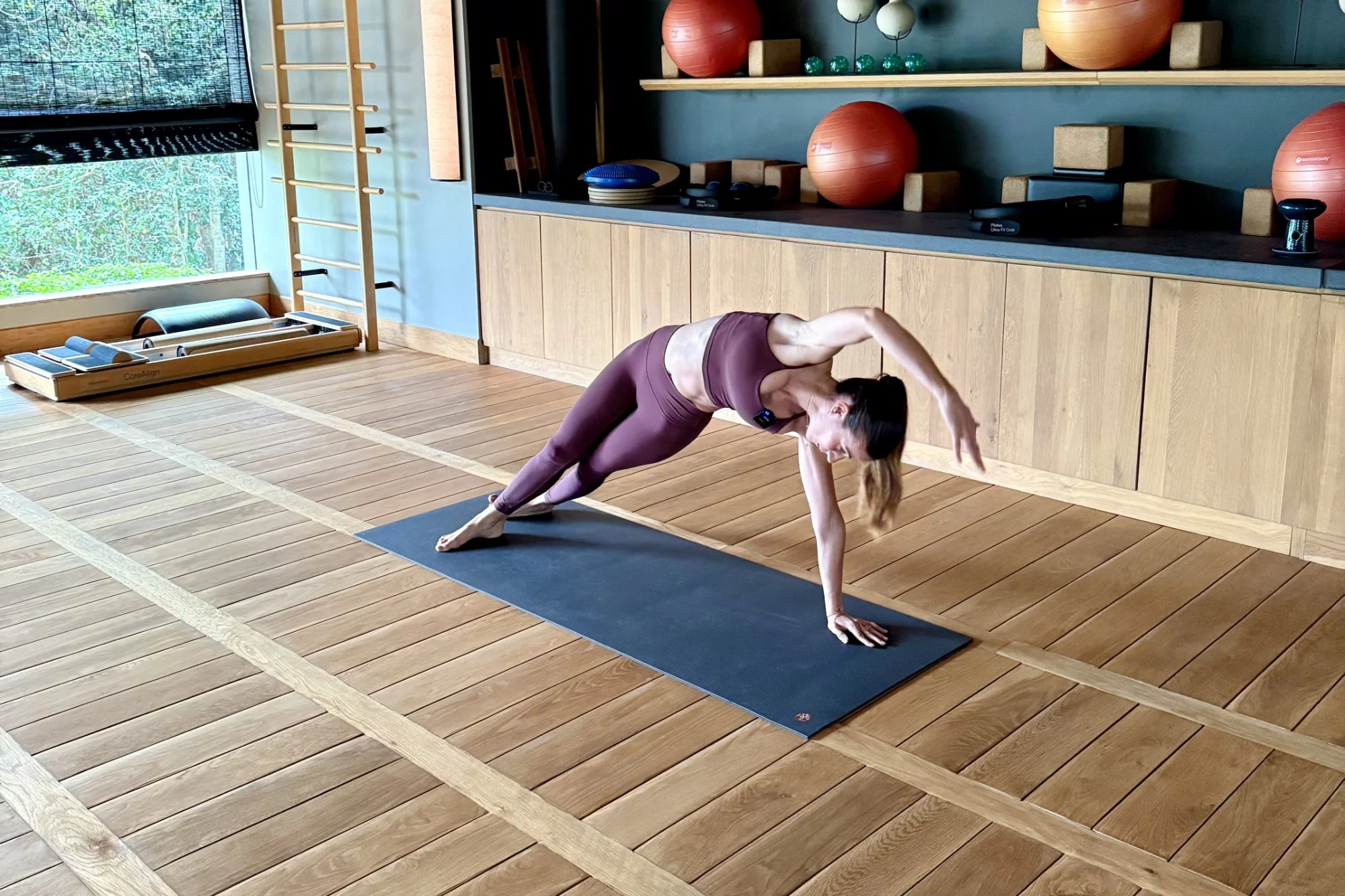
I noticed it for the first time in a plank, eyes between my hands, the way I always teach it to keep the natural curve of your neck.
My hands were visibly puffy. My wrists had little "rolls" they'd never had before. They looked fuller, softer, and the backs of my hands weren't showing their veins the way they usually do.
And I hadn't gained weight. I hadn't changed how I ate or how I trained.
But I knew something was off.
My hands and wrists are the leanest part of my body, always have been. And they're the part I notice first when something changes, because I see them all day long.
In everyday life, but also in planks and on all fours. It took me a while to figure out where that puffiness was coming from.
Then it hit me like lightning: I'd started taking creatine.
If you follow the fitness and wellness world on social media at all, you've heard everyone talking about it lately. Everyone says you should be taking creatine, that the benefits are incredible, that it works miracles.
For women too.
And they reassure you that no, creatine doesn't make you bloated, because "the water goes inside the muscle, not under the skin."
I believed it too.
I said it too.
And I tried it. Twice, for three months each time, long enough to draw real conclusions about my own body.
And sadly, both times it ended the same way: I felt and looked visibly puffier, with no other benefit I could actually notice.
So I stopped.
For good this time, I think (or at least for a long while, never say never).
In this article I'll tell you about my experience, but more than that I'll walk you through what the research actually says. Because when I went and read the studies, I found something nobody mentions: almost everything we know about creatine, we learned from men.
And that's no accident. Almost all research in every field, and health and fitness above all, has been done on men.
One thing before I get buried in angry comments: I'm not saying creatine is bad for you. I'm saying that what works for a 25-year-old man who lifts weights doesn't necessarily work for you. And it definitely doesn't work for me.
My experience
Like I said, I took creatine twice, for about three months each time. Long enough to saturate my stores and see the real, settled effects, not the first-week ones that fade.

The first time: 3 grams a day
That's less than the usual 5 grams, and with no loading phase (the phase many people recommend at the start, where you take around 20 grams a day for the first 5 to 7 days).
The second time: 2 grams
I went down to 2 grams, specifically to see whether an even lower dose changed anything. Spoiler: it didn't.
Both times I looked puffier all over. But where I noticed it most was my hands and wrists, because they've always been my leanest spot and they're right in front of me all day.
On all fours, hand flat on the mat, I could see my wrist looking fuller and the back of my hand swollen. A small detail, but to me unmistakable.
It wasn't the kind of bloat you get after a heavy meal, the kind that's gone by morning.
It wasn't my cycle (I took it long enough to rule that out, and I'll explain how further down).
It was a fuller, heavier, less defined body. And it didn't change no matter what I did.

Since I love experiments, for about ten days I even tried a light "diet" (or at least I kept a close eye on how much and what I was eating), to check whether I was simply eating more and whether that would shift anything.
Nothing changed.
The only thing that changed things was stopping the creatine. A few days later, I was back to my usual self.
And puffiness aside, I honestly didn't notice a single benefit I could REALLY feel. No obvious extra strength, no extra energy, no extra mental clarity.
So I did what I always do: I went and read the studies.
What the science says about creatine
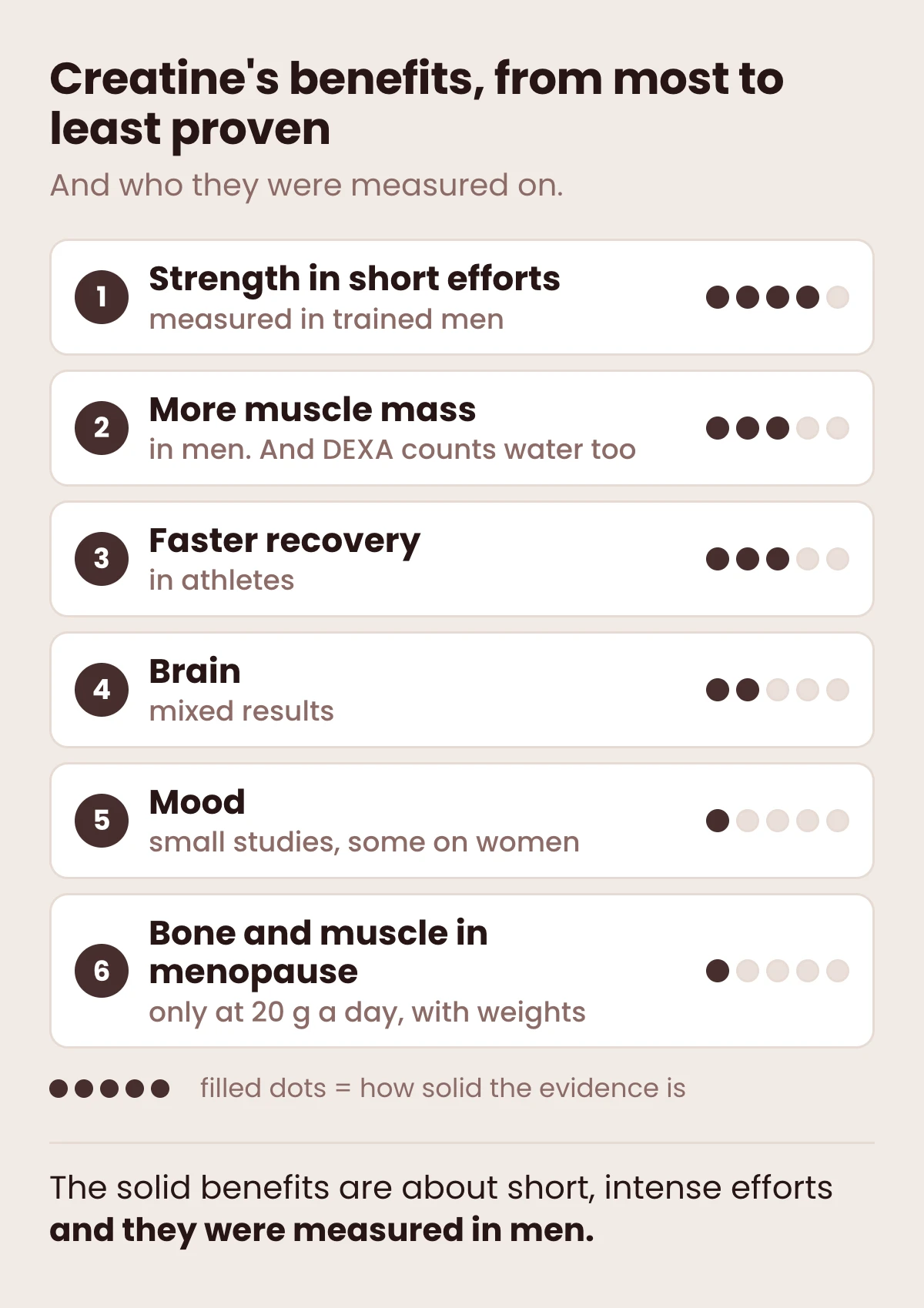
Let's start with the benefits creatine gets credit for, ranked by how solid the evidence is.
-
Strength and power in short, intense efforts
Sprints, heavy lifts, low-rep sets. This is the most studied and most consistent benefit. The effect is real but modest. And above all, it's been measured almost exclusively in trained men. Almost never in women.
-
More muscle mass over time
The idea is simple: creatine lets you squeeze out a few extra reps, so your muscles get more stimulus. Analyses of the studies point to around 1 kg of extra lean mass.
I'll come back to this one, because it's the one I care about most.
-
Faster recovery between workouts
Decent evidence, mostly in athletes.
-
Brain
Memory, focus, less mental fatigue, especially in people who don't sleep enough or who eat vegetarian or vegan (creatine is found almost only in meat and fish).
It's the reason plenty of people who never train take it. Interesting results, but mixed: in a study from this year, half the cognitive tests showed no improvement at all.
-
Mood
A few small studies, some on women, have used it alongside treatment for depression. Still preliminary.
-
Bone and muscle in menopause
Here there's actual data on women, but at very high doses (0.3 grams per kilo of body weight, so nearly 20 grams a day for a 60 kg woman) and always combined with resistance training. At 3 or 5 grams, nothing has ever been shown.
To sum up: the solid benefits are about short, intense efforts, and they were measured in men. Everything else is "promising," which is the polite way of saying "we don't know what it does yet, but we'd rather not say it might be useless."
"It doesn't bloat you, the water goes into the muscle": is that true?
Yes and no.
It's true that creatine pulls water inside the muscle cell, not under the skin like edema. Physiologically, it's not "bad" water retention.
But half a kilo, a kilo, a kilo and a half of extra water in your muscles still shows. Legs and arms look fuller, the whole body heavier. And in a woman, who has less muscle mass than a man to begin with, the same amount of water is far more visible.
The point is that "the water is inside the muscle" is an explanation, not a consolation. If your goal is to feel light and debloated, where that water sits hardly matters. What matters is whether it's there or not.
The "muscle" the scans see is actually water
Here's the part I really want you to understand.
When a study says "creatine increased lean mass," it almost always measured it with a DEXA scan, the test that splits your body into fat, bone and "lean mass."
And do you know what DEXA counts as "lean mass"?
Muscle, yes. But also organs, connective tissue. And water.
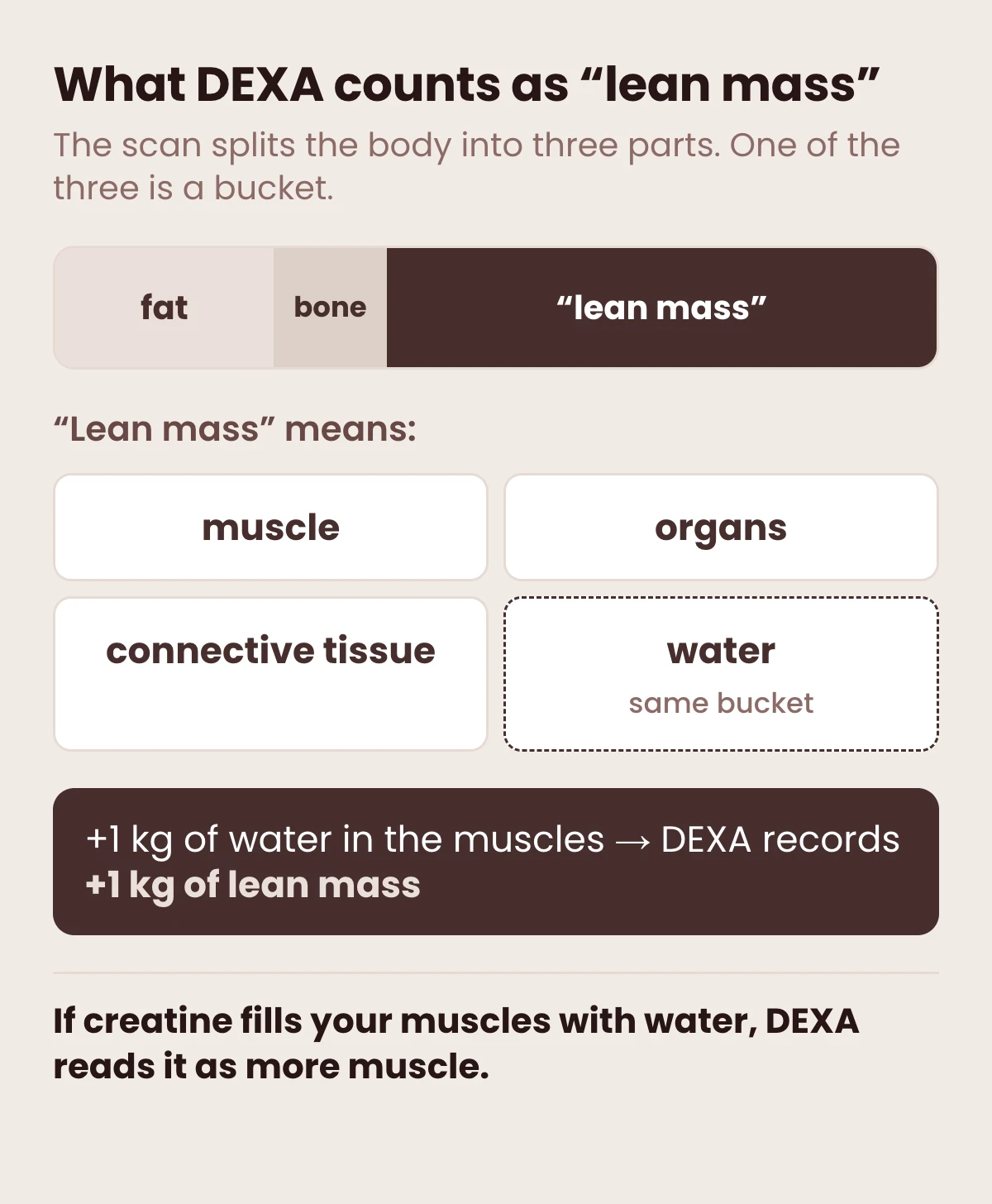
You read that right: for DEXA (considered the gold standard for measuring how much muscle you have), water and muscle land in the same bucket. It can't tell them apart.
So if creatine fills your muscles with water, DEXA reads it as more muscle.
In 2025, a group of researchers at the University of New South Wales in Australia did something simple that nobody had done before: they gave half the participants 5 grams of creatine a day for one week before any training started.
The result: in that one week, without lifting a single weight, the creatine group had already "gained" half a kilo of lean mass. And women were the ones who gained the most.
Muscle built in seven days without training? Obviously not. It was water.
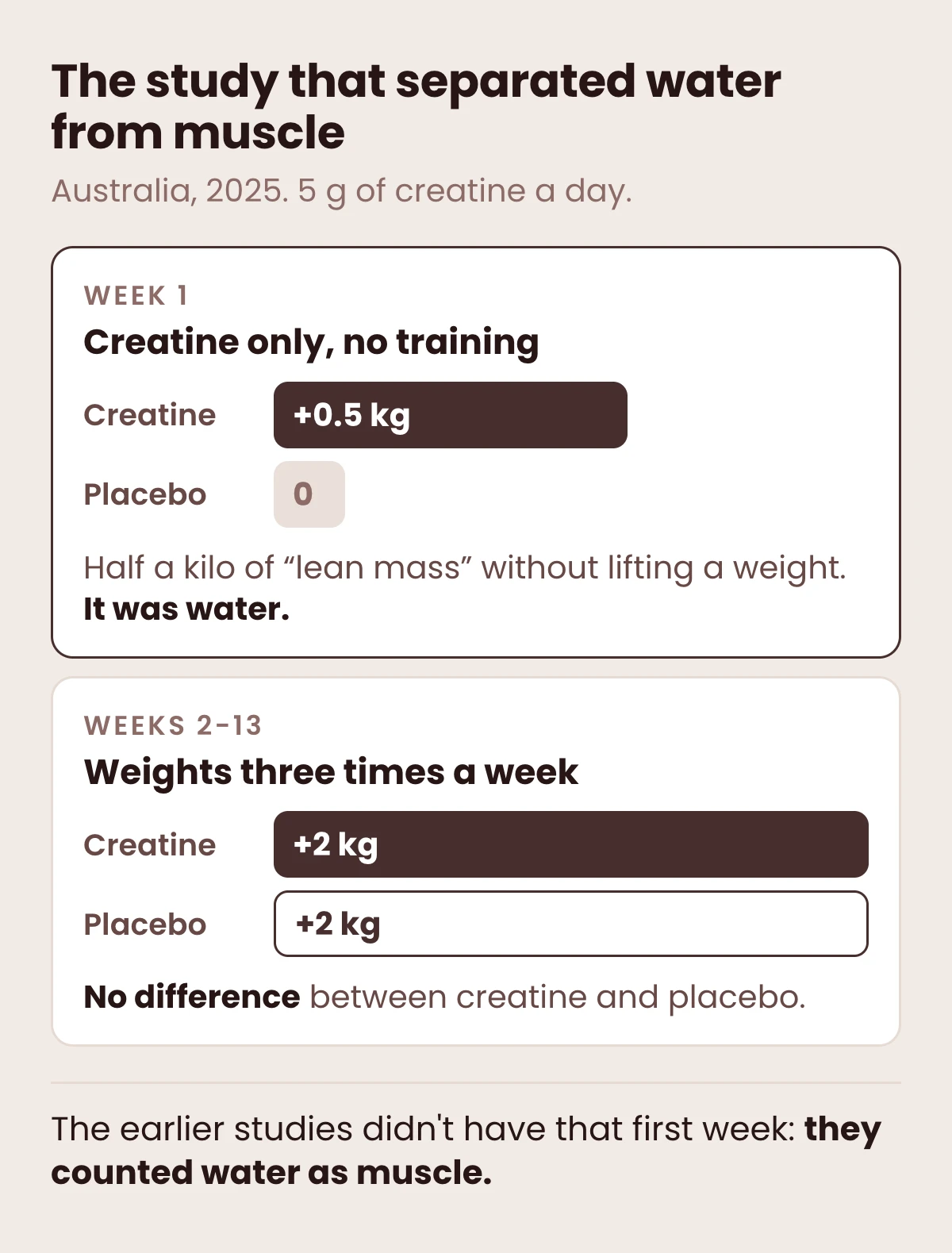
Then came 12 weeks of resistance training. And at the end, between the people taking creatine and the people taking a placebo, there was no difference at all: both groups had gained about 2 kg of lean mass.
The earlier studies that found "1 kg of extra muscle with creatine" didn't have that first week. Most likely, they were counting water as muscle.
And then there's a brand-new study from August 2026, published in the Journal of the International Society of Sports Nutrition by Richard Kreider's group, one of the best-known creatine researchers in the world.
They gave 10 grams of creatine a day to sedentary adults aged 45 to 65 for 12 weeks. Some participants did no exercise at all; the others followed an exercise and diet program.
The result: the people taking creatine without exercising "gained" 1.1 kg of lean mass on DEXA. More than the people training three times a week without creatine (who, to be fair, were also on a weight-loss diet).
On social media, as you can imagine, this instantly became "creatine builds muscle even if you don't work out."
But are we sure? Miracles don't exist.
Now, take a guess. Who were the participants? 40 women and 24 men.
That's right: it's one of the very few creatine studies with more women than men. And what does it show? That in middle-aged women who don't train, creatine raises what DEXA calls lean mass by over a kilo.
Muscle built sitting on the couch? I don't think so. It's simply water.
The study didn't measure body water, so it doesn't say this explicitly. But it's the simplest, most intuitive explanation if you know how these scans and the human body work.
Even Bryan Johnson thinks so. He's the American entrepreneur who became the face of the longevity movement with his Blueprint protocol, he's taken creatine for years, and he even sells it. Here's how he commented on the study on X:
"Creatine didn't build muscle or burn fat in this study. It was water retention. DEXA scans count water as lean mass. Creatine hydrated muscle cells. It didn't synthesize new contractile fibers."
And he added something worth remembering every time you see a "before and after" with a body fat percentage: if you add water to the body, your body fat percentage drops by pure math, even if you haven't lost a single gram of fat.
Let me show you with a very simple example.
Take a 60 kg woman at 25% body fat. That's 15 kg of fat and 45 kg of everything else.
Now she starts creatine and holds an extra kilo of water in her muscles. She weighs 61 kg. Her fat is still 15 kg, she hasn't lost a gram. But 15 divided by 61 is 24.6%.
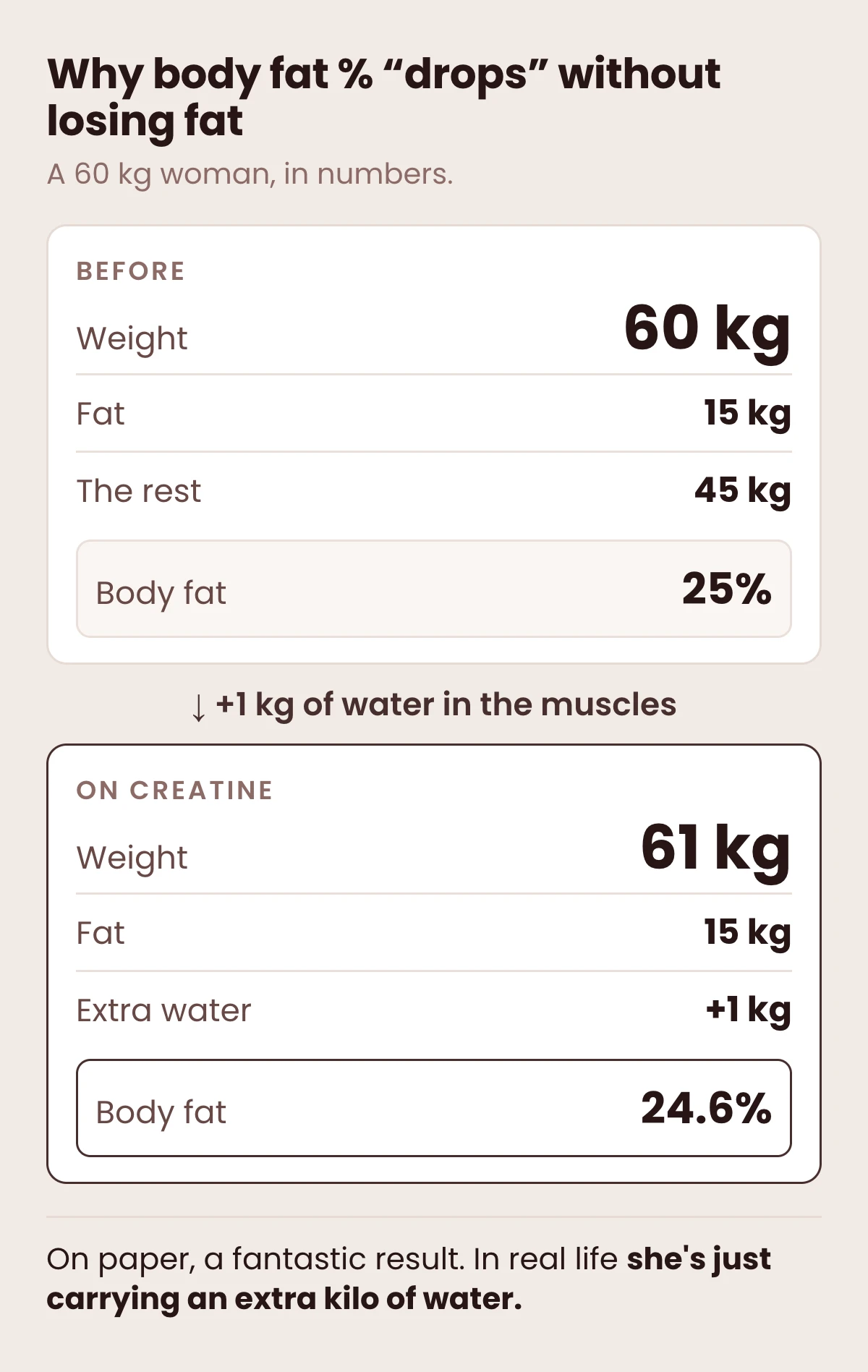
Her body fat percentage "went down" and her lean mass "went up." On paper, a fantastic result. In real life, she's just carrying an extra kilo of water.
So: if even someone who's taken it for years and sells it admits that extra kilo is water, the question for a woman becomes simple. That extra water, do I want it or not?
Personally, having seen no other benefit, I decided to stop.
The real problem: creatine was studied on men
Now we get to the point that, to me, matters most of all.
Creatine is one of the most studied supplements in the world. That's true. But the vast majority of those studies were done on men, often young and trained.
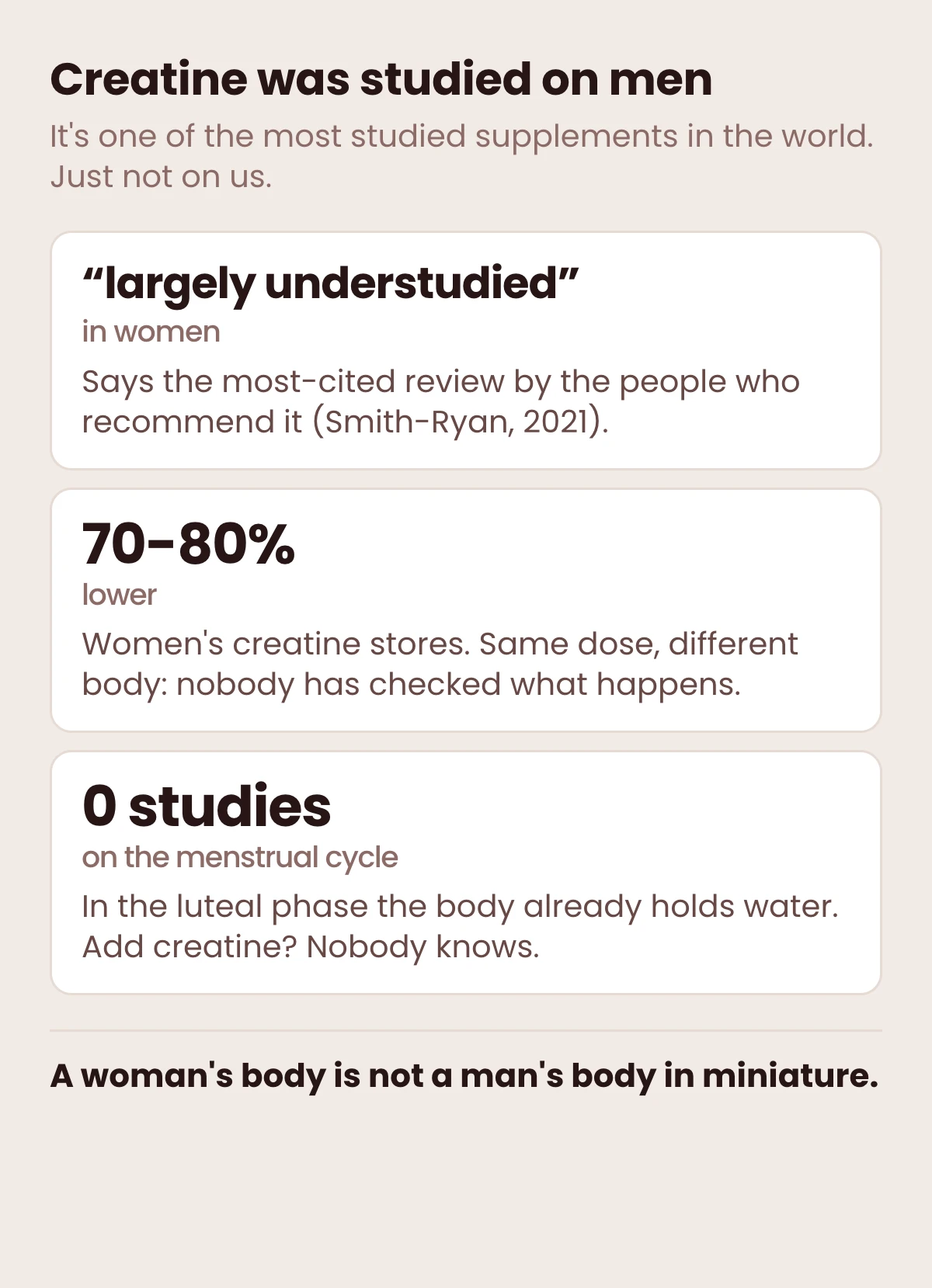
Don't take my word for it. The most-cited review by the very people who recommend creatine to women (Smith-Ryan and colleagues, 2021) states in black and white that supplementation in women has been "largely understudied."
And it's no coincidence that the one major recent study with more women than men, Kreider's, is exactly the one where creatine raised lean mass with no training whatsoever.
When we finally look at women, what we see is water.
Which brings me back to what I always say: a woman's body is not a man's body in miniature.
That's exactly why, for years and years, I saw no results on my own body from the workouts everyone recommends, workouts that were actually designed for the male body.
And it's exactly why I created my own method, built on female physiology, to debloat and tone.
Sorry for the detour, but these are things I've been saying for years and I care about them deeply.
Back to creatine.
If we compare men and women, two differences come to mind.
-
Women have lower creatine stores than men
70 to 80% lower according to the same review. People who promote creatine use this to say "so you need it even more, because you have less."
But you can read it the other way around: a body with far lower stores receiving the same dose as a man might respond differently. Nobody has checked whether that translates into more water retention.
-
Female hormones change how the body handles fluids
And they change every week. Estrogen and progesterone on their own, in the luteal phase (the week before your period), make you retain water.
What happens when you add creatine on top? Nobody knows. The Australian study I told you about, the one where women got puffier in the first week, didn't even record which phase of the cycle the participants were in.
And the authors of that review themselves are calling for menstrual-cycle studies that still don't exist.
And that's exactly why, when I tried it, I wanted to rule out the most obvious objection. It would have been easy to think "it's my cycle, not the creatine."
So I deliberately started it in my follicular phase, in the weeks after my period, when the body is naturally at its least bloated.
And over three months, with follicular and luteal phases alternating, the puffiness in my hands never went away. It didn't follow my cycle. It followed the creatine.
So the correct statement isn't "creatine is bad for women." It's: almost nothing has been proven in women, and the little evidence there is on bloating points in exactly the same direction as what I saw on myself.
So, should you take it or not?
It depends on what you're after.
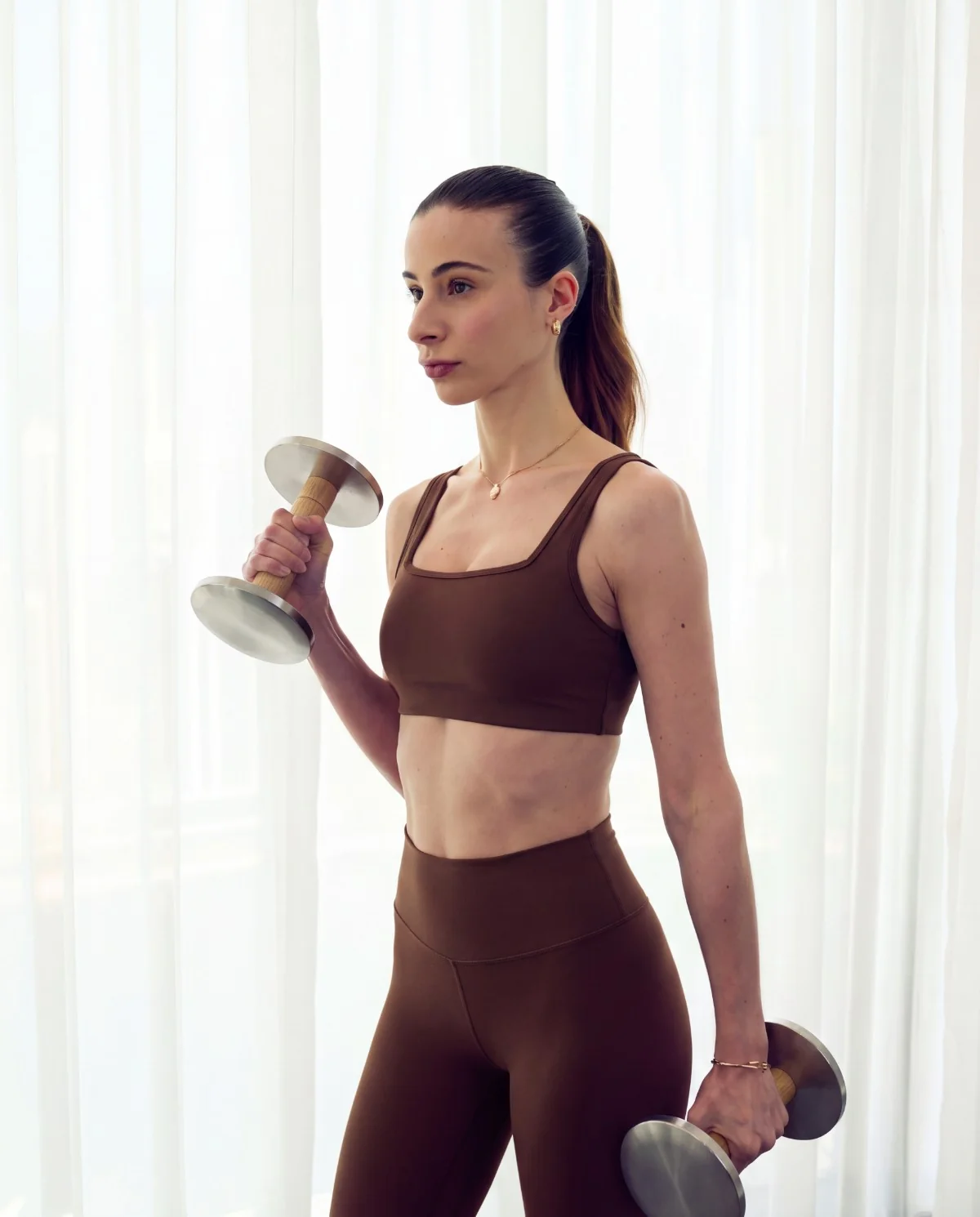
If you do strength sports
Powerlifting, competitions, sprints, heavy lifting, and you care about that extra 2 to 5% of performance: creatine makes sense and the puffiness may be a price worth paying.
If instead you train to feel good
To feel light, to debloat and depuff, like me and like most of the women who follow Lymphatic Sculpt Pilates™, the math is different: the benefit is uncertain and the side effect is certain.
I chose not to take it. Not because it's dangerous, but because for my goals, feeling light and debloated, it's one step back and none forward.
If you want to try it anyway, here's my advice: do what I did. Start in your follicular phase (right after your period), at a low dose, no loading, and watch yourself honestly for a few weeks.
Look at the parts of your body you know best, the ones that have always been leanest: that's where you'll notice it first. If you look and feel puffier and see no upside, it's not "in your head" and there's nothing wrong with you. Your body is giving you a data point the studies haven't collected yet.
Frequently asked questions
Does creatine make you gain fat?
No. The weight you gain in the first few days is water, not fat. But it's water you can see and feel, especially as a woman.
How long does creatine bloat last?
As long as you take it. Your muscle stores stay saturated and the water stays put. Once you stop, within a few days (a couple of weeks at worst) your body goes back to normal.
If I only take 2 or 3 grams, will I avoid the bloat?
Not necessarily. At low doses your stores fill up more slowly, but they still fill up, and the water still comes. I tried both 3 and 2 grams, for three months each: same result.
Is creatine good for menopause?
The studies showing benefits for muscle and bone in menopause use very high doses (around 20 grams a day), always combined with resistance training.
There's no evidence that 3 or 5 grams make any difference. If you're in menopause and curious, talk to your doctor.
Is creatine bad for your kidneys?
In healthy people, at normal doses, no: it's one of the safest supplements out there. If you have kidney problems, though, always check with your doctor first.
Creatine or protein, which is better?
They're not alternatives. Protein is food, and you need it every day to maintain your muscles. Creatine is a performance supplement.
If you have to choose where to focus, always start with how you eat and how you train, not with a supplement.
In short
Creatine has real benefits for strength in short, intense efforts, measured mostly in men.
"It doesn't bloat you because the water goes into the muscle" is true in theory, but that water shows, and you feel it.
Much of the "extra muscle" in the studies is water that DEXA reads as lean mass: a 2025 study shows it, and a 2026 study, done mostly on women, confirms it.
Creatine has barely been studied in women, and nobody has looked at how it interacts with the menstrual cycle yet.
I tried it twice, for three months, at 3 and then 2 grams, starting in my follicular phase (when you're at your least bloated). The result was always the same: more puffiness and no other real benefit. I decided to stop.
Test it on yourself
If your goal is to feel light and debloated, creatine is probably not the right tool. But I'm certainly not going to tell you not to try it. Testing things on ourselves is always the best way.
And it's the same answer I give when you ask me how I tone and debloat my body: don't trust what works on other people, test it on yourself.
Lymphatic Sculpt Pilates™ was born exactly like that, by testing on my own body what the "one size fits all" workouts weren't giving me.
If you want to see the difference, start your free 7-day trial. Seven days are enough to find out whether your body responds. Just like with creatine, except this time I like the answer.

Carlotta's insights, straight to your inbox
Just your name and email, unsubscribe anytime.