Cellulite Statistics 2026: The Numbers and How Reliable They Are
How common is cellulite in women? Discover how widespread it is, why it is less common in men and how reliable the available statistics really are.

Every article on cellulite starts with the same number: 90% of women. Nobody says where it comes from.
Here you'll find all the cellulite numbers updated to 2026 and, for each, how much you can trust.
The main numbers, in short:
80-90% of women after puberty have cellulitis (studies range from 80 to 98%)
Less than 10% of men
85-98% among women of European descent, less among those of East Asian descent
It does not depend on weight: it also appears with a low BMI
The treatment market is worth between $1.85 billion and $4.73 billion, depending on who measures it
But the question no one asks: how reliable are these numbers?
I do this because the sources that publish them openly say that there are no reliable epidemiological studies, and market estimates diverge from each other by 3 (three!) times.
Let's investigate together.
How many women have cellulite
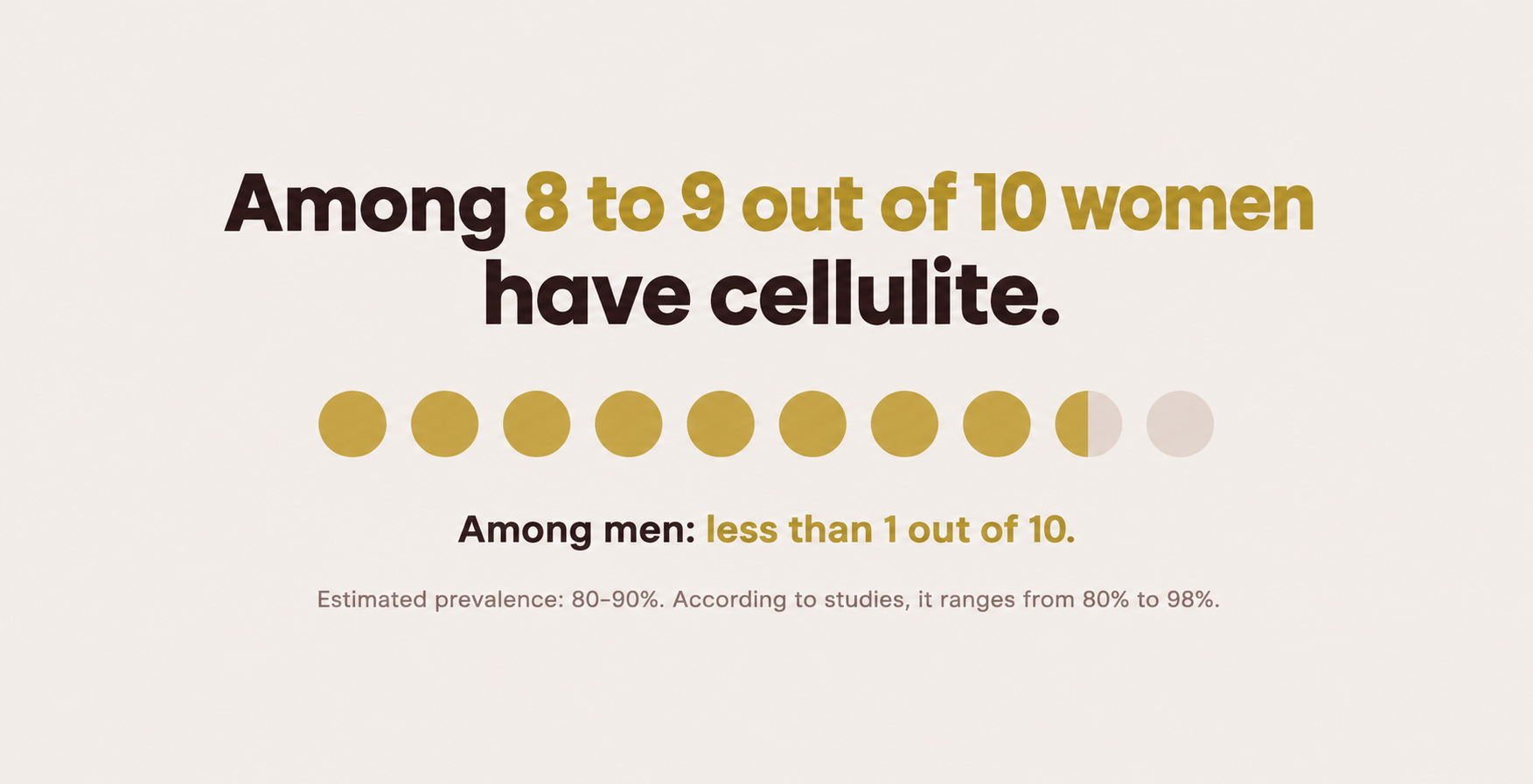
The most cited figure: 80-90%.
This is the reference literature number, taken from the main clinical sources. The Cleveland Clinic says between 80 and 90 percent of women after puberty, and less than 10 percent of men.
Because the range is so wide.
Depending on which study you open, the number changes: 80-90%, 80-98%, 85-98% among women of European descent, over 90% worldwide.
Eighteen points difference on such a large population is not a detail.
There are no solid epidemiological studies on cellulite. The sources themselves say so.
Academic reviews state this: precise data are lacking, because systematic population-based studies are lacking. What is circulating are estimates, built on limited samples and repeated over the years until they become a fact.
The practical conclusion: cellulite affects the vast majority of women, and that's solid. The exact figure, no.
How 90% Became a Fact
In Italy the history of this issue is reconstructed well, and is instructive.
In 2018, ANSA published a piece entitled "90% of women have cellulite". From then on, that figure appears everywhere: clinics, beauty salons, magazines, blogs.
That's why you find the intervals here, not a dry number: in eight years of repetition, the figure has lost its uncertainty without ever having resolved it.
Men and women: the structural difference
This, on the other hand, is solid data, because it does not come from surveys but from imaging.
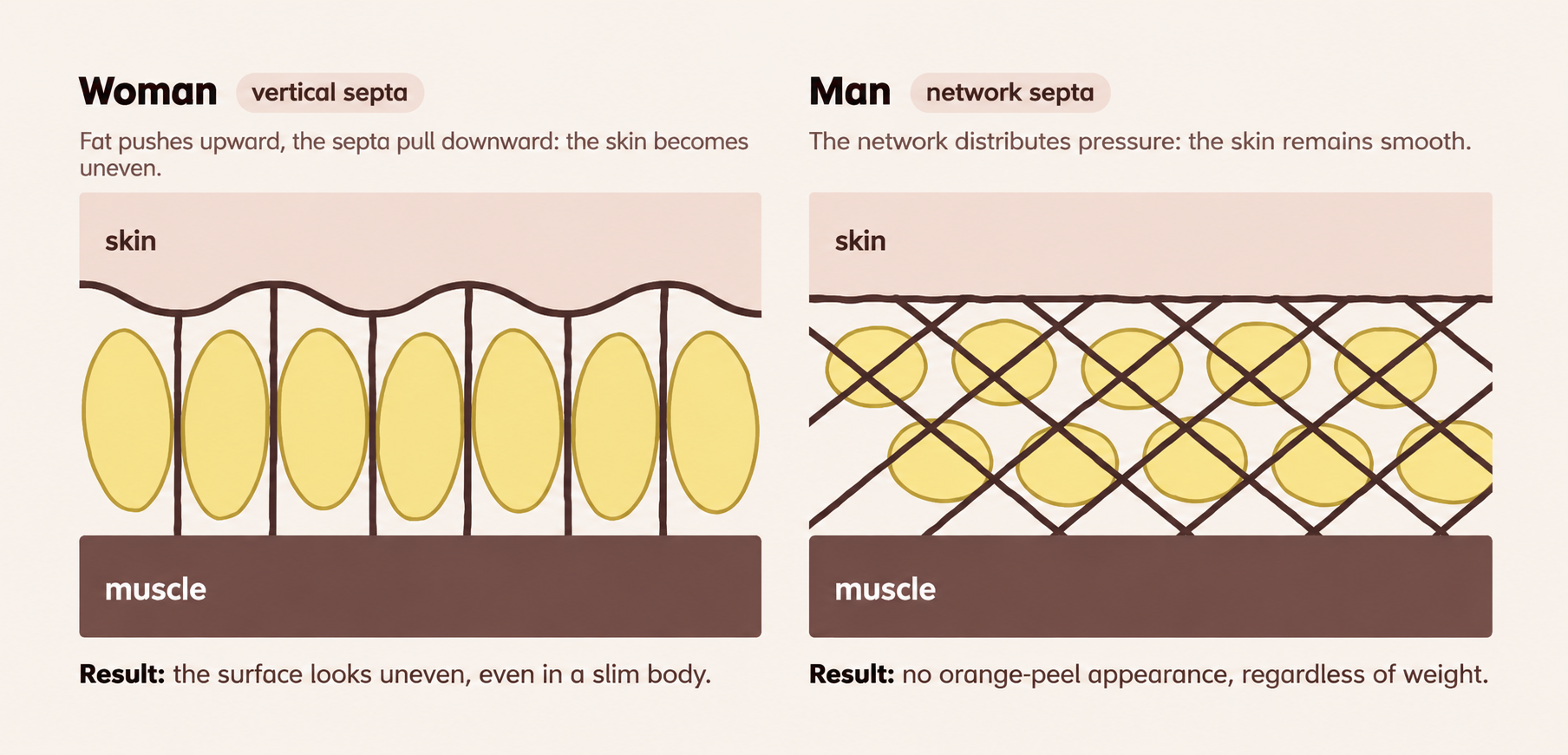
Between the skin and the muscle, fat is organized into lobules separated by bands of connective tissue: the fibrous septa. It's their direction that makes the difference.
-
In the female body the septa are vertical
They pull the skin down at the anchor points, while the fat lobules push up. The surface ripples.
-
In the male body they are oblique, net-like
The network distributes pressure instead of concentrating it at individual points. The surface remains smooth.
An MRI study compared women with and without cellulitis: in the former there were more vertical septa. It is one of the few data that does not depend on eye assessments.
And that's why the difference between the sexes is so stark: it's not habits, it's the architecture of fat, present from birth.
Body weight is not the factor
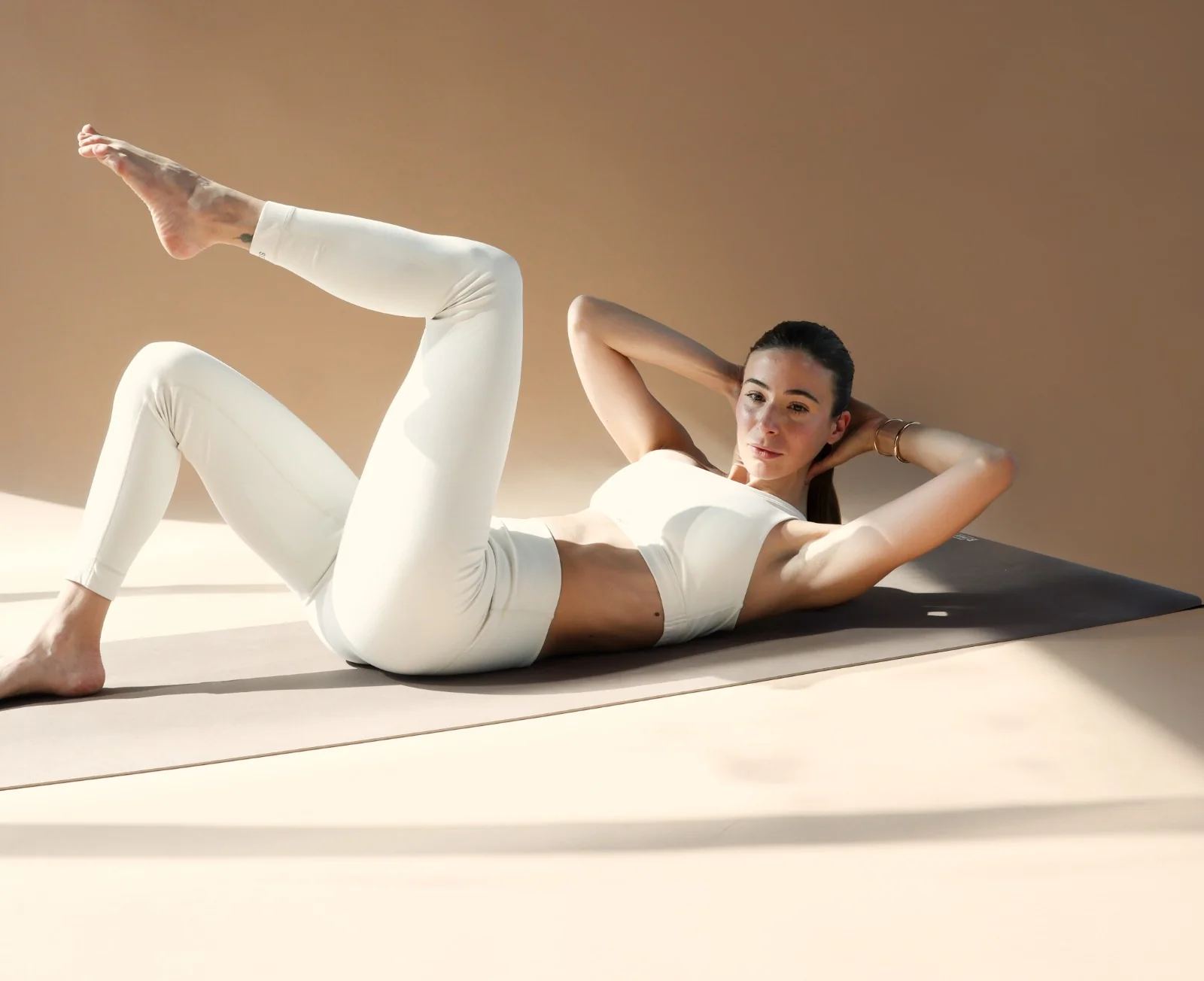
The literature is clear: cellulite appears regardless of body size and BMI. Women with a below-average BMI may have moderate to severe BMI, even eating well and exercising.
Excess weight can make it look worse, but it's not the cause. The fact that a thin woman can have her is the most direct proof that the mechanism is different: I'll explain why she also appears in a thin body in the dedicated article.
There's more, and it's counterintuitive: crash diets can make cellulite worse.
Clinical sources report this, along with hormonal changes and rapid weight changes. It's not the weight you have to move: it's the liquids the fabric holds.
Where does age appear and how much does it affect

The most affected areas, in the order reported in the literature:
- Thighs, back and side
- Buttocks
- Hips
- Abdomen
They are the areas under greatest estrogenic influence. Explain both where it appears and when: typically after puberty.
And there's one thing about age that surprises everyone.

After puberty
It appears with estrogen, in areas where fat is distributed hormonally.
After menopause
Many women report a reduction: with the drop in estrogen, fat moves towards the abdomen, away from the cellulite areas.
With the years
The skin loses elasticity, and the present one can become more noticeable. The two effects coexist.
You didn't expect that, did you?
Ethnicity
Prevalence is not uniform across populations.
Sources report a significantly higher frequency among women of European descent (85-98% in one review) than among those of East Asian descent.
The reason is traced to differences in connective tissue and subcutaneous fat distribution.
Here too: they are estimates, not censuses.
How to measure cellulite: the Nürnberger-Müller scale
"I have a lot of it," "I have little of it." That's how it's said between us.
In the clinic, no: the Nürnberger-Müller scale is used, four degrees from 0 to 3. I'll explain it to you because it helps you too, to understand where you stand.
Grade 0
Smooth skin standing, lying down and even pinching it.
Grade 1
Smooth standing and lying down. Irregularities appear only when the skin is pinched or the muscle is contracted.
Grade 2
Irregularities visible standing, but not lying down.
Grade 3
Irregularities visible both standing and lying down.
Knowing her serves two purposes. It gives you precise language. And it explains why studies don't compare well with each other: many use different scales or eye assessments, and that's one reason the numbers diverge.
How much is spent: the treatment market
And here we are at the part where the numbers become really unreliable.
I compared global cellulite treatment market estimates published by leading research firms for 2025 and 2026.
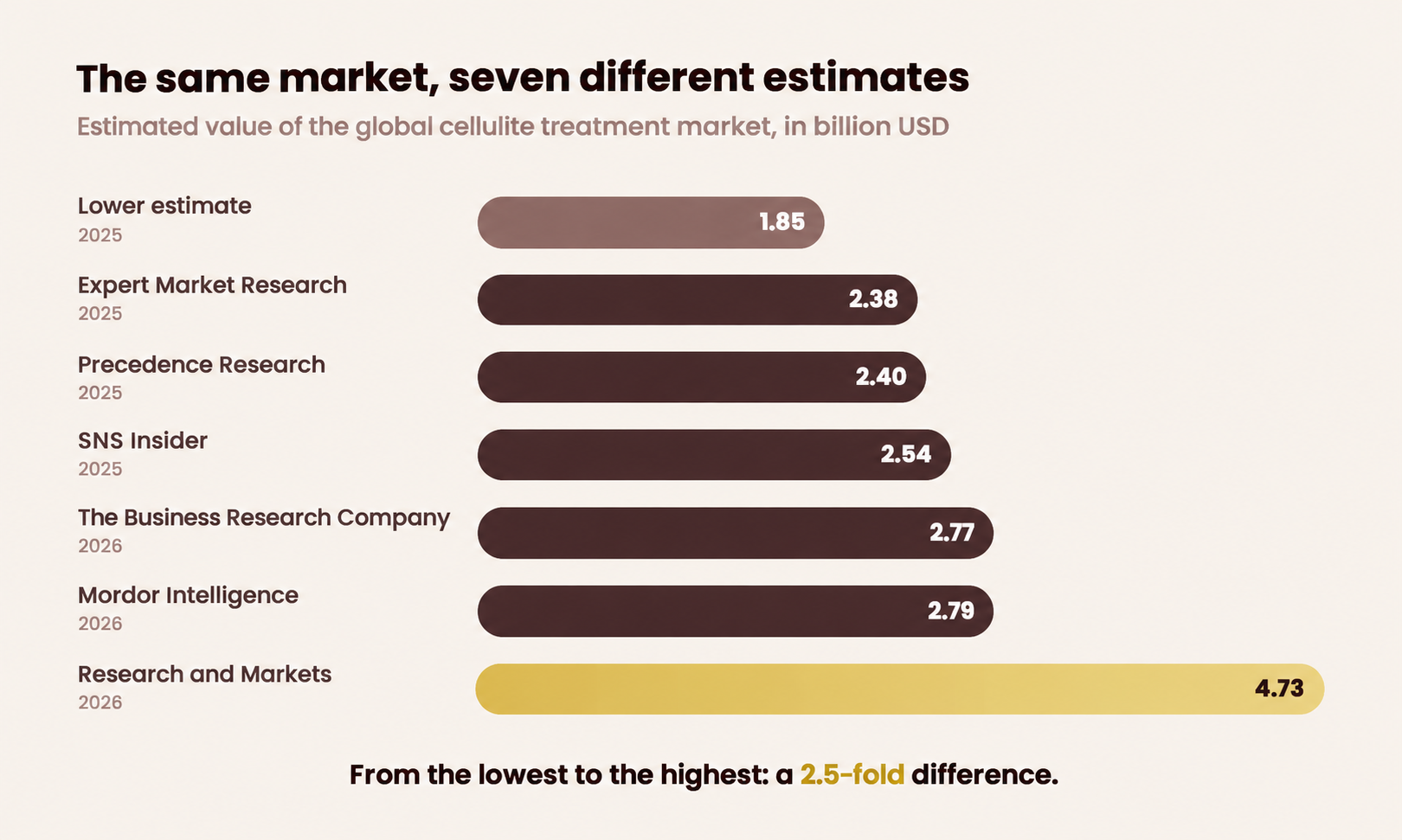
From the lowest to the highest estimate there is a difference of two and a half times, for the same market over the same period.
On growth, however, everyone agrees: about 10% per year.
And the most solid fact is the composition: non-invasive treatments are worth about 48% of the turnover, the rest is divided between minimally invasive and creams, gels and supplements.
An instructive case: a report values the same market at $634.66 billion.
If you can't verify a number on multiple independent sources, it 's not a given. Point.
The hidden statistic
I close with the most interesting absence of all this material.
All data treat cellulite as a fixed condition: you have it or you don't, grade one, two, or three.
No one measures how much her appearance varies in the same woman.
Yet any woman who has her knows that she is not identical every day. It gets worse in summer, when the heat dilates the pots. It gets worse in the evening, after hours of standing or sitting. It gets worse before your period, when your body retains more fluid.
That variability is not the structure: the septa do not change from one day to the next. It is the liquids held in the tissue, which press against the skin and make it more irregular.
It's the difference between cellulite and water retention, and water retention is the part that can be addressed most quickly. On which there is not a single published data.
I know because I lived it on my body. My septa didn't change: the amount of fluid my tissue was holding changed.
This is me, before and after Lymphatic Sculpt Pilates™.


Prevalence data come from reviews published in the dermatological literature and from clinical reference sources. Where estimates diverge, I report the range and not a single value.
Market data comes from reports from independent research firms: trade estimates, using non-public and incomparable methodologies. They should be read as orders of magnitude.
If you cite this article, I ask you to link to it and include the ranges, which is the correct way to use these numbers.
Frequently Asked Questions
How many women have cellulite?
The most commonly cited estimate in the literature indicates between 80 and 90% of women after puberty, with a range that, depending on the study, reaches 98%.
In men, the frequency is less than 10%. However, it must be said that academic sources explicitly state the absence of systematic epidemiological studies on a population basis: the data should therefore be read as an order of magnitude estimate, not as a measurement.
What is solid is that it concerns the very large majority of women.
Why don't men have cellulite?
For a structural difference in tissue, present from birth. The fibrous septa that connect the skin to the underlying layers are arranged perpendicularly in the female body and obliquely, in a mesh-like pattern, in the male body.
The perpendicular arrangement causes the fat lobules to push against the skin as the septa pull down, while the mesh arrangement distributes the pressure.
An MRI study confirmed a higher number of perpendicular septa in women with cellulitis.
Does cellulite depend on weight?
No, and this is one of the most consolidated data. The literature reports that it is observed regardless of body size and body mass index: women with below-average BMI may have moderate to severe cellulitis.
Excess weight can make it look worse, but it's not the cause. Clinical sources also report that crash diets and rapid weight changes can make it worse.
At what age does cellulite appear?
Typically after puberty, because the distribution of fat in the affected areas is influenced by estrogen.
In the post-menopausal period, however, many women report a reduction, attributed to the fact that with the estrogenic decline, fat redistributes towards the abdominal region.
However, aging reduces skin elasticity, which can make the cellulite present more evident: they are two opposite effects that coexist.
How is cellulite classified?
With the Nürnberger-Müller scale, which identifies four degrees. Grade 0: No irregularities visible under any conditions.
Grade 1: irregularities visible only by pinching the skin or contracting the muscle. Grade 2: Irregularities visible standing but not lying down.
Grade 3: irregularities visible both standing and lying down. The use of different scales across studies is one reason why prevalence data diverge.
How much is the cellulite treatment market worth?
Estimates published by major research firms for 2025 and 2026 range between $1.85 billion and $4.73 billion (Expert Market Research 2.38; Precedence Research 2.40; SNS Insider 2.54.
The Business Research Company 2.77; Mordor Intelligence 2.79; Research and Markets 4.73), with a gap of about two and a half times between the lowest and highest.
On the other hand, there is convergence on growth, around 10% per year compound. Non-invasive treatments account for approximately 48% of turnover.
These are trade estimates with non-public methodologies, to be treated as orders of magnitude.
Is cellulite more common in some ethnicities?
Yes. Sources report a significantly higher prevalence among women of European descent, with estimates of 85-98%, compared to those of East Asian descent.
The reason is traced to differences in connective tissue structure and subcutaneous fat distribution, but as with all prevalence data, these are estimates and not systematic surveys.
Is there any data on how much cellulite changes throughout the day?
No, and it is the most relevant absence in all the available literature. All data treat cellulite as a fixed condition and classify it at a specific time, while its appearance actually varies in the same person: it worsens in the summer, in the evening and in the days preceding the cycle.
That variability is not due to the structure, which does not change from one day to the next, but to the amount of fluids retained in the tissue. It is also the component on which action can be taken most quickly.
In Short
Women get cellulite because of a structural difference in the tissue that is present from birth. The fibrous bands connecting skin to the layers beneath run perpendicular to the skin in women and in a crossed lattice in men.
The perpendicular arrangement lets fat lobules push upwards against the skin while the bands pull down where they anchor. The lattice spreads that pressure instead of concentrating it.
So, it is not about weight, diet or discipline. This is why 80 to 90% of women have cellulite and under 10% of men do.
Carlotta's insights, straight to your inbox
Just your name and email, unsubscribe anytime.