
When to do Pilates: morning or evening for better drainage
The short answer: There is no single best time, because morning and evening solve two different problems. Morning clears what the night created: swelling in the upper body, face, eyelids and hands, from hours spent lying flat.
Evening clears what the day created: swelling in the lower body, legs and ankles, from twelve hours of gravity. Choose based on where you swell, not on what anyone else recommends.
If you have looked for an answer to this question, you will have found the same thing everywhere: mornings have their advantages, evenings have theirs, and in the end what matters is doing it when it suits you.
That is not wrong, but it does not help you decide anything.
And it misses the point entirely: the fluid in your body does not stay put through the day. It moves, and it moves predictably. Which means training at seven in the morning and training at nine at night are not the same thing at different times. They are two different jobs.
This article explains what the difference is, and how to choose based on what is actually happening in your body rather than on a general rule.
Morning or evening Pilates: the question is not which is better
Let’s start here, because it changes everything that follows.
Your lymphatic system has no pump of its own the way blood has the heart. Lymph moves only through two things: the contraction of the muscles around the lymphatic vessels, and the movement of the diaphragm when you breathe deeply.
Which means that when you are still, fluid is still. And the position you are still in decides where it accumulates.
Eight hours horizontal and twelve hours vertical produce two different kinds of swelling, in two different places.
So the right question is not “when is it better to train”. It is: which of the two is your problem?
How fluid moves through the day
Why you are swollen in the upper body in the morning
When you sleep you are horizontal for seven or eight hours, and gravity stops pulling downwards.
The fluid that accumulated in your legs during the day redistributes: some returns to circulation and is cleared, which is why many women get up once or twice in the night. But some of it redistributes upwards.
Which is why on waking the swelling is exactly where you would not want it: face, eyelids and hands.
Swollen hands in the morning are one of the most common and least explained signs. You wake with stiff fingers, a ring that will not turn, the feeling of needing half an hour to work them loose. You are not imagining it: that is fluid that moved there while you were lying down and has not yet returned to circulation.
The same applies to a puffy face and heavy eyelids, both of which are worse if you ate salty food, drank alcohol or slept badly the night before.
How long it lasts. It usually resolves on its own within a couple of hours of waking, simply because you are upright again and moving. The problem is that those two hours are often precisely the ones in which you have to leave the house.
Why you are swollen in the lower body in the evening
The opposite mechanism.
From the moment you get up, gravity works against lymphatic return for every hour you spend standing or sitting. And the pump that should counter it, the calf, only switches on when you walk.
Eight hours at a desk is not a neutral state: it is eight hours with the engine off while gravity keeps pulling.
The result is the evening swelling you know: heavy legs, swollen ankles, the sock mark that stays imprinted, trousers pulling behind the knee by five in the afternoon.
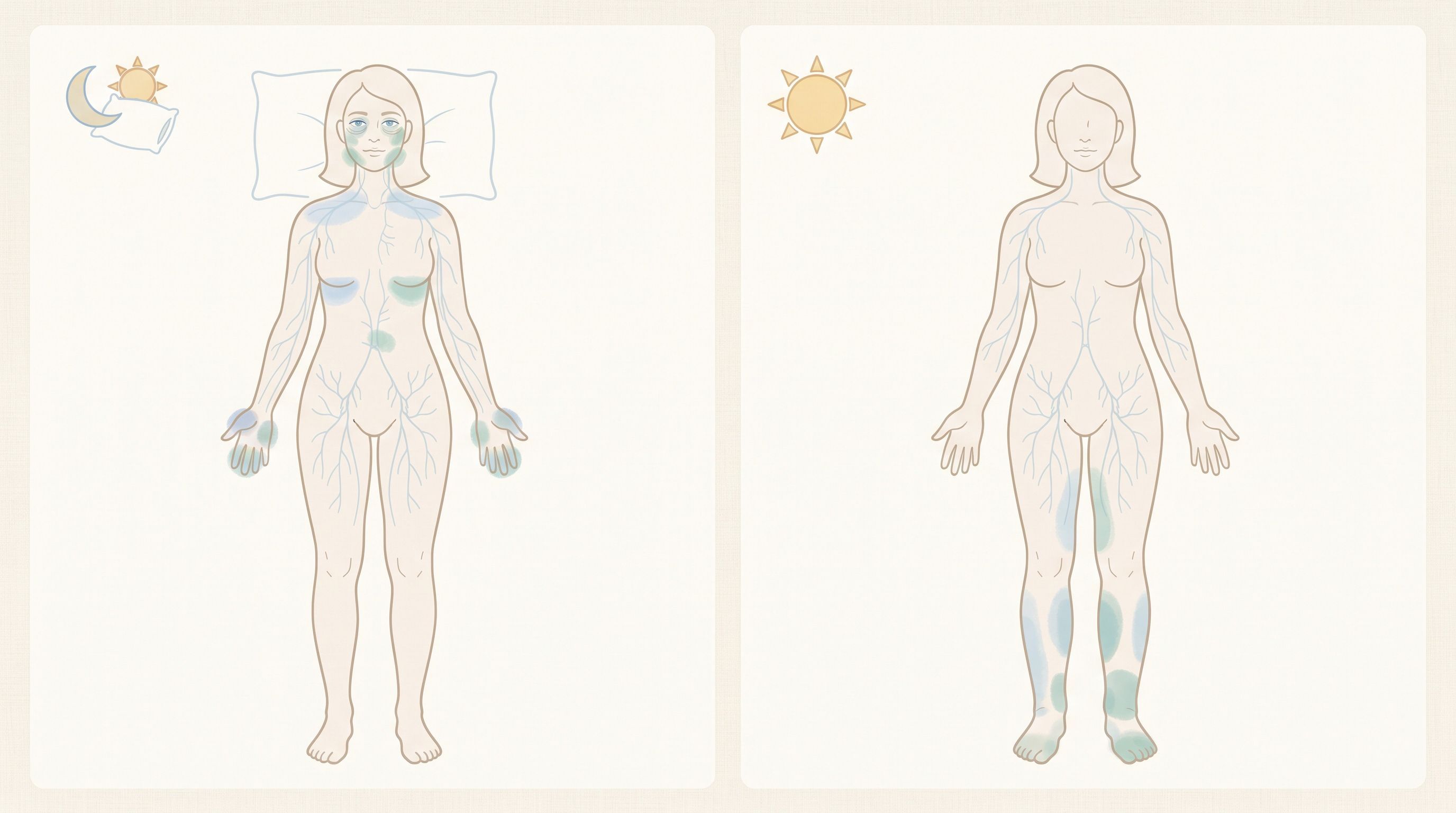
What happens while you sleep
Worth adding one thing, because it explains why sleep matters more than it seems.
Night is not only when gravity takes a break. It is also when cortisol should be at its lowest.
If you sleep badly or too little, cortisol stays elevated overnight too, and high cortisol encourages sodium and water retention. Which means a five-hour night does not just leave you tired: it leaves you more swollen.
What morning Pilates actually does

Restarting the pump after a still night
In the morning your body is coming off seven or eight hours of almost complete stillness. The muscle pump has been effectively switched off all night and lymph has moved very little.
A morning session does something quite specific: it restarts transport and clears the fluid that redistributed upwards.
Which is why facial and hand swelling resolves far faster if you move than if you wait. Waiting takes a couple of hours; moving takes considerably less.
There is also an advantage that has nothing to do with fluid: what you do in the morning is what is hardest to lose. As the day goes on, the chances of something getting in the way only increase.
Morning cortisol is not a problem
This needs clearing up, because there is a lot of confusion about it.
Cortisol has a physiological peak in the morning, in the first thirty to sixty minutes after waking. That is how it is meant to work: it wakes you up, gives you energy, gets you going.
Training in that window is not a problem and does not “add stress”. Quite the opposite: morning movement helps define that peak more sharply and helps cortisol fall more decisively across the day, which means arriving at the evening with lower levels and sleeping better.
The cortisol problem is not the morning peak. It is cortisol staying high all day because you sleep too little and live under pressure.
Who mornings work better for
- You wake with a puffy face, eyelids or swollen hands
- Your days are unpredictable and you know an evening session would get lost
- You want to use movement to regulate your circadian rhythm and sleep better
- You train better on an empty stomach or practise intermittent fasting
- You need it done so you can stop thinking about it
What evening Pilates actually does
Emptying what the day accumulated
In the evening your body is coming off twelve hours in which gravity has worked against lymphatic return, and in which, if you have a sedentary job or stand still a lot, the calf pump has barely engaged.
Fluid has accumulated in the lower body and it is sitting there.
An evening session, particularly one including inversion work with the feet above the pelvis, does exactly the job that is needed at that moment: it removes the task of climbing against gravity and empties what has built up through the day.
It is why the most-used class in my app is Light Legs in 7 minutes, done with the legs against the wall before sleep, and why anyone who tries it in the evening notices immediately.
Does training in the evening ruin your sleep?
And here we come to the part where the standard answer is wrong. Or rather, right for one kind of training and wrong for another.
The advice you always hear, do not train late because you will not sleep, comes from something real: intense evening training raises adrenaline and core body temperature, and both need hours to come back down. Running, HIIT, heavy loading, spinning: do those at nine at night and at eleven your body is still in active mode.
But that advice is about intensity, not about timing.
Low-impact work does the opposite. Deep breathing and slow, controlled movement activate the parasympathetic system, the rest and digest side. They do not raise body temperature significantly, they do not generate adrenaline, and the inversion positions have a measurable calming effect.
Which means Pilates Linfodrenante® is one of very few things that works better in the evening than in the morning, rather than worse. It does not just avoid disturbing your sleep: it prepares it.
The only caveat is to stay on the gentle work if you are training very late. An intense toning session at midnight is not the same thing as a mobility and drainage sequence.
Who evenings work better for
- You have heavy legs, swollen ankles or sock marks by the end of the day
- You spend the day sitting or standing still
- You struggle to fall asleep and want something that helps you wind down
- Mornings realistically do not exist for you
- You need a moment to draw a line under the day
Morning or evening Pilates: how to decide
Train in the morning if your problem is:
- Swollen face, eyelids or hands upon waking, as it clears away the fluid redistributed during the night
- Difficulty waking up and getting going, because it better defines the physiological cortisol peak
- Unpredictable days, because it's the only moment that isn't taken away from you
- Morning stiffness, because mobility responds immediately to movement
Train in the evening if your problem is:
- Swollen legs and ankles at the end of the day, because it empties what gravity has accumulated in twelve hours
- Difficulty falling asleep, because working hard activates the parasympathetic system and lowers the revs
You can train at both times if your problem is:
- Widespread retention, up and down, because little (short workouts) and often beats a lot and rarely
What if the only slot you have is lunchtime?
That works well, for a reason worth understanding.
Lunchtime falls in the middle of the sedentary block, which is precisely the point at which the muscle pump has been off for the longest consecutive stretch.
Breaking that block has real value: you are not just training, you are interrupting the longest period of stillness in your day.
The only caveat concerns meals. Better to train before eating, or to leave at least an hour after a light meal, because during digestion blood flow concentrates on the digestive system and training immediately afterwards is simply uncomfortable.
If you have only half an hour and also need to eat, fifteen minutes of session and twenty of lunch works better than you would expect.
What matters more than the time of day
Now the part that is worth more than everything else on this page.

Consistency beats timing, always
Drainage is maintained, not accumulated. Unlike muscle, which stays even after a break, lymph moves while you move it: the benefit lasts as long as you keep producing it.
Which leads to a very practical conclusion: the best time is the one you can actually keep to every day.
Fifteen minutes at seven in the morning, done six days out of seven, is worth far more than a perfect session at nine at night that you manage twice a week.
If you are reading this article to identify the optimal slot, the most useful answer I can give you is: choose the one that does not get skipped.

The wrong intensity cancels the advantage
The other variable that matters more than timing is what kind of training you do.
High-impact work, or work with very heavy loads, raises body temperature and generates acute inflammation. On a lymphatic system that is already struggling, it adds load rather than removing it, and it does so at any hour of the day.
If your goal is drainage, timing is the second decision. The first is the type of movement.

How to use morning and evening without training twice
You do not need to train twice a day, and I would not recommend it anyway.
What works very well instead is one real session plus a short gesture at the other end of the day.
If you train in the morning: add five to ten minutes of legs up the wall in the evening, breathing deeply. It is not a second workout, it is a position. It costs almost nothing and it empties what the day accumulated.
If you train in the evening: add two minutes in the morning. Some ankle and wrist movement while still in bed, a couple of deep breaths, and a walk however short as soon as you can. It restarts transport after the night.
That is thirty seconds of planning and it covers both kinds of swelling without doubling the commitment.
Where to start
If you have never done Pilates, start with Pilates Linfodrenante® Beginners: two months to build the foundations.
If you are short on time, Pilates Linfodrenante® Express: fifteen minutes a day, which is the format that fits into any slot.
If you already have a practice, the full 9-month programme.
And in the evening, Light Legs in 7 minutes, with your legs against the wall before sleep.
Frequently asked questions
When is the best time to do Pilates, morning or evening?
It depends on where you swell, because the two solve different problems. In the morning the swelling is in the upper body, face, eyelids and hands, because lying flat overnight redistributes fluid upwards: a morning session restarts transport and clears it.
In the evening the swelling is in the lower body, legs and ankles, because gravity has worked against lymphatic return all day: an evening session, particularly with inversion work, empties what has accumulated.
If you have no strong preference either way, the best time is the one you can be consistent with.
Why do I wake up with swollen hands?
Because overnight you are horizontal and gravity stops pulling downwards: some of the fluid that accumulated in your legs during the day redistributes upwards and settles in the face, eyelids and hands.
You wake with stiff fingers and a ring that will not turn. It usually resolves on its own within a couple of hours simply because you are upright again, but movement speeds it up considerably.
It is worse if you ate salty food, drank alcohol or slept badly the night before.
Is exercising in the evening bad for sleep?
It depends on intensity, not on timing. Intense training such as running, HIIT or heavy lifting raises adrenaline and core body temperature, and both need hours to come down: those, done late, can genuinely disturb sleep.
Low-impact work with deep breathing and slow movement does the opposite, because it activates the parasympathetic system and does not significantly raise body temperature.
Pilates Linfodrenante® is one of very few activities that works better in the evening than in the morning, and the inversion positions help you fall asleep.
Does doing Pilates in the morning raise cortisol?
Cortisol has a physiological peak in the first thirty to sixty minutes after waking: that is how it should work, it wakes you and gives you energy.
Training in that window is not a problem and actually helps define the peak more sharply, so cortisol falls more decisively across the day and you reach the evening with lower levels.
Cortisol becomes a problem when it stays high all day through poor sleep and chronic stress, not because of a morning workout.
Is it better to do Pilates before or after breakfast?
Both work and the difference is more about comfort than results. Many women prefer an empty stomach, feeling lighter and not having to wait for digestion, and for anyone practising intermittent fasting it is the natural choice.
If you train after breakfast, leave at least an hour, or forty-five minutes if you ate lightly. The thing to avoid is training straight after a large meal.
How long before bed should you exercise?
For intense training, at least two to three hours, because adrenaline and body temperature need time to come down.
For low-impact work such as a mobility or drainage sequence, no margin is needed: you can do it immediately before bed and it actually helps you fall asleep.
Legs up the wall is an excellent last thing to do in the day.
Can you do Pilates at lunchtime?
Yes, and it is a better choice than it looks, because it breaks the longest block of stillness in your day right in the middle.
The muscle pump restarts at midday rather than only in the evening. The only caveat concerns meals: better to train before eating, or to leave at least an hour after a light meal.
Does training twice a day drain more?
It is not necessary and I would not recommend it. What works very well instead is one real session plus a short gesture at the other end of the day: if you train in the morning, five to ten minutes of legs up the wall in the evening; if you train in the evening, two minutes of ankle movement and a few deep breaths on waking. You cover both kinds of swelling without doubling the commitment.
In short
There is no single best time, because morning and evening do two different jobs.
Morning clears the swelling the night created, the one in the upper body: face, eyelids, hands.
Evening clears the swelling the day created, the one in the lower body: legs and ankles.
Choose based on where you swell. And if you swell in both places, choose based on when you can be consistent, because drainage is maintained rather than accumulated: the perfect slot you skip three times a week is worth less than the imperfect one you always keep.
The best time is the one that does not get skipped.
