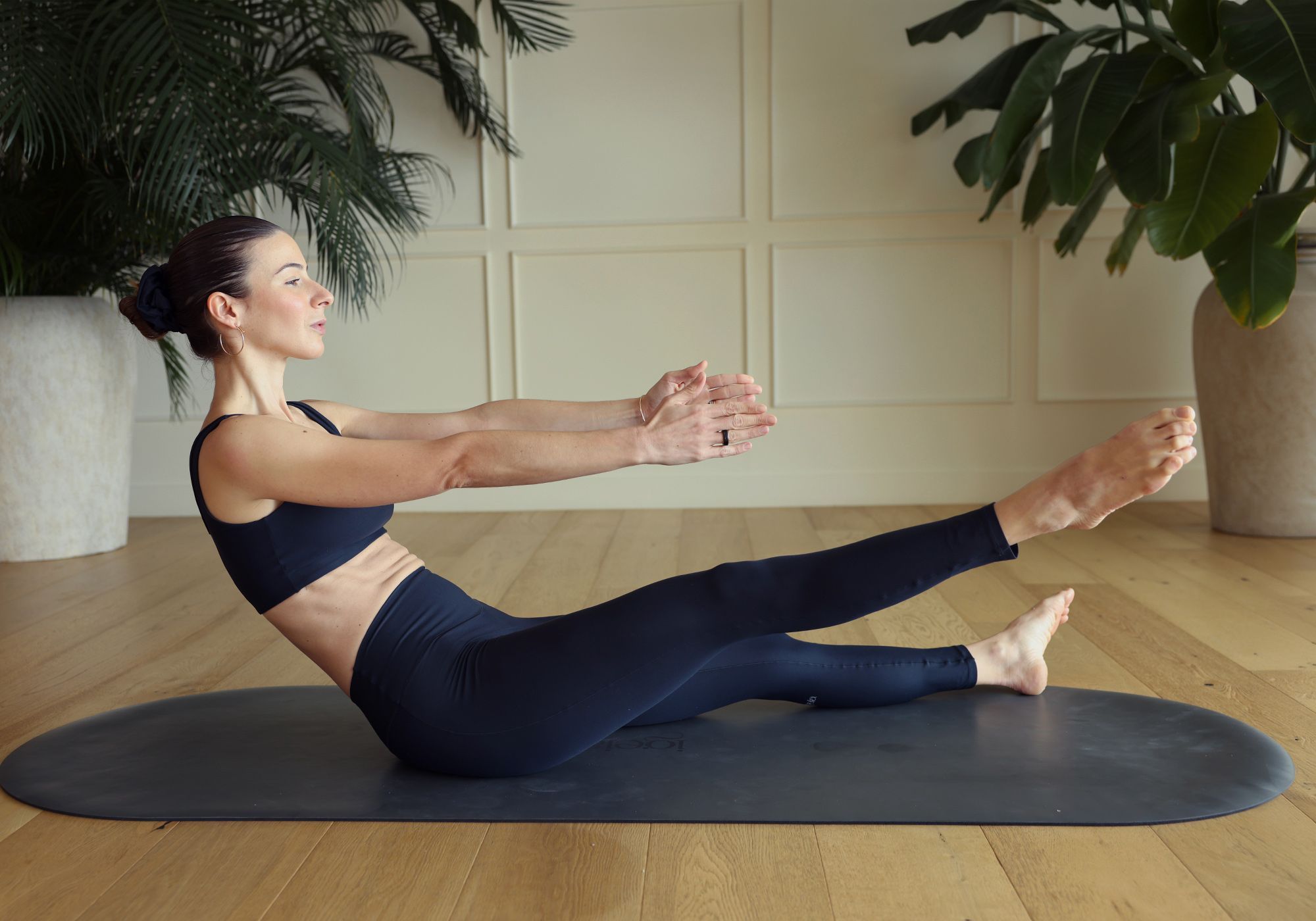
Mat Pilates: what it is and why the method starts on the floor
In short: Mat Pilates is Pilates performed with your own body weight on a mat, without machines. The resistance is your weight plus gravity, which makes it less assisted and in several ways harder than working on equipment. In Pilates Linfodrenante® the mat is not a cheaper version of the Reformer: it is the surface the method needs, because much of the work is done on the floor and in inversion, with the feet higher than the pelvis.
If you have started looking into Pilates, you have probably come across the same scene two or three times: an article explaining the difference between mat and Reformer that ends, more or less politely, by telling you the Reformer is the serious option.
Before we get there, I want you to look at who writes those articles.
We will come back to it. Let’s start with the basics.
What mat Pilates is
Mat Pilates is Pilates performed with your own body weight, on a mat, without machines.
It is the original form of the method. Joseph Pilates developed the floor repertoire first, and only afterwards built the machines, largely to help people who, through injury or weakness, could not perform that repertoire unassisted.
That detail matters more than it sounds, and we will come back to it too.
In a mat session the resistance comes from two things only: your body weight and gravity. Nothing supports you and nothing corrects you. You do the stabilising.
Matwork, mat Pilates, floor Pilates: the same thing
A quick note to save you some confusion, because there is a lot of it about.
Mat Pilates, matwork, floor Pilates and bodyweight Pilates all describe the same thing. Matwork is simply the work done on the mat.
They are not different variants of the method, and they are not different difficulty levels. They are the same training called four different names.
Mat or Reformer: what actually changes
This is the question everyone asks, so it deserves a proper answer: what each one does, rather than declaring a winner.

What the Reformer does
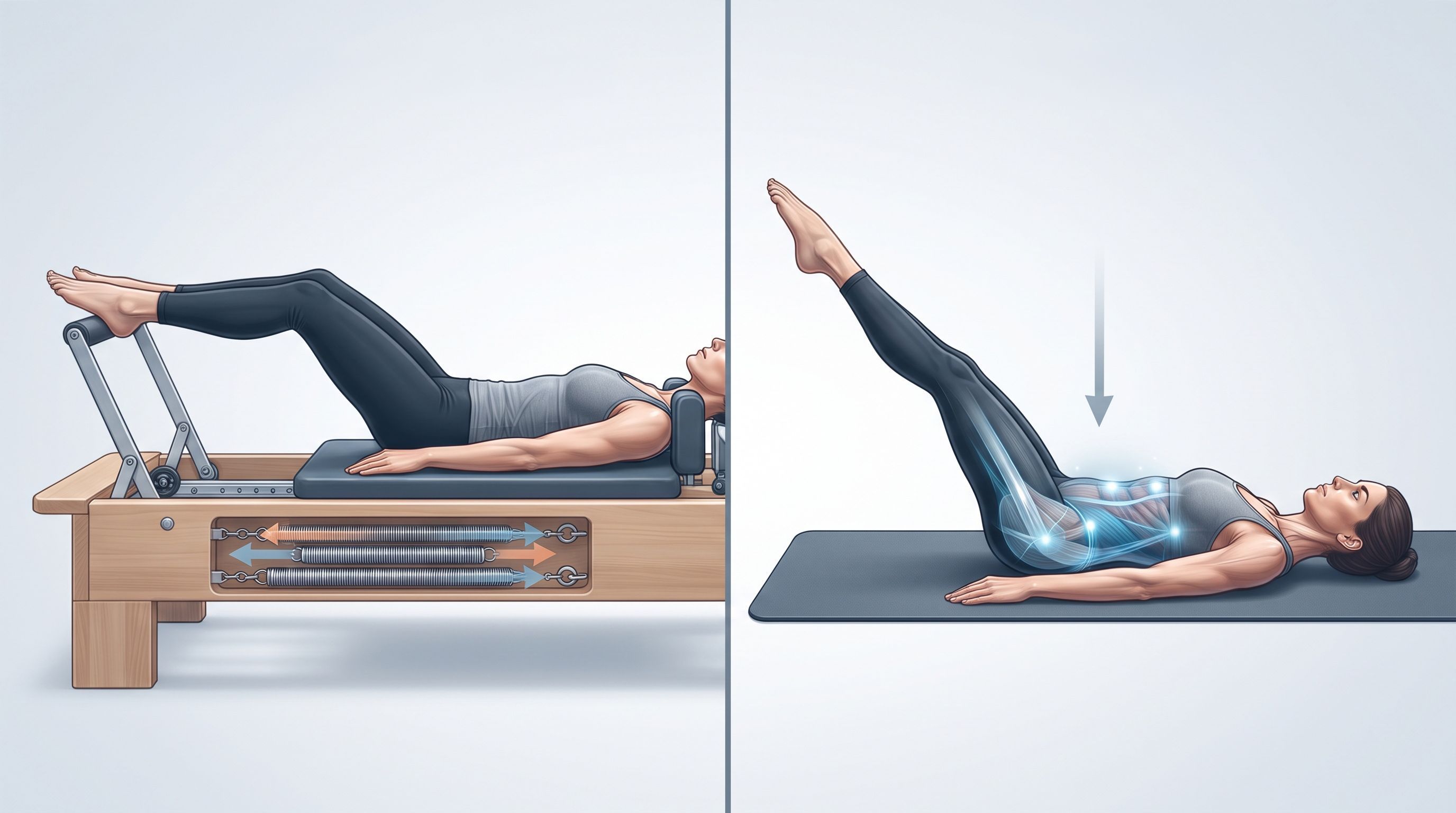
The Reformer is a piece of equipment made up of a carriage running on rails, connected to a frame by a set of springs.
The thing almost nobody explains properly is that those springs can do two opposite jobs.
They can resist, in which case they add load: you push against a resistance your body alone would not provide.
But they can also assist, in which case they make a movement easier than it would be on the floor. It is why the Reformer is an excellent tool in rehabilitation, for anyone with mobility limitations, for anyone starting from a position of weakness, or where progressive loading needs to be applied precisely.
The carriage also gives immediate feedback: if you are not stable, it moves. That is genuinely useful.
The Reformer is a serious piece of equipment and it does things you cannot do on the floor. I have no argument with any of that.
What the mat does
On the mat there is neither added resistance nor assistance. There is gravity, which is constant, and there is you.
Which means two things.
The first is that the stabilising is entirely yours. No carriage tells you when your alignment is going, and no spring holds you. You have to produce, with your deep muscles, the stability that equipment otherwise supplies from outside.
The second is that the load cannot be reduced. On a Reformer you can lighten a spring. On the mat your body weight is what it is, and gravity does not negotiate.
Why almost everyone gives the same answer
Now back to the question we opened with: who writes the articles you have been reading?
Look at what comes up when you search mat versus Reformer. In the overwhelming majority of cases it is Pilates studios that have invested in Reformers and need to fill those classes, or companies that sell the machines.
That is not dishonesty. It is that when you have a studio full of equipment to pay off, or a catalogue to sell, the conclusion tends to write itself.
We sell no equipment. Which leaves us free to say something you rarely hear in this market:
For a great many people, and a great many goals, the mat is not the fallback. It is the better choice.
And for the method I teach, as you will see shortly, it is not even a choice.
Why bodyweight work is harder than it looks
There is a widespread assumption that mat is the beginner level and the Reformer is the advanced one.
In practice it is often the other way round.
A beginner on a Reformer with light springs finds several movements easier than on the floor, because the spring is helping her. That is precisely why Joseph Pilates built those machines: to make a repertoire that was too difficult on the floor accessible to weakened bodies.
The full classical mat repertoire is considered advanced by any trained instructor. Exercises like the teaser or the jackknife require control you cannot improvise.
So the question is not which is harder in absolute terms, but where the difficulty sits.
On the Reformer it is adjusted from outside: change the spring, change the load.
On the mat it is modulated from inside, by changing the lever, the range of movement or the number of repetitions. It is finer work, and it requires you to learn to read your own body rather than adjust a machine.
The benefits of mat Pilates
What you actually get from working on the floor.
Active deep muscles
Mat work targets the transverse abdominis, the pelvic floor, the gluteus medius, the multifidus and the scapular stabilisers. These are the muscles you do not see in the mirror and that decide your posture.
Better posture
Not as a side effect but as a direct goal. When the pelvis aligns and the rib cage sits back over it, the outline of the body changes before body composition has changed at all.
Control and proprioception.
Having to stabilise yourself, you learn where your body is in space. That is a skill you take off the mat, into how you lift the shopping or get out of bed.
Joint mobility
Floor work lets you isolate movement very precisely, moving one part of the spine while stabilising the rest.
Strength without heavy loading
Slow controlled contractions, isometric resistance, body weight. You build muscle without raising body temperature much and without generating the acute inflammation that comes with high-intensity training.
Sustainability
And this is the least mentioned and most important benefit: training you can do at home, without equipment and without appointments, is training you actually do. Everything else is good intentions.
Why Pilates Linfodrenante® starts on the mat
Now we come to the part specific to the method I created, because in our case the mat is not a preference and it is not about cost.
It is a mechanical constraint: on a Reformer, much of what we do could not be done.
Here is why, point by point.

The inversion work
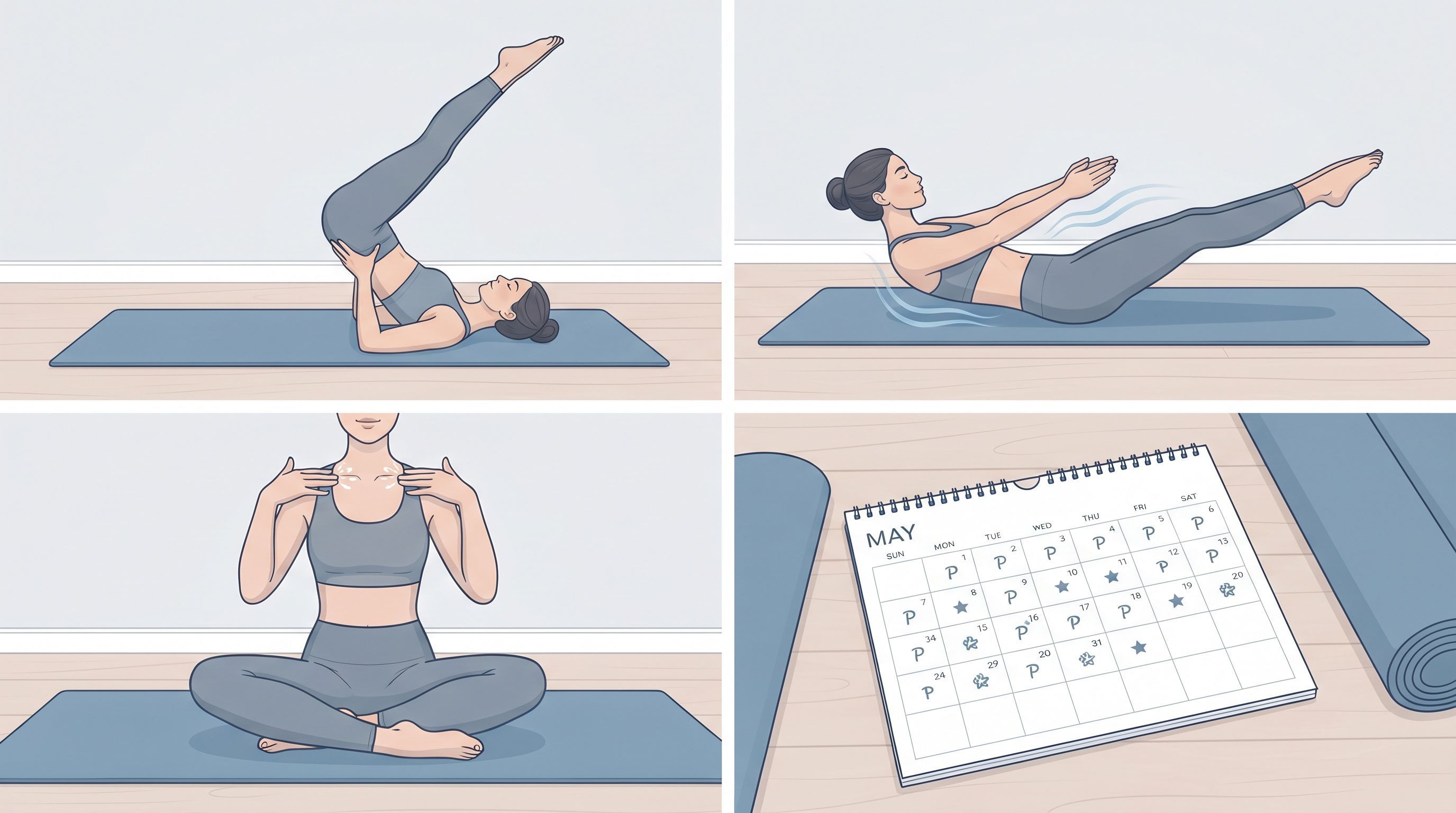
A significant part of Pilates Linfodrenante® is performed with the feet higher than the pelvis.
That is not a stylistic choice. Lymph leaving the legs has to travel all the way up to the base of the neck, against gravity, without a pump of its own the way blood has the heart. Putting the feet up removes gravity as an obstacle and turns it into help.
It is the principle behind the most-used class in my app, Light Legs in 7 minutes, done with the legs resting against the wall before sleep.
On a carriage running on rails, with a footbar at one end, that work cannot be reproduced. It needs a stable surface and a wall.

Breathing prescribed movement by movement
In Pilates Linfodrenante® I tell you exactly when to inhale and when to exhale, exercise by exercise.
The reason is that the thoracic duct, the largest lymphatic vessel in the body, passes through the diaphragm: every deep breath pumps it, drawing lymph up from the lower body. Without that coordination you have engaged one pump out of two.
Doing it requires your attention to be on the breath. On a Reformer part of your attention is managing the carriage, which is excellent when stability is the goal, but here it competes with what we are after.

Opening the lymphatic stations
Every session begins by activating the six lymphatic stations, the points where lymph is filtered before it moves on: the base of the neck, the armpits, the groin, behind the knees, the abdomen.
It is two minutes of work done on the floor, before the workout itself begins, and it puts the body in a state to drain while it trains.

Daily frequency
This is the decisive point, and it is worth more than the other three together.
Drainage is maintained, not accumulated. Muscle stays even if you stop for two weeks. Lymph does not: it moves while you move it, and the benefit lasts as long as you keep producing it.
Which means fifteen minutes every day is worth more than an hour and a half twice a week, because in the first case the pump comes on seven days out of seven and in the second, two.
Now picture that frequency on a machine. It means a studio, a class subscription, fixed times and travel, or buying a piece of equipment that costs as much as a major appliance and takes up half a room.
The mat means you do it tonight.
And if you do not have a mat
More common a question than you would think, and the short answer is that you carry on anyway.
A mat does two things: it protects your spine and knees from hard surfaces, and it stops you slipping. On a soft rug or a firm bed much of the work is still possible, bearing in mind that a surface that gives too much makes deep muscle work less stable.
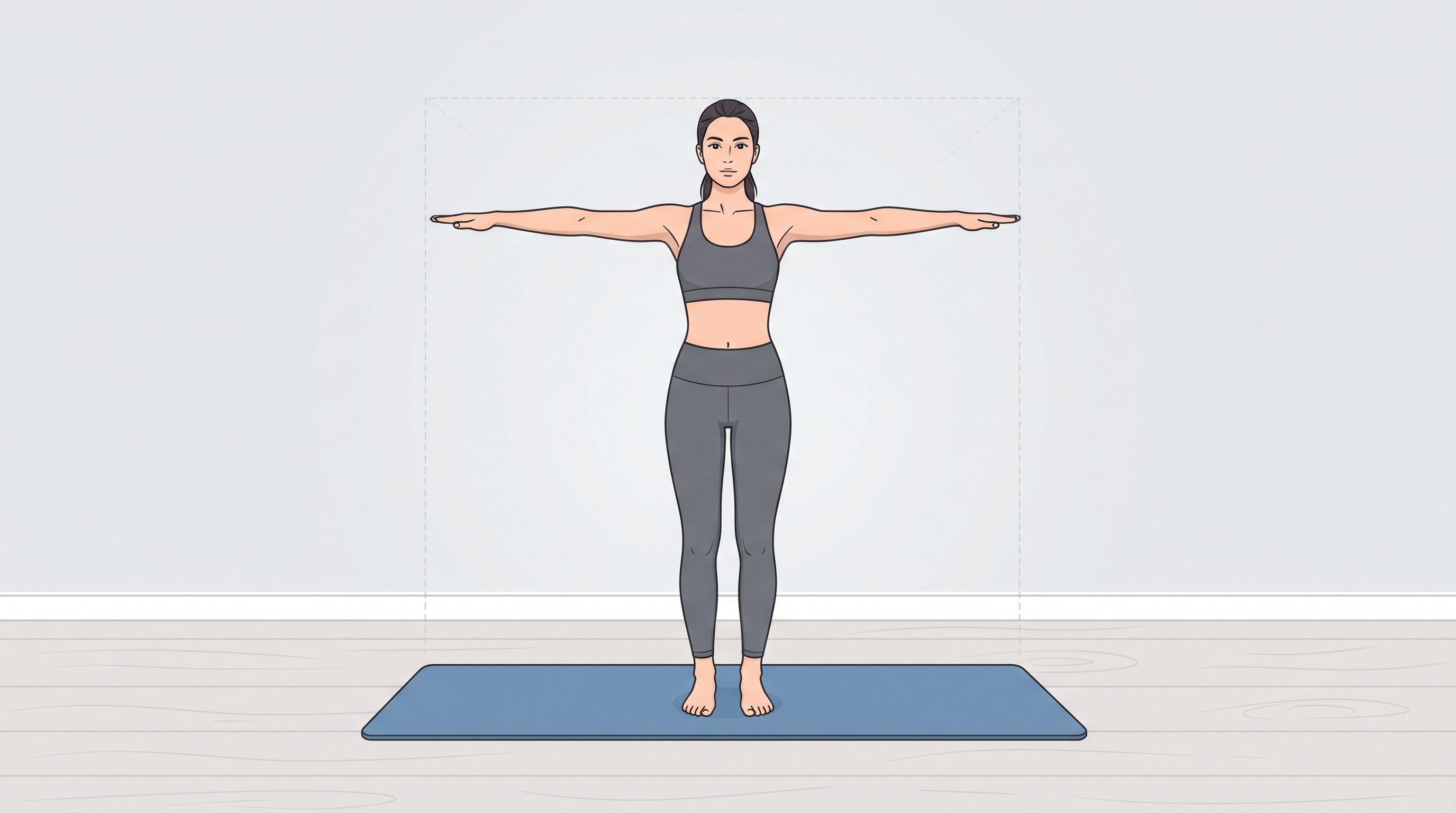
If you are travelling or short on space, the app has a no-mat section: standing sessions designed to be done anywhere, in a hotel room or a corner of the house. You need enough room to open your arms into a T, and nothing else.
Where to start
If you have never done Pilates, start with Pilates Linfodrenante® Beginners: two months to build the foundations, learn the breathing and activate the deep muscles without asking too much of the body at once.
If you already have a practice, the full 9-month programme works on toning and drainage together.
If time is your obstacle, Pilates Linfodrenante® Express: fifteen minutes a day.
You need a mat. Some classes use a ball or a resistance band, and in the no-mat section you do not even need that.
Frequently asked questions
What is mat Pilates?
It is Pilates performed with your own body weight on a mat, without machines. The resistance comes from body weight and gravity, and the stabilising is entirely down to the person doing it, with no equipment assisting or correcting.
It is the original form of the method: Joseph Pilates developed the floor repertoire first and built the machines afterwards, largely to make that repertoire accessible to people who could not perform it unassisted.
What is the difference between mat Pilates and Reformer?
On a Reformer a spring system can either add resistance or provide assistance, and the carriage gives immediate feedback on stability. On the mat there is neither: there is gravity, and the stabilising is all yours.
The Reformer is particularly useful in rehabilitation, with mobility limitations, and where progressive loading needs precision. Mat work develops more autonomous control and can be practised anywhere, every day.
Is mat Pilates easier than the Reformer?
Not necessarily, and often the opposite. Reformer springs can assist the movement, making exercises accessible that would be difficult on the floor, which is exactly why the machines were built.
The full classical mat repertoire is considered advanced. The real difference is that on a Reformer difficulty is adjusted externally by changing springs, while on the mat it is modulated internally through lever, range and repetitions.
Mat or Reformer: which should I choose?
It depends on your goal and your starting point. The Reformer makes sense in rehabilitation, with significant joint limitations, or where you need precisely modulated progressive loading.
Mat work makes sense if you are after control, posture, mobility and drainage, and particularly if you need a sustainable daily practice without travel or appointments.
Worth noting that most of the content available online on this comparison is produced by studios offering Reformer classes or by companies selling the machines.
What are the benefits of mat Pilates?
Activation of the deep muscles, particularly the transverse abdominis, pelvic floor, gluteus medius and scapular stabilisers. Improved posture and alignment.
Greater control and proprioception, because the stabilising is autonomous. Joint mobility, thanks to the ability to isolate movement precisely.
Strength built without heavy loading and without generating acute inflammation. And sustainability over time, which is the least cited benefit and the one that determines results.
Why is Pilates Linfodrenante® done on the mat?
For mechanical reasons, not cost. A significant part of the method is performed with the feet higher than the pelvis, to assist lymphatic return, and that work needs a stable surface and a wall.
The breathing is prescribed movement by movement and requires your attention to be on the breath rather than on managing a carriage.
Every session opens by activating the lymphatic stations on the floor. And drainage needs daily frequency, which a mat makes possible and equipment does not.
Can beginners do mat Pilates at home?
Yes, and it is how most people start. You need a mat and room to open your arms. The one thing that matters is starting with a programme designed for beginners rather than the level that sounds more serious: the foundations built in the first two months are the reason everything else works, and they substantially reduce the chance of giving up in the early weeks.
How much space do you need for mat Pilates?
The space of a mat plus room to open your arms. If you can stand and stretch your arms into a T without touching anything, you have enough.
In short
Mat Pilates is bodyweight Pilates, and it is the original form of the method. It is not the beginner level: it is work where the stabilising is entirely yours and the load cannot be lightened.
The Reformer is a serious piece of equipment that does things the floor cannot, and in rehabilitation or with significant limitations it is the right choice. But it is worth remembering who writes almost everything you read about this comparison.
In Pilates Linfodrenante® the mat is not the cheaper alternative: it is the surface the method works on, because the inversion work, the guided breathing and the daily frequency need that and not a machine.
If you want to try it, you need a mat and fifteen minutes.
