How long does it take to see results from Pilates? Why bloating goes before tone
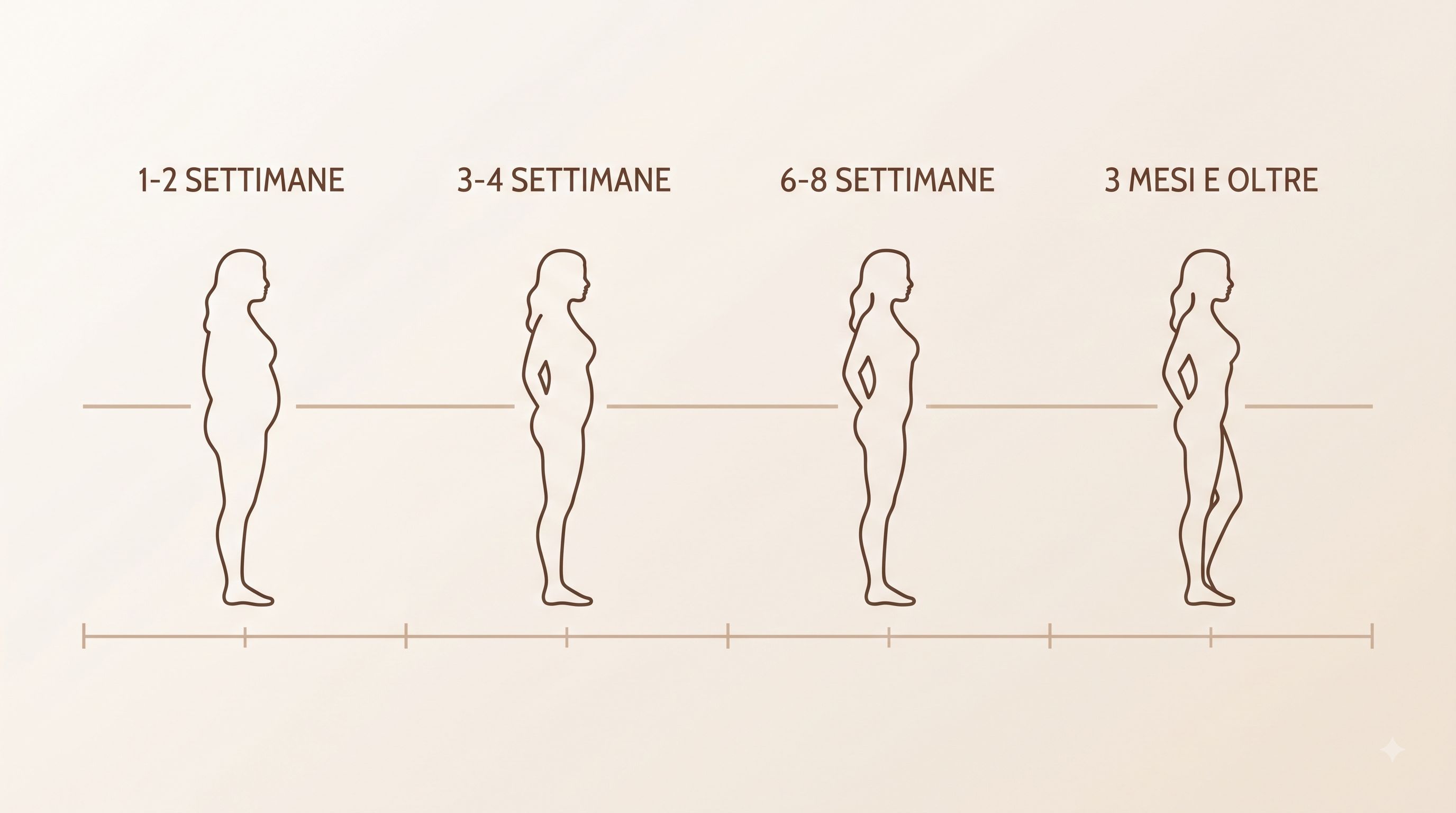
The short answer: with three to four sessions a week, less bloating and lighter legs arrive within one to two weeks. The first visible muscle tone appears between weeks three and four. A clear change in photographs generally comes between weeks six and eight. Lasting reshaping takes three months and beyond.
The order is always the same, and it is not random. Fluid moves first because shifting something that is already there is quick. Tone comes second because building tissue takes time. Skin changes last because it rests on what is underneath it.
Which means there is a stretch, roughly between weeks two and four, where you feel a great deal and see almost nothing. That is not a sign it is failing. It is the phase that everything else is built on.
Why the order is what it is
There is one sentence that explains all of it: the first result is a displacement, the second is a construction.
Reducing swelling means moving fluid that is already in your body. Nothing new has to be produced: it just has to get back into circulation. That is transport, and transport is fast.
Increasing tone means changing muscle tissue. That requires protein synthesis, adaptations the body puts in place over time, and enough accumulated change to alter the outline of your body.
Building takes longer than moving. It always does.
The four phases at a glance

Fluid
When : Days, 1-2 weeks
What happens : Drainage is reactivated, swelling goes down, legs feel lighter.

Neural adaptation
When : 2-4 weeks
What happens : Your body learns to recruit deep muscles. You're more stable, but not yet more toned.

Visible tone
When : 6-8 weeks
What happens : The muscle changes enough to be visible. The clothes change, the shape changes.

Remodelling
When : From 3 months onwards
What happens : Posture, proportions, and composition settle. This is what remains.
If you are in phase two and judging yourself by the standards of phase three, you are giving yourself a hard time for no reason.
Why fluid moves before muscle
Worth going into properly, because once you understand the mechanism you stop expecting the wrong thing at the wrong time.
How fast fluid drainage is
The fluid causing the swelling sits in the spaces between your cells. It is already there, already in your body: the problem is not that there is too much of it in absolute terms, it is that it cannot get back into circulation.
And the reason it cannot is that the lymphatic system has no pump of its own the way blood has the heart. Lymph moves only through the contraction of the muscles around the lymphatic vessels and the movement of the diaphragm when you breathe deeply.
Which means something very practical: the moment you start moving, transport restarts.
There is no adaptation period. Nothing has to be built. The first session already moves fluid, and so does the second.
It is why the feeling of lighter legs can arrive within days, and why after an evening with your legs up the wall you get up different from how you lay down.
How long muscle takes to adapt
Here it changes completely, and there is an intermediate stage almost nobody mentions.
In the first two or three weeks of training you get stronger without getting more toned.
That sounds like a contradiction and it is not. The first adaptations to training are neural: the nervous system learns to recruit more muscle fibres, to coordinate them better, to activate the right muscles at the right moment. The muscle works better, but it has not yet changed structurally.
In Pilates Linfodrenante® this phase is especially pronounced, because we work heavily on the deep muscles, the ones most people never recruit at all: the transverse abdominis, the pelvic floor, the gluteus medius, the scapular stabilisers.
In those first weeks your body is literally learning to use them. It is real work, it is the foundation of everything that follows, and it does not show.
The structural change in muscle, the one that alters the outline of your body, generally takes six to eight weeks to become visible. Before that it is happening, but below the threshold at which the eye picks it up.
Why skin changes last
Skin is last for two reasons that compound.
The first is that skin rests on what is underneath it. If there is toned muscle underneath, the surface has support and the profile changes. So the improvement in skin appearance is largely a consequence of the previous phase rather than a process of its own: it arrives later because it depends on something that arrives earlier.
The second is that collagen turnover in the dermis is slow. Very slow. It is measured in months and years, not weeks. There is no way to accelerate it, and anyone promising otherwise is selling you something.
The good part is that there is also an immediate component: less fluid in the tissue means less pressure against the skin, so a smoother surface as early as phase one. But that is an effect of phase one, not the skin having changed.
Week by week: what to expect
These are the averages we see with women training three or four times a week. They are not a promise and they do not apply identically to everyone, but this is the pattern that repeats most often.

Weeks 1 and 2: lightness first
The lymphatic system restarts. Legs feel lighter, particularly in the evening. The mark from your sock elastic is less pronounced. Abdominal bloating changes less between morning and evening.
Many women also notice better sleep, which is not a coincidence: deep breathing and controlled movement activate the parasympathetic system.
What you will not see: essentially nothing in a photograph. And that is exactly right.
Weeks 3 and 4: less retention, first tone
Fluid retention drops more steadily, not just after a session. Clothes start to change: trousers that pulled at the waist by evening now fasten more easily.
The first muscle tone appears, particularly where the deep muscles were most dormant: the abdomen and the glutes.
This is the phase where most women give up. Because the change is real but still below the threshold of what the mirror shows, and the scale has probably not moved.
Weeks 6 to 8: skin and shape
This is when most women take their first photograph and genuinely notice.
Skin looks smoother, the appearance of cellulite improves, the body is visibly more toned. Posture has changed enough to alter the outline: the rib cage sits back over the pelvis and the stomach protrudes less even without any fat being lost.
3 months onwards: remodelling
The changes become structural. The core is stronger, posture has settled, proportions have changed.
This is the phase where the result stops being something you are working towards and becomes simply how your body is now.
The first month in detail: what you feel before you see
This list is the most useful thing on this page, because these are all real things that happen before there is anything to photograph.
- Lighter legs in the evening, particularly after a day sitting
- The sock mark less pronounced
- Less abdominal bloating by the end of the day, with less difference between how you look in the morning and how you look at night
- Rings turning again on days when they previously would not
- Better sleep, and often falling asleep faster
- The sensation of the deep muscles switching on, which feels strange at first and then becomes familiar
- More awareness of your posture, including off the mat: you notice how you are sitting
- Less stiffness on waking
None of these show in a photograph. All of them are signals that the mechanism is working.
If you are judging the early weeks with your eyes alone, you are using the wrong instrument for the phase you are in.
If it feels like it is not working
That said, there are cases where something genuinely is not right. Before concluding the method is not for you, four things are worth checking.
Frequency
The first to look at, and the most common.
Drainage is maintained, not accumulated. Unlike muscle, which stays even after a break, lymph moves while you move it: the benefit lasts as long as you keep producing it.
Which means two weeks on and three weeks off does not give you half a result. It gives you a result that resets every time and starts again.
Three or four sessions a week, or fifteen minutes daily, is the threshold below which it is hard to see anything.
Hydration, sleep and stress
Three things that look like side issues and are not.
Drinking too little makes lymph thicker and harder to move, and pushes your body to hold on to the fluid it has rather than letting it go.
Sleeping too little keeps cortisol high all day instead of letting it fall, and high cortisol encourages retention and fat storage.
Chronic stress does the same thing by the same route.
You can train perfectly well and see far smaller results than you deserve simply because you sleep six hours.

Where you are in your cycle
In the week before your period your body physiologically holds more fluid, and a swing of one or two kilos is normal.
Which means comparing a pre-period day with a post-period one tells you nothing. It only makes you feel bad for no reason.
If you measure or photograph yourself, always do it at the same point in your cycle, month against month.

You are watching the wrong signal
And the fourth, which is the most common of all.
If your only instrument is the scale, you will see nothing in phase two, because in phase two weight is not what is changing.
In fact your weight can stay identical while your shape changes, because you are losing fluid and building muscle at the same time. Two opposite movements that cancel out on the scale and do not cancel out in the mirror.
What affects the timeline
The averages are averages, and these are the variables that shift them.
- Your starting point. Anyone with a lot of fluid retention experiences phase one far more dramatically, simply because there is more fluid to move. Anyone with little will feel less difference at first and see more of phase two.
- Frequency, which weighs most.
- Continuity. Three consecutive months are worth far more than six months done intermittently, for the same reason as above: drainage is maintained.
- Whether you have trained before. Anyone who has previously had muscle regains it faster than someone starting from nothing builds it.
- Age and hormonal phase. In menopause muscular adaptation is slower and retention tends to be more constant. It does not change the direction, it changes the pace.
- Sleep, stress and nutrition, for the reasons above.
- Time of year. In summer heat dilates the vessels and increases filtration: the same person swells more in July than in February, all else being equal.
How to track progress without the scale
Since the scale is the wrong instrument in the early phases, you need other reference points.
- A tape measure, every four weeks. Waist, hips, thigh, arm. Always at the same time, first thing in the morning.
- Your clothes. The most honest measure there is, and the one women notice first.
- Photographs, every four weeks, always in the same conditions. The full protocol for taking them so they are genuinely comparable is in the transformations article.
- How you feel. Energy, sleep quality, heaviness in the legs. Write two lines once a month: rereading them six months later is the most surprising part of all.
And if you weigh yourself, always do it at the same point in your cycle.
What Pilates Linfodrenante® does in each phase
Worth closing the loop, because the method is built around exactly this order.
In the fluid phase
The work comes from opening the lymphatic stations at the start of each session, from the breathing prescribed movement by movement that makes the diaphragm the second pump, and from the inversion sequences with the feet above the pelvis.
In the neural adaptation phase
The work comes from precision: slow controlled contractions on the deep muscles, which is how the nervous system learns to recruit them.
In the tone phase
It comes from the weekly progression of the programmes, which increases load gradually without ever moving to heavy loading.
In the remodelling phase
Everything works together, plus posture, which changes the outline of the body even with body composition unchanged.
And across all four, the characteristic that holds it together: it can be done every day. With no heavy loading you accumulate neither inflammation nor stress, so daily frequency is sustainable. And since phase one is maintained rather than accumulated, frequency determines everything else.
Where to start
If you have never done Pilates, start with Pilates Linfodrenante® Beginners: two months to build the foundations, which is precisely phase two done properly.
If you already have a practice, the full 9-month programme carries you through all four phases.
If time is your obstacle, Pilates Linfodrenante® Express: fifteen minutes a day.
And in the evening, Light Legs in 7 minutes, which is the fastest way to feel phase one.
Frequently asked questions
How long does it take to see results from Pilates?
It depends which result. Reduced swelling is often felt within one to two weeks, because fluid only needs moving and nothing has to be built.
The first visible muscle tone appears between weeks three and four, a clear change in photographs between weeks six and eight, and lasting remodelling from three months onwards.
The order is always the same because it follows physiology: moving fluid is faster than building tissue.
Why does bloating go before tone?
Because they are two different kinds of process. Reducing swelling means moving fluid that is already in your body, returning it to circulation through the lymphatic system: that is transport, and it restarts the moment you begin moving.
Increasing tone means changing muscle tissue, which requires neural adaptations first, then structural change, and finally enough accumulated change to be visible. Building takes longer than moving.
Why am I not seeing results after three weeks of Pilates?
Because week three falls in the phase where the body is learning to recruit the deep muscles, a neural adaptation that is real work but not yet visible.
In that phase the signals are different: lighter legs in the evening, less swelling, clothes changing at the waist, better sleep, more awareness of posture. If you are judging only with your eyes or with the scale, you are using the wrong instrument for the phase you are in.
What is the difference between debloating and toning?
Debloating means reducing fluid sitting in the spaces between cells, and it concerns the lymphatic system. Toning means increasing the quality and quantity of muscle tissue, and it concerns adaptation to training.
They respond to different stimuli and on different timelines: the first is measured in days and weeks, the second in weeks and months. They can also cancel each other out on the scale, because losing fluid and gaining muscle move in opposite directions.
Can your body change shape without your weight changing?
Yes, and it is what happens most often in the early weeks. If you lose fluid and build muscle at the same time, the scale stays still while your shape changes.
On top of that, muscle takes up less space than fat for the same weight, and different posture alters the outline of the body without altering its composition. It is why a tape measure and your clothes are more reliable instruments than the scale.
How often should you do Pilates to see results?
Three to four times a week, or fifteen minutes every day. Below that threshold it is hard to see anything, and the reason is that drainage is maintained rather than accumulated: the benefit lasts as long as you keep producing it.
An on-and-off rhythm does not produce half a result, it produces a result that restarts from zero each time.
Why is the scale not moving even though I am training?
Because two things change in the early weeks that cancel out on the scale: you lose fluid and you build muscle.
On top of that, weight fluctuates physiologically with your cycle, and a swing of one or two kilos in the days before your period is entirely normal.
Which is why, if you weigh yourself, it makes sense to do it at the same point in your cycle, month against month, and to use a tape measure and photographs alongside it.
How long before skin improves?
It is the last change and it has two components. An immediate one, from reduced fluid in the tissue, which lowers the pressure against the skin and makes the surface smoother within the first weeks.
And a slow one, linked to the support the underlying muscle gives the skin and to collagen turnover in the dermis, which is measured in months. A clear improvement generally arrives between weeks six and eight and continues afterwards.
In short
Results arrive in a fixed order, always the same, and that order does not depend on you.
Fluid first, because moving something that is already there is quick. Tone second, because building takes time. Skin last, because it depends on what is underneath it.
Which means there is a phase, roughly between weeks two and four, where you feel a great deal and see very little. That is not a phase where it is failing: it is the phase where your body is learning to recruit the muscles that will later change your shape.
It is also the phase where most women stop. Knowing that it is coming is the thing that separates the women who reach month three from the women who start again next year.
If you are in week three and wondering whether it is working, the most likely answer is yes.
