Lymphatic drainage: what it is, how it works and how often to do it
In short: Lymphatic drainage is not a single technique, it is a category: it covers manual massage performed by a therapist, mechanical drainage such as pressotherapy, and drainage through movement. They all work, but the question that matters is not which is most powerful. It is which one you can do often enough, because drainage is maintained rather than accumulated and the benefit lasts only as long as you keep producing it.
If you have searched for lymphatic drainage, you will have noticed that the term covers several very different things.
A massage at a spa. A session with a physiotherapist in a clinical setting. A machine that inflates sleeves around your legs. A self-massage video. And also what I do.
They are all real and all different, with different costs, different indications and different results.
This article sorts it out: what it actually is, how the system you are trying to help actually works, what the three routes are, and above all how often it needs doing, which is the question almost nobody addresses and the one that decides the result more than any other.
What lymphatic drainage is
Lymphatic drainage is any intervention that helps lymph move through the lymphatic system.
It is not one technique. It is a category.
The purpose is always the same: to help fluid that is sitting in the spaces between cells get back into circulation, so the body can clear it rather than holding it in the tissues.
Lymphatic drainage, lymphatic drainage massage, MLD: what the terms mean
There is a lot of confusion here, so let’s settle it.
- Lymphatic drainage is the broadest term and refers to the outcome, moving the lymph, however you achieve it. It covers everything below.
- Lymphatic drainage massage is more specific and refers to the hands-on treatment performed by a therapist.
- Manual lymphatic drainage, or MLD, is the correct technical term in a clinical setting, and refers to codified protocols such as the Vodder, Leduc or Földi methods.
So, to summarise: every lymphatic drainage massage is lymphatic drainage, but not all lymphatic drainage is a massage.
That distinction sounds pedantic and is actually the most useful thing on this page, because most people searching for lymphatic drainage are picturing a massage by default, and therefore never consider the other two routes. Which happen to be the ones you can do every day.
What lymphatic drainage is not
Worth being clear, because a considerable amount of marketing has grown up around this word.
- It is not a detox. Lymph does not remove toxins in the sense the wellness industry means. Clearing waste products is the job of the liver and kidneys, which manage perfectly well on their own. Lymph does something different and equally important: it collects excess fluid from between the cells, along with proteins and immune cells, and returns it to the blood.
- It is not weight loss. Draining means moving fluid, not reducing fat. If the scale drops after a treatment, that is water, and it will come back.
- It is not a deep tissue massage. It is the opposite, and this is the most common misunderstanding of all. We will come back to it, because it deserves the space.
- It is not a cure for lymphatic disease. In lymphoedema, for example, manual drainage forms part of a wider clinical pathway under medical supervision, alongside bandaging and compression. It is not an alternative to it.
How the lymphatic system works
Two pieces of information, and they are all you need for the rest.

First, what lymph is
Blood reaches your tissues through very fine capillaries, and at that level some of the fluid it carries leaks out into the spaces between cells.
Most of it returns into the venous capillaries, but a proportion stays behind. That proportion is lymph, and to get back into circulation it has to take another route: the lymphatic system.
Every day your body produces several litres of fluid that has to return that way.

Second, and this is what explains everything: lymph has no pump
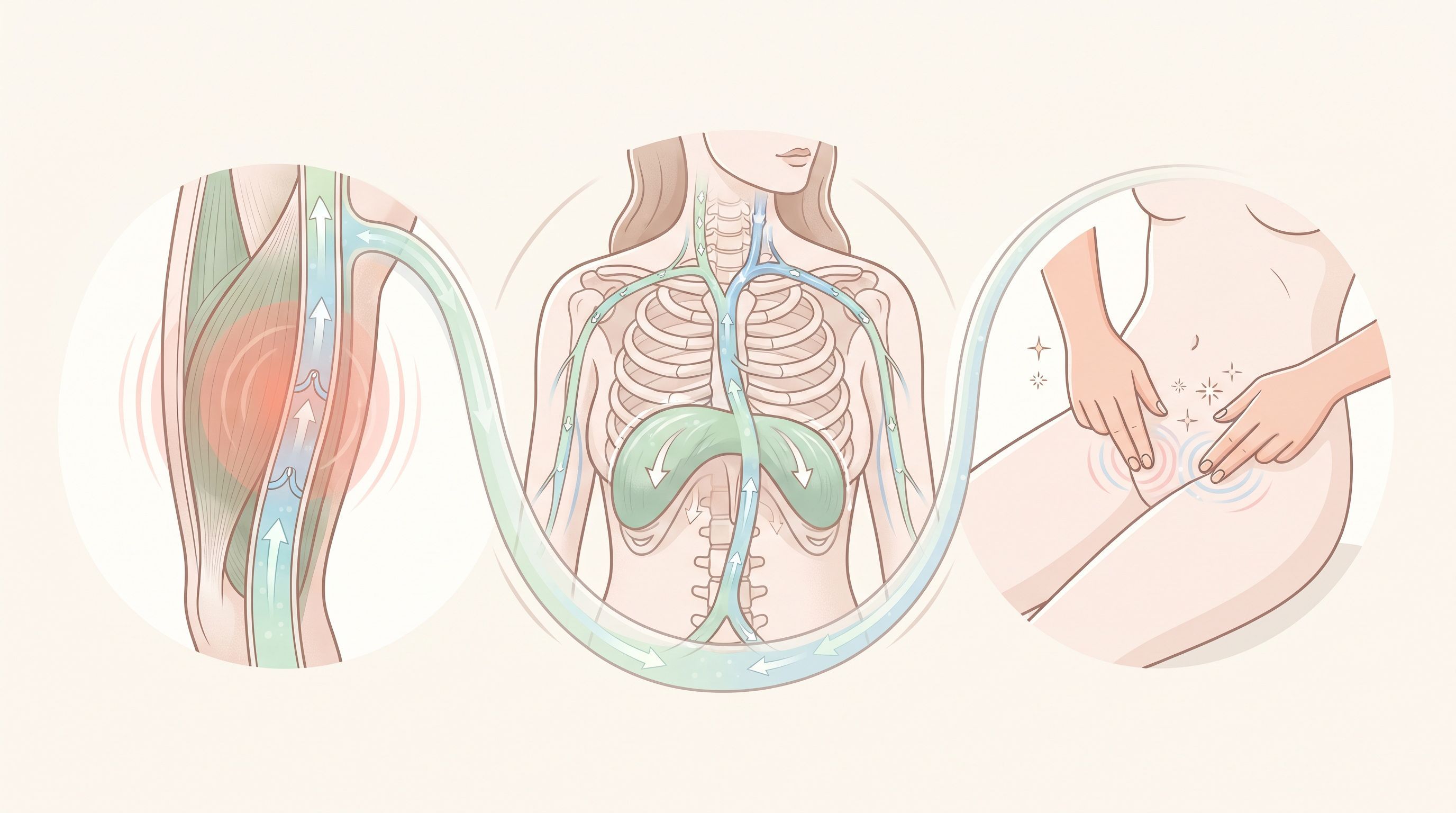
Blood has the heart, beating all day. The lymphatic system has nothing equivalent: lymphatic vessels have a very weak contractile ability of their own, but on its own it is not enough.
Lymph moves through three external forces, and they are precisely the three routes this article is about:
- Muscle contraction around the lymphatic vessels, compressing them and pushing fluid forward, with one-way valves preventing it falling back
- The movement of the diaphragm, because the thoracic duct, the largest lymphatic vessel in the body, passes through it: every deep breath creates a draw that pulls lymph upwards
- External compression, whether from a therapist’s hands, a pressure sleeve or a compression stocking
If you remember one sentence from this article, remember this one: your lymphatic system works when you make it work.
What lymphatic drainage is for
It depends a great deal on the context, and it is worth separating two worlds that often get confused.
In a clinical setting, manual lymphatic drainage has precise and recognised indications: primary and secondary lymphoedema, recovery after certain surgical procedures where it is prescribed, some post-traumatic conditions. In these cases it is part of a complete therapeutic pathway that also includes compression and exercise, managed by a healthcare professional.
In a non-clinical setting, which is the great majority of cases, it is used for ordinary water retention, heavy legs, swelling that varies across the day, that sense of heaviness.
Here there is no disease to treat: there is a system working less well than it could, almost always because we move it too little.
How far lymphatic drainage goes
And here is something almost nobody says.
Drainage acts on fluid. Not on fat, not on the structure of the tissue, not on muscle mass.
Which means it is very effective on swelling, retention and heaviness, and that its effect on the appearance of cellulite is real but indirect: less fluid in the tissue means less pressure against the skin and therefore a smoother surface, but the underlying structure stays as it is.
It also means that if you are expecting to lose weight, you are expecting the wrong thing.
The three routes to lymphatic drainage
Now the practical part. Three routes, all effective, all different.
Lymphatic drainage massage
This is the route almost everyone has in mind when they search for lymphatic drainage, so it is worth explaining properly.
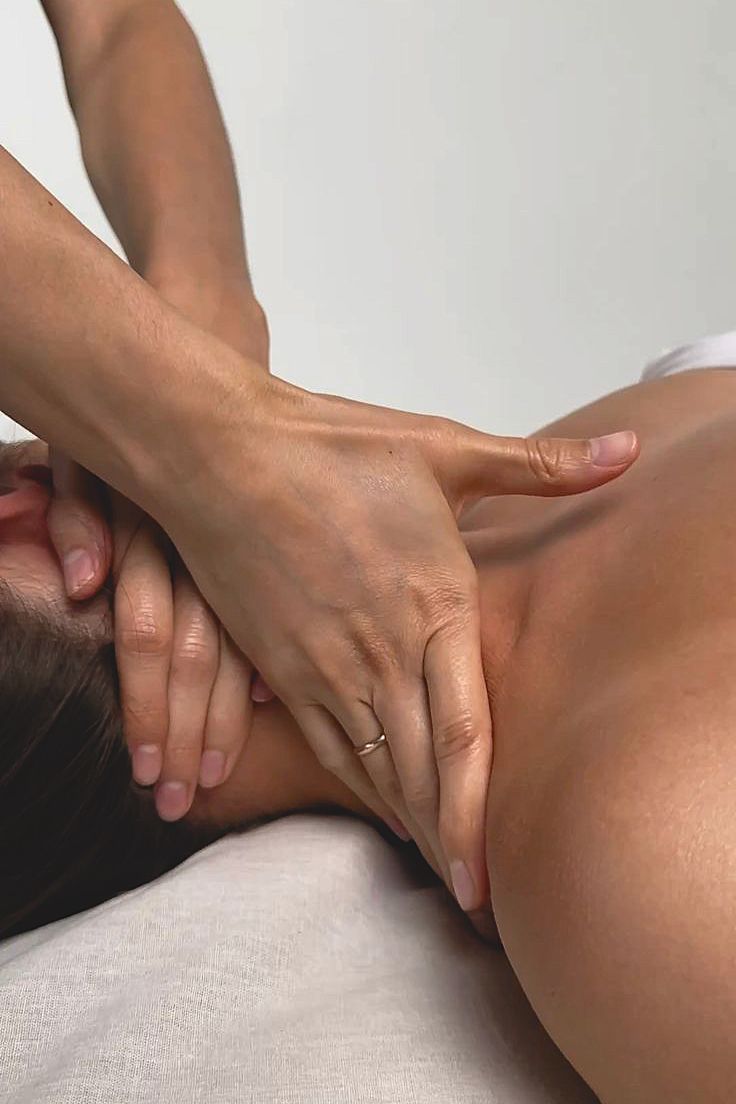
What it is. A treatment performed by a trained therapist, with slow, rhythmic, repeated strokes following the anatomical direction of lymphatic flow. It always begins at the lymph node stations to clear the route upstream, and only then works on the area being drained: it is like clearing the exit before pushing the traffic towards it.
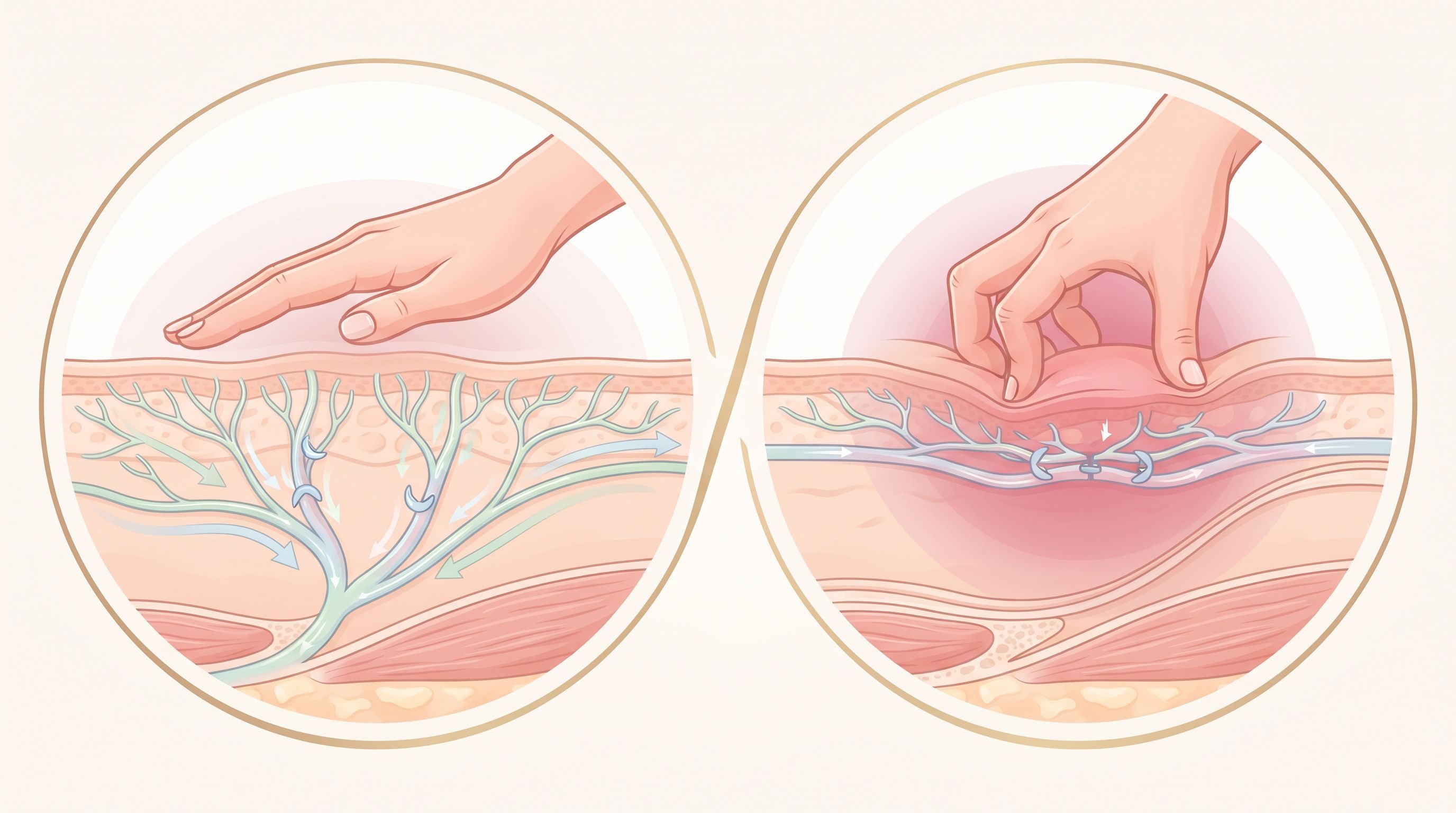
The most important thing to know: the pressure is extremely light.
This is the most widespread misconception there is. The superficial lymphatic vessels sit just under the skin, a few millimetres deep. Heavy pressure flattens them rather than helping them.
Which means that a vigorous massage, one that leaves bruises or hurts, is not a lymphatic drainage massage. It is a different kind of massage, which will have its own effects, but not that one.
If you come out of a session thinking “that was far too gentle, I barely felt anything”, it was in all likelihood done properly. If you come out aching, it was something else.
- Who performs it. In a clinical setting, a physiotherapist with specific MLD training. In a spa or beauty setting, a trained massage therapist. The difference in training is real and worth asking about: the codified methods are principally Vodder, Leduc and Földi, and anyone who has studied them will tell you without hesitation.
- What a session is like. Usually forty to sixty minutes. The strokes are slow and repetitive, and a lot of people fall asleep. It is normal to need to pass urine more in the following hours: that is the fluid that has returned to circulation and that your kidneys are clearing.
- When it is the right choice. In a clinical setting, where there is a diagnosis and a professional running the pathway. And as a periodic addition when you can afford it, because it is an effective and genuinely pleasant treatment.
- The limitation, which is practical rather than technical. It costs per session and requires an appointment. Which means that for most people it is not something done daily for years. The technique is excellent: it is the achievable frequency that is the constraint, and shortly we will see why that is the decisive point.
- And self-massage? The same principles can be applied yourself, with light pressure and always starting from the lymph node stations. You cannot reach everywhere and the technique needs learning, but for legs, abdomen and face it works and it is free. There is a full evening routine in the article on legs.
Mechanical drainage
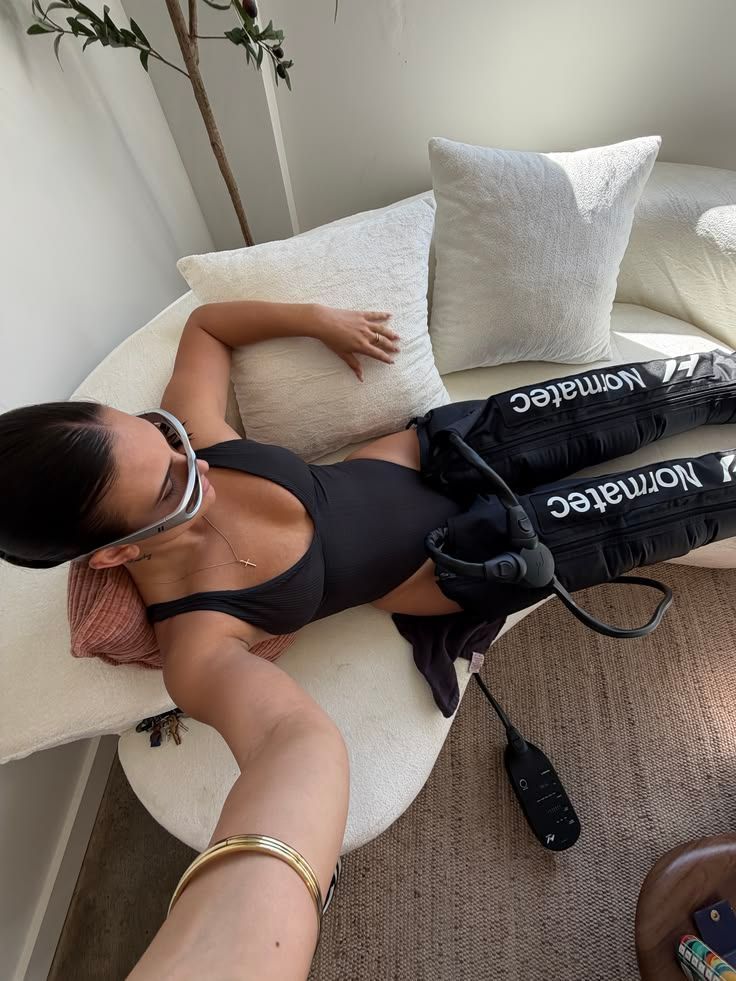
Sleeves or wraps connected to a machine that inflates and deflates air chambers in sequence, compressing the limbs from the bottom upwards. The most common form is pressotherapy.
When it is the right choice: where consistent, prolonged compression is needed, particularly on the legs, and where it forms part of a defined programme.
The limitation: it works on the limbs, and you are still during the treatment. Which means there is no muscle contraction and no breathing work, so two of the three forces that move lymph stay switched off. And you either pay per session or buy the device.

Drainage through movement
And here we come to the one that changes things in everyday life.
Movement is the only route that engages both of the body’s natural pumps together: muscle contraction and the diaphragm.
It is the only free one, the only one that needs no appointment, and the only one that also builds muscle, which in turn makes the pump more efficient over time.
But not all movement works the same way.

Movement that drains well is low impact, involves many muscle groups, alternates positions including ones where the feet are above the pelvis, and above all is coordinated with deep breathing. Without the breath, you have engaged one pump out of two.
Movement that drains badly is high impact, heavily loaded, or raises body temperature considerably, because it adds acute inflammation to a system already struggling.
How often should you do lymphatic drainage?
This is the question in the title, and it is where everything is decided.
The short answer is that it depends on the route you choose. But the useful answer is a different one, and getting there requires understanding one thing.
Drainage is maintained, not accumulated.
Muscle accumulates. Train for six months, stop for two weeks, and the muscle is still there.
Lymph does not. It moves while you move it. The benefit of a session, a workout or a self-massage lasts as long as you keep producing it. It is not a reserve you build up, it is a state you maintain.
Which leads to a counterintuitive but solid conclusion: little and often beats a lot, rarely.
Look at the two scenarios.
An intensive treatment once a week: the pump comes on one day out of seven. On the other six, fluid sits.
Fifteen minutes of movement every day: the pump comes on seven days out of seven. Drainage never stops.
The second scenario costs less time in total, costs less money, and produces a better result on swelling.
So, in practice:
Lymphatic drainage massage follows the guidance of whoever performs it. In a clinical setting the protocols are defined and can include intensive phases. Outside that, it is generally done in courses, and rather than the cost of a single session the number that matters is the cost of the course, because an isolated session produces a temporary effect.
Mechanical drainage is done in courses, according to how it has been set up.
Self-massage and movement can be done daily, and that is in fact when they pay back most.
So the right question is not “how often should I do lymphatic drainage”. It is: which of these routes can I sustain often enough to maintain the result?
And the best combination of all, if you can afford it, is daily movement plus periodic sessions. They are complementary rather than alternatives.
When not to do lymphatic drainage
Drainage is generally safe, but there are situations where it should be avoided or done only on medical advice.
- Acute infection in progress, with fever: the lymphatic system is working on the immune response
- Inflammation or infection of the skin in the area: risk of spread
- Suspected or active deep vein thrombosis: serious risk, urgent evaluation required.
- Uncompensated heart failure: Increasing fluid return to the heart can be dangerous
- Renal failure: fluid load must be managed clinically
- Active tumors: must be evaluated on a case-by-case basis with the oncologist
- Pregnancy: Many things can be done, but adjustments and the gynecologist's approval are required.
And regardless of drainage, some swellings should be seen rather than treated: those that appear suddenly, those on one leg especially with pain or heat, those accompanied by shortness of breath, and those that don't improve at all after a night's rest.
Lymphatic drainage in Pilates Linfodrenante®
By now it will be clear why I built the method the way I did.
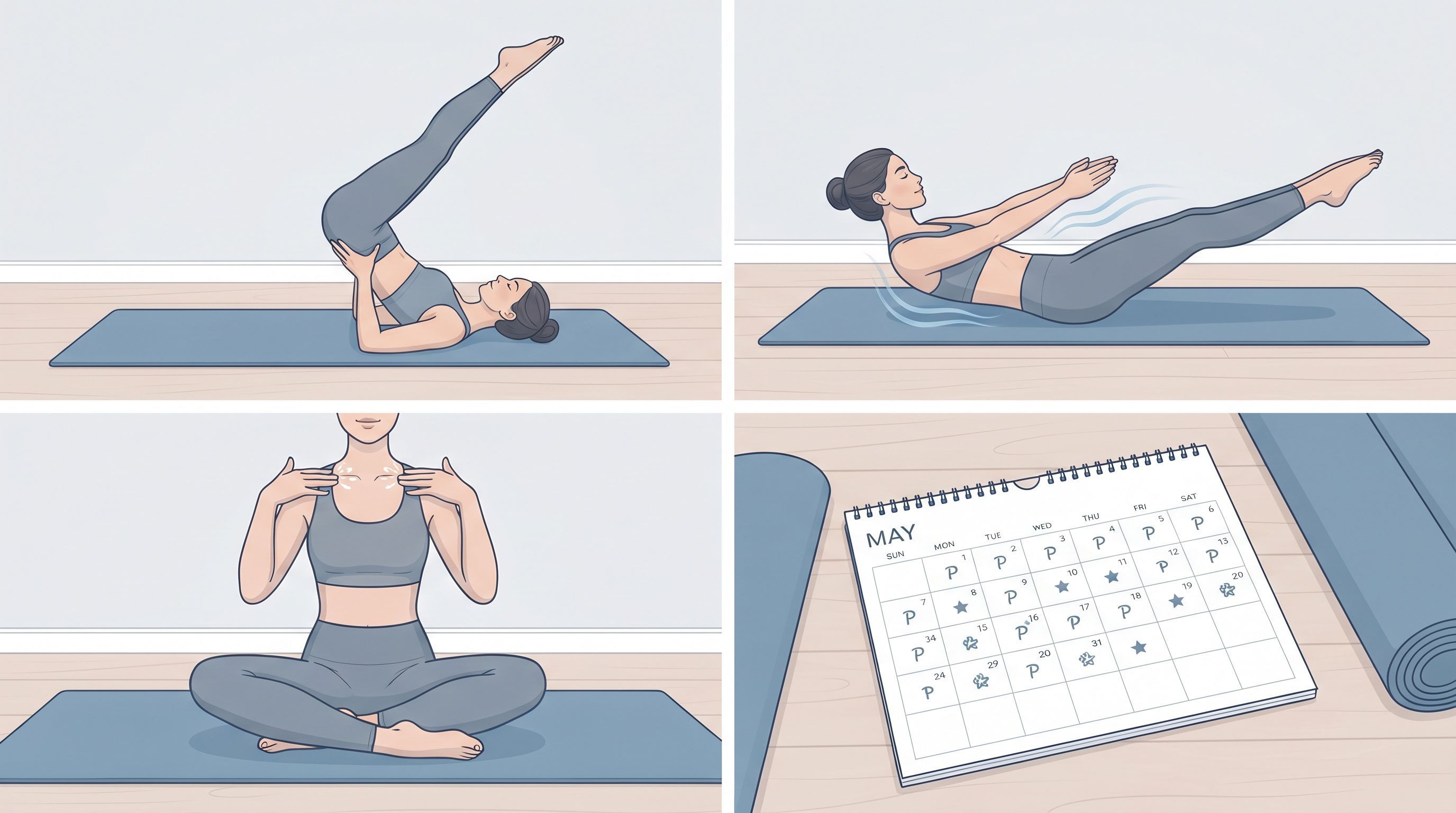
Pilates Linfodrenante® takes the principle of drainage and puts it inside a workout rather than inside a treatment. Which solves precisely the frequency problem.

Every session opens by activating the lymphatic stations
The same six points a properly performed lymphatic drainage massage starts from: base of the neck, armpits, groin, behind the knees, abdomen.
They clear the route before pushing fluid towards it, which is why it is not a generic warm-up but already useful work.
Every movement is paired with prescribed breathing
I tell you exactly when to inhale and when to exhale, exercise by exercise, because the diaphragm is the second pump and without that coordination only one is working. With it, every single repetition does two jobs at once.
The sequences alternate standing work with inversions
Feet above the pelvis, so gravity works with you rather than against you.
And it can be done every day
Because it uses no heavy loading and does not raise body temperature, so it accumulates neither inflammation nor stress.
It does not replace lymphatic drainage massage where a clinical pathway is needed. It is the daily, active version of the same principle, one you can afford in both time and money for the rest of your life.
Where to start
If you have never done Pilates, start with Pilates Linfodrenante® Beginners: two months to build the foundations.
If you already have a practice, the full 9-month programme works on drainage and tone together.
If time is your obstacle, Pilates Linfodrenante® Express: fifteen minutes a day.
And in the evening, Light Legs in 7 minutes, with your legs against the wall before sleep.
Frequently asked questions
What is lymphatic drainage?
It is any intervention that helps lymph move, meaning the fluid that accumulates in the spaces between cells and needs to return to circulation.
It is not one specific technique but a category covering manual massage performed by a therapist, mechanical drainage such as pressotherapy, self-massage and movement.
The purpose is always the same: to help a system that, unlike blood, has no central pump and depends on muscle contraction, the movement of the diaphragm and external compression.
What is the difference between lymphatic drainage and lymphatic drainage massage?
Lymphatic drainage is the broader term and refers to the outcome, moving the lymph, by whatever means. Lymphatic drainage massage is specific and refers to the hands-on treatment.
Manual lymphatic drainage, or MLD, is the technical term in a clinical setting and refers to codified protocols such as the Vodder, Leduc or Földi methods.
In short: every lymphatic drainage massage is lymphatic drainage, but not all lymphatic drainage is a massage.
How is a lymphatic drainage massage performed?
With slow, rhythmic, repeated strokes following the anatomical direction of lymphatic flow, always starting at the lymph node stations to clear the route and only afterwards working on the area being drained.
The defining characteristic is that the pressure is extremely light, because the superficial lymphatic vessels sit a few millimetres under the skin and heavy pressure flattens them rather than helping.
A vigorous or painful massage is not a lymphatic drainage massage.
Should a lymphatic drainage massage hurt?
No, and this is the most widespread misconception. A correctly performed drainage is gentle, almost imperceptible, and many people fall asleep during the session.
If you finish aching or with bruises, what you received was a different kind of massage. The feeling that it was “too light” is usually the sign that it was done properly.
How many lymphatic drainage sessions do you need?
It depends on the aim. In a clinical setting the number and frequency are set by whoever is treating you, and protocols can include an intensive phase followed by maintenance.
For ordinary swelling there is no definitive number, because drainage is not accumulated but maintained for as long as you keep producing it.
Rather than the cost of a single session, the number that matters is the cost of the course.
How often should you do lymphatic drainage?
Lymphatic drainage massage follows the therapist’s guidance, mechanical drainage is generally done in courses, while self-massage and movement can be done daily and that is when they pay back most.
The more useful question, though, is not how often to do it but which route you can sustain often enough: lymph responds to frequency, and fifteen minutes a day switches the pump on seven days out of seven against one for a weekly treatment.
Does lymphatic drainage help you lose weight?
No. Drainage moves fluid, it does not reduce fat. If the scale drops after a treatment that is water, and the figure tends to return.
That said, many women see their body shape and clothes size change through draining, because swelling from fluid retention affects appearance considerably even when weight does not change. They are two different things and it is worth not confusing them.
Can you do lymphatic drainage at home?
Yes. Self-massage can be learned, with light pressure and starting from the lymph node stations, and movement is by definition something you do yourself.
What cannot be done alone is the clinical pathway where there is lymphatic disease, which requires a professional.
For ordinary swelling, though, the daily tools are within anyone’s reach, and because they can be repeated every day they are also the ones that produce the best result.
Pressotherapy or lymphatic drainage massage?
They answer different needs. Manual massage is more precise and adaptable to the individual, because the therapist feels the tissue and modulates the strokes.
Pressotherapy is more consistent and less dependent on the operator, and works well on the limbs. Both share the same limitation: they are passive treatments requiring time, money or a device, and they rarely become a daily habit.
During both, there is also no muscle contraction and no breathing work.
Does lymphatic drainage remove toxins?
No, and it is one of the most widespread misunderstandings. Clearing waste products is the job of the liver and kidneys.
The lymphatic system collects excess fluid from between the cells, along with proteins and immune cells, and returns it to the blood. It is a different function and has nothing to do with the detoxification promised by marketing.
How long before you see results?
The fluid component responds quickly: lighter legs and less swelling are often felt within one to two weeks of consistent practice.
A visible change in photographs generally arrives between the third and fourth week, when clothes start to change too.
Changes that hold take months, because at that point it is no longer only about fluid.
Who should not have lymphatic drainage?
It should be avoided or done only on medical advice in cases of acute infection, skin inflammation or infection in the area, suspected deep vein thrombosis, uncontrolled heart failure, kidney failure and active cancer. In pregnancy much is possible with appropriate adaptations, but you need clearance from your midwife or obstetrician.
In short
Lymphatic drainage is not a technique, it is a category, and all three routes work.
But because drainage is maintained rather than accumulated, what counts is not which is most powerful. It is which one you can do often enough.
A properly performed lymphatic drainage massage is effective and genuinely pleasant, and in a clinical setting it is the right choice. It costs per session and needs an appointment, so it rarely becomes daily.
Movement is the only route that engages both natural pumps together, costs nothing, and you can repeat it tomorrow.
If you can do both, all the better. If you can only do one, choose the one you can do again tomorrow.
