Why your workouts are making your posture worse and what that has to do with bloating and cellulite
Rounded shoulders, stubborn belly fat, cellulite that won't budge. Your exercises are strengthening the wrong muscles and making all three worse.
You know that feeling of looking at yourself in the mirror and thinking: “But I work out. Why do I look like this?”
Rounded shoulders. A slightly curved back. A belly that pushes out even when you’ve barely eaten. Head jutting forward.
And despite the workouts, something doesn’t add up.
Let me tell you right away: it’s not your fault. And it doesn’t mean you need to do more.
If anything, you’re probably already doing too much.
In this article I’ll tell you what I discovered about my own body after years of training.
And above all, why posture, bloating, and localized fat are far more connected than you think.
My story: rounded shoulders, curved back, a belly that pushed out
Rounded shoulders, curved back, a belly that pushed out, head jutting forward.
That was me. And no, I wasn’t sedentary. I’d been training with weights for years.
I did all the exercises that, I’m sure, someone has recommended to you at least once in your life: pull-ups, hip thrusts, push-ups, lunges, squats.
But my posture wasn’t improving. If anything, the opposite.
I understood why only later… and when I did, it changed the way I train forever.
My body had imbalances. And the exercises, paradoxically, were making them worse.

The strong muscles (pecs, lats, quads) were pulling me forward. Meanwhile, the muscles that should have been holding me upright were asleep: the shoulder rotators, the deep abdominals, the gluteus medius, the hip flexors.
Every time I trained, I was adding strength on top of a compensation.
Like building a tower on unstable foundations. Would you ever live in it?
Why exercises aren’t enough (and sometimes make things worse)
What was happening to me happens to so many women.
It’s not a question of doing things “badly” or “properly.”
It’s a question of which muscles you’re activating, and which ones you should be activating instead.
The imbalance between “strong” muscles and “sleeping” muscles
The body is a system of balances. Every muscle “pulls” in one direction.
This system works perfectly when the muscles pulling from the opposite side do their job to balance things out. The body is in equilibrium.
But when one group of muscles is hyperactive (because you train it a lot, or because it activates more easily) and the opposite group is “asleep” (because you never consciously engage it, or it struggles to switch on), the body gets “pulled” in the direction of the stronger muscles.
The result: your posture gets worse, even though you train a lot. Or rather: especially because you train a lot.
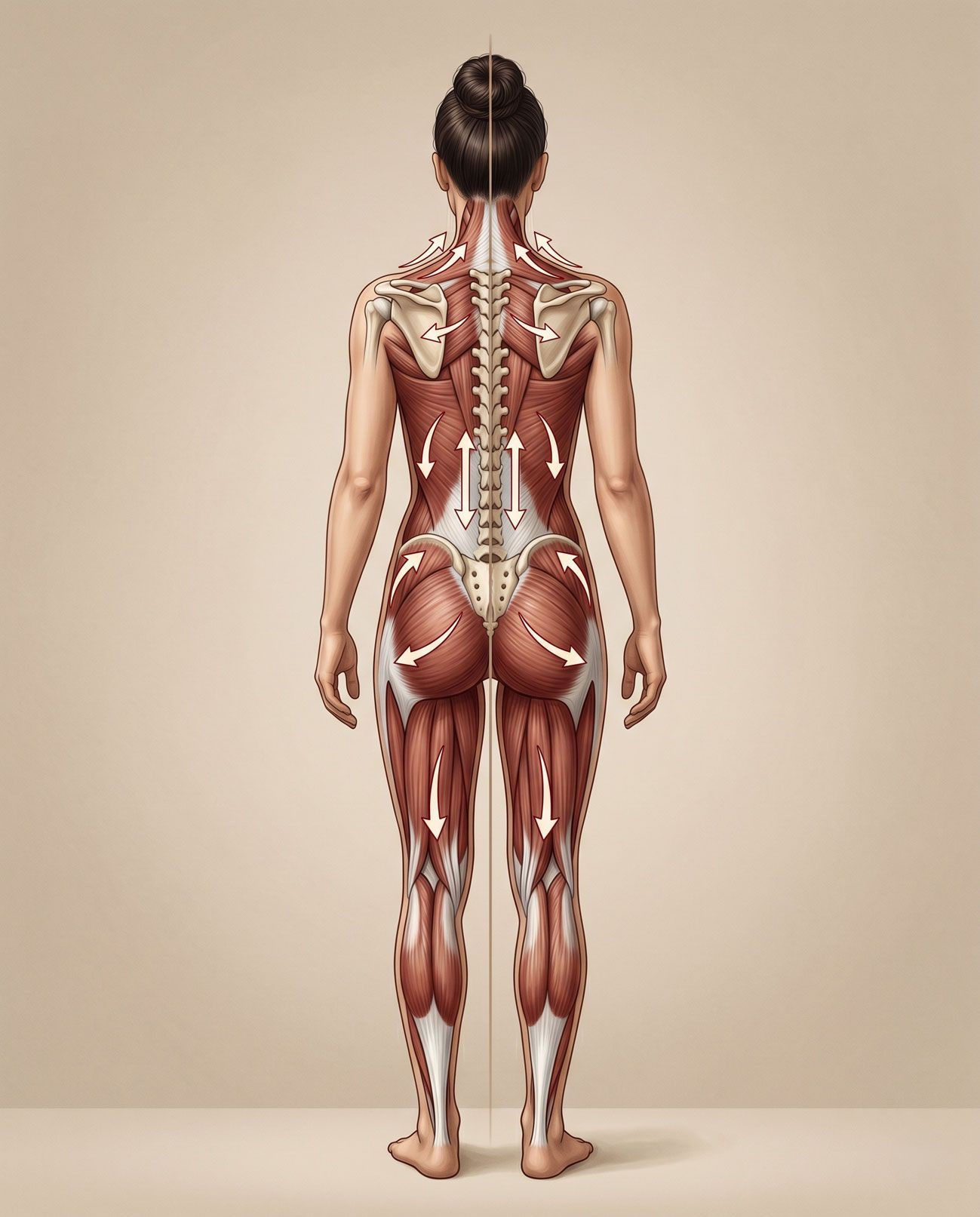
The muscles pulling you forward vs the ones that should hold you upright
In my case (and if you’re here reading this, probably in yours too), the protagonists were:
- The “strong” muscles pulling me forward: pecs, lats, quads.
- The “sleeping” muscles that should have been holding me upright: shoulder rotators, deep abdominals, gluteus medius, hip flexors.
Do you see the problem? The big, visible muscles are the ones we train to “look toned.” They’re the ones involved in most gym exercises.
The deep muscles are the ones that keep us aligned. They’re often small or “hidden” (in the sense of deep). And they get systematically ignored.
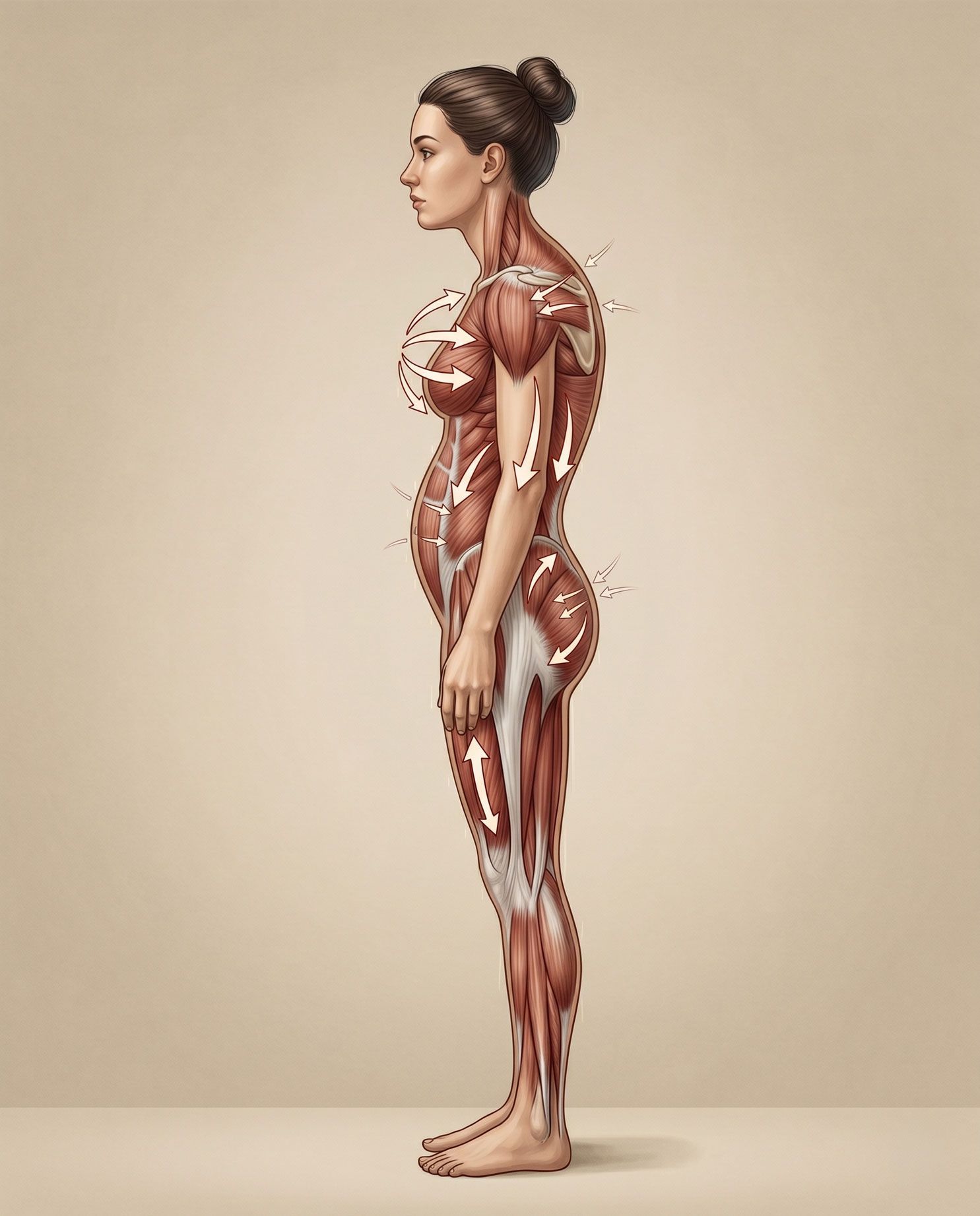
Adding strength on top of a compensation
Every time you train without first reactivating the deep muscles, one precise thing happens: you add strength on top of a compensation.
Think about it: if your back is already curved and your pecs are already shortened, doing push-ups means further strengthening the muscles that are pulling you forward. Without waking up the ones that should be pulling you back.
It’s like building a tower on unstable foundations.
Posture, bloating, and localized fat: three faces of the same problem
And here comes the part nobody talks about.
When the deep muscles don’t work, it’s not just your posture that suffers.
Much more changes.

Circulation slows down (and fat gets “stuck”)
When the deep muscles don’t activate and posture deteriorates, circulation slows down. The lymphatic stations always sit close to the joints.
If mobility is limited, lymphatic and blood flow are limited too.
And if less blood arrives, the body struggles to “unlock” fat deposits, especially in the most stubborn areas: outer thighs, love handles, saddlebags.
Exactly the areas that never seem to slim down. You lose weight everywhere (in your face, your chest…), but the saddlebags are still there. Like the red wine stain on a white shirt that has survived stain remover, pre-treatment, and three washes at 90 degrees. And those areas are often the ones where circulation is most limited.
It’s not always a question of what and how much we eat.
The lymphatic system stagnates (and bloating becomes chronic)
Lymph doesn’t have a pump of its own like the heart. It moves thanks to muscle contraction, breathing, and joint mobility. When the deep muscles are “asleep” and breathing is shallow, lymph stagnates.
The result: fluid, bloating, heaviness.
And over the years it becomes chronic. You’re perpetually inflamed.
Posture as a signal, not a problem
And this is where I want to pause for a second.
Posture, bloating, and localized fat go together.
They’re not three different problems. They’re the same imbalance seen from three different angles.
Poor posture is the visible signal. Bloating and stubborn fat are the internal consequences of that same imbalance.
That’s why working only on posture (or only on bloating, or only on fat) doesn’t work. You have to work on the cause that produces all three.
What to do: wake up the right muscles
Maybe you’ve been training for a while, doing things properly, and yet that sense of heaviness never goes away.
Your shoulders stay rounded. Your pelvis isn’t aligned. Your knees collapse slightly inward. Sometimes your back bothers you.
It’s not your fault. And it doesn’t mean you need to do more.
It means you need to wake up the right muscles.
The deep ones. The ones “classic” fitness tends to ignore because you can’t see them in the mirror: the pelvic stabilizers, the deep abdominals, the shoulder rotators, the diaphragm.
The Original Lymphatic Drainage Pilates (Pilates Linfodrenante®) works on exactly this: it rebalances, tones, unblocks.
- It strengthens the deep abdominals and pelvic stabilizers.
- It restores diaphragmatic breathing.
- It helps “shift” stubborn fat by activating circulation and lymphatic drainage in the neglected areas.
The result? The body “straightens up.” You feel less bloated.
And with time, your body can finally start to change.
One thing you can do today: 30 seconds that make a difference
Don’t wait to start a full Journey before you feel the difference.
Try this tonight, wherever you are.
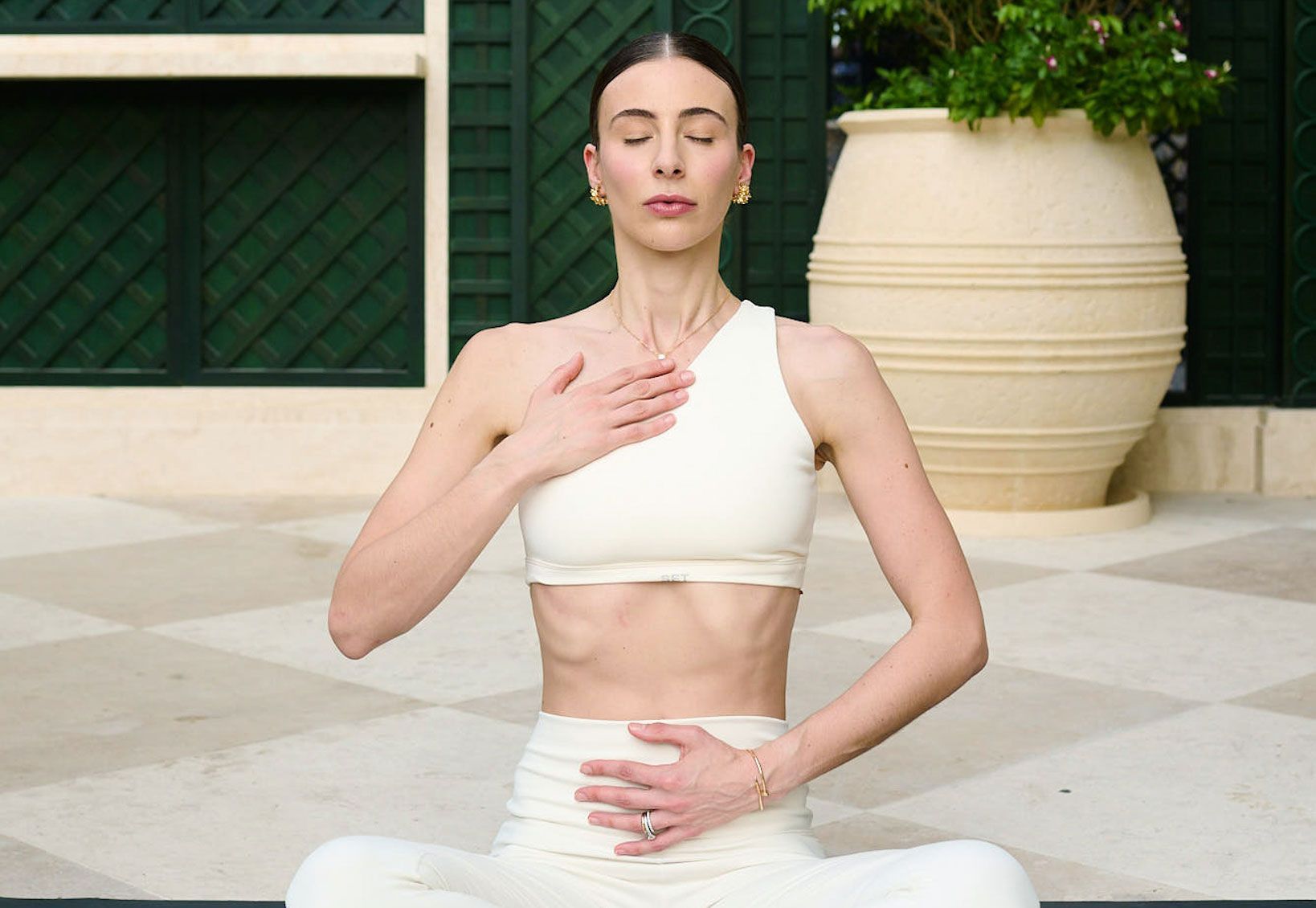
- Standing, shoulders relaxed, close your eyes.
- 5 deep breaths: inhale through your nose, exhale through your mouth.
- Try to expand your rib cage 360 degrees: the air goes to the front, but also to the sides and into your back.
- With every exhale, let your shoulders drop one more millimeter.
30 seconds.
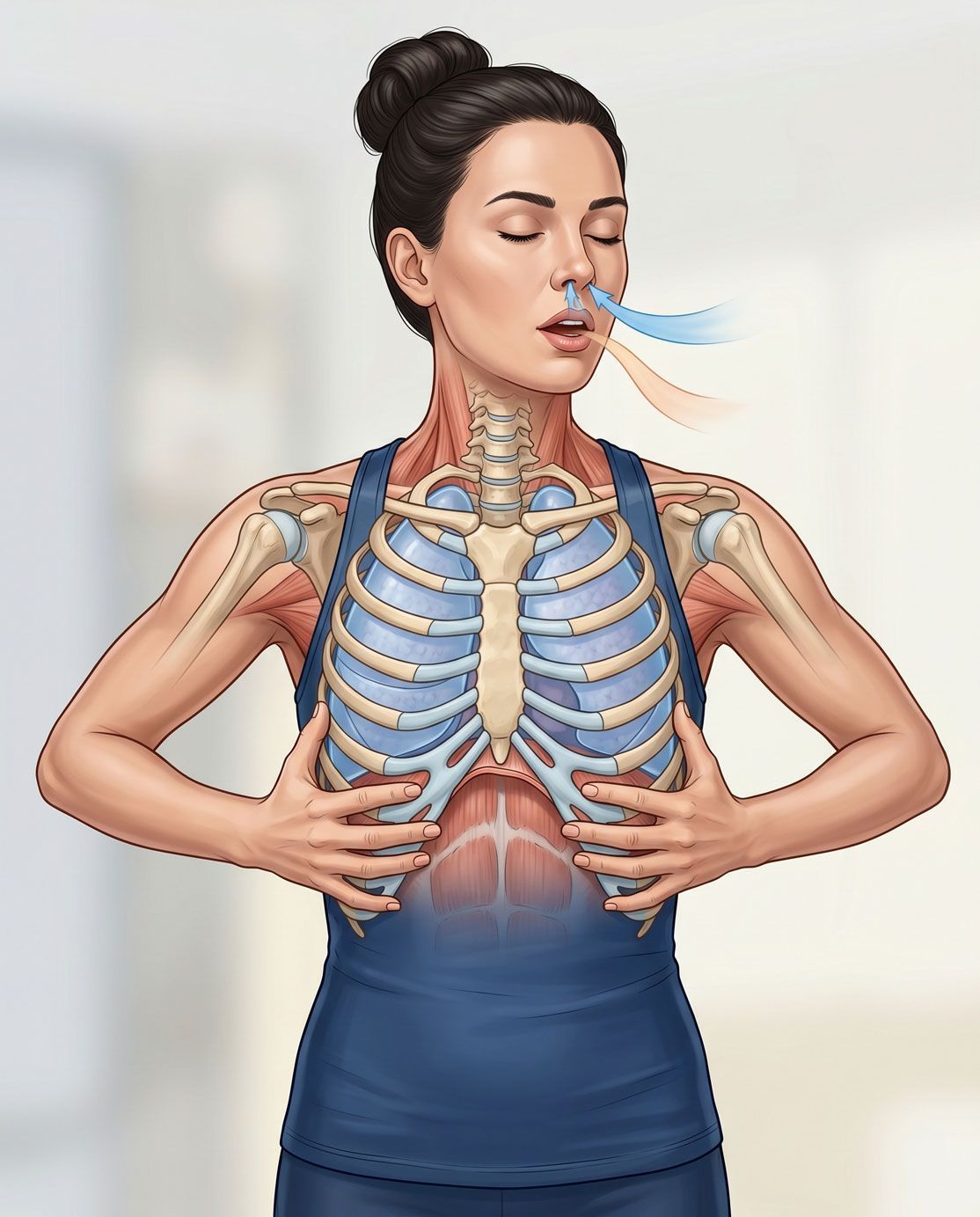
The diaphragm (the breathing muscle) is one of the main pumps of the lymphatic system. This one gesture, done well, does more than a thousand push-ups if the goal is to change your posture, your bloating, and your tone.
No mat. No equipment. Try it tonight.
Frequently asked questions
Do I have to stop training with weights?
If you enjoy it, no, you don’t have to stop.
But you also can’t neglect mobility, deep muscle activation, and the lymphatic system.
Lymphatic Drainage Pilates can coexist beautifully with other activities. That's why there's also a Lymphatic Gym Journey, combining 2 Lymphatic Drainage Pilates sessions a week with 2 gym sessions
How long does it take to see changes in posture?
The first signs (more relaxed shoulders, fuller breathing, less neck tension) come after just a few sessions.
More structural changes (visibly different posture, a belly that pushes forward less, lighter legs) take a couple of months.
Does it work even if I’ve never done any sport?
Yes; in fact, starting from zero is often an advantage, because you don’t have “compensations” ingrained by years of training. You start from the basics and build.
Can “inherited” postural problems really be changed?
Bone structure obviously doesn’t change, but the way muscles adapt and support the skeleton does.
A good part of what we call an “inherited problem” is actually a learned movement pattern, and it can be re-educated.
Structural scoliosis and specific pathologies are a different story; in those cases you need a specialist evaluation.
Does Lymphatic Drainage Pilates replace strength training?
It depends on your goals.
For many women, it can be their main workout.
For anyone who wants to build significant muscle mass, it’s the perfect complement: it lets you do that without worsening imbalances, while improving lymphatic and blood circulation.
How often should I do it?
Ideally at least 2-3 Lymphatic Drainage Pilates sessions a week. As with everything: consistency beats intensity.
Start here
You don’t need to revolutionize your life.
Start with those 30 seconds of 360-degree breathing, tonight. Really focus while you do it, and you’ll see that breathing well isn’t so simple (in fact, it’s one of the hardest things! I’ve been working on it for years and I still am).
Tomorrow, try again.
And little by little, you improve.
And if you’d like to be guided through a Journey that works on exactly this: waking up the deep muscles, rebalancing your posture, toning the body without stressing it, unblocking drainage in the difficult areas, try my Lymphatic Drainage Pilates.
It’s the method I created for myself to improve posture, bloating, localized fat, and cellulite.
Find the Lymphatic Drainage Pilates Journey that's right for you
Carlotta's insights, straight to your inbox
Just your name and email, unsubscribe anytime.