
Is 15 minutes of Pilates Linfodrenante® a day really enough? Selvaggia’s story
In short: Selvaggia changed her body using the 15-minute Pilates Linfodrenante® Express classes. Fifteen minutes of most workouts genuinely is not much. It works here because the active ingredient is different: lymphatic drainage switches on rather than accumulating, and the session is built to activate it from the first minute instead of losing a third of the time to a warm-up. The second thing that made the difference is that her routine is identical every single day.
When Selvaggia sent me her photo, she wrote something that made me smile: “sorry about the mess, it was a very haphazard check after a shower.”
Then she added the line that made this article necessary:
“The 15-minute classes have been my salvation!”
And before we go any further, I have to agree with your objection, because it is a fair one.
Fifteen minutes, for most kinds of training, genuinely is not much.
Fifteen minutes of running does not shift a great deal. Fifteen minutes in a weights room is a warm-up. Fifteen minutes of HIIT is half a session, and a third of it goes on getting your body warm.
So the right question is not whether fifteen minutes is enough.
It is: 15 minutes of what.
The active ingredient is not the same
Every kind of training produces its result through a mechanism. And some mechanisms need volume, while others do not.
Hypertrophy needs volume. Growing a muscle takes sets, reps and progressive loading accumulated over time. There is no way to compress that: fifteen minutes is not much and never will be.
Calorie burn needs duration. You burn calories for as long as you are moving. Fifteen minutes burns what fifteen minutes burns.
Lymphatic drainage does not work like that. Drainage switches on.
Let me explain what that means, because everything else follows from it.
Your lymphatic system has no pump of its own the way your circulatory system has the heart. Lymph moves through two things only: the contraction of the muscles around the lymphatic vessels, and the movement of the diaphragm when you breathe deeply.
Those two things work like a switch, not like a tank. Either you turn the pump on or you do not. Once it is on, going for longer adds something, but far less than turning it on again tomorrow does.
Which is why fifteen minutes built to activate drainage is worth more than an hour built to burn calories, if what you are dealing with is bloating rather than weight.
What is actually inside those fifteen minutes
Now the concrete part, because “fifteen minutes of Pilates” can mean anything.
A Pilates Linfodrenante® Express session is built so that not one of the fifteen minutes is wasted. Here is how.
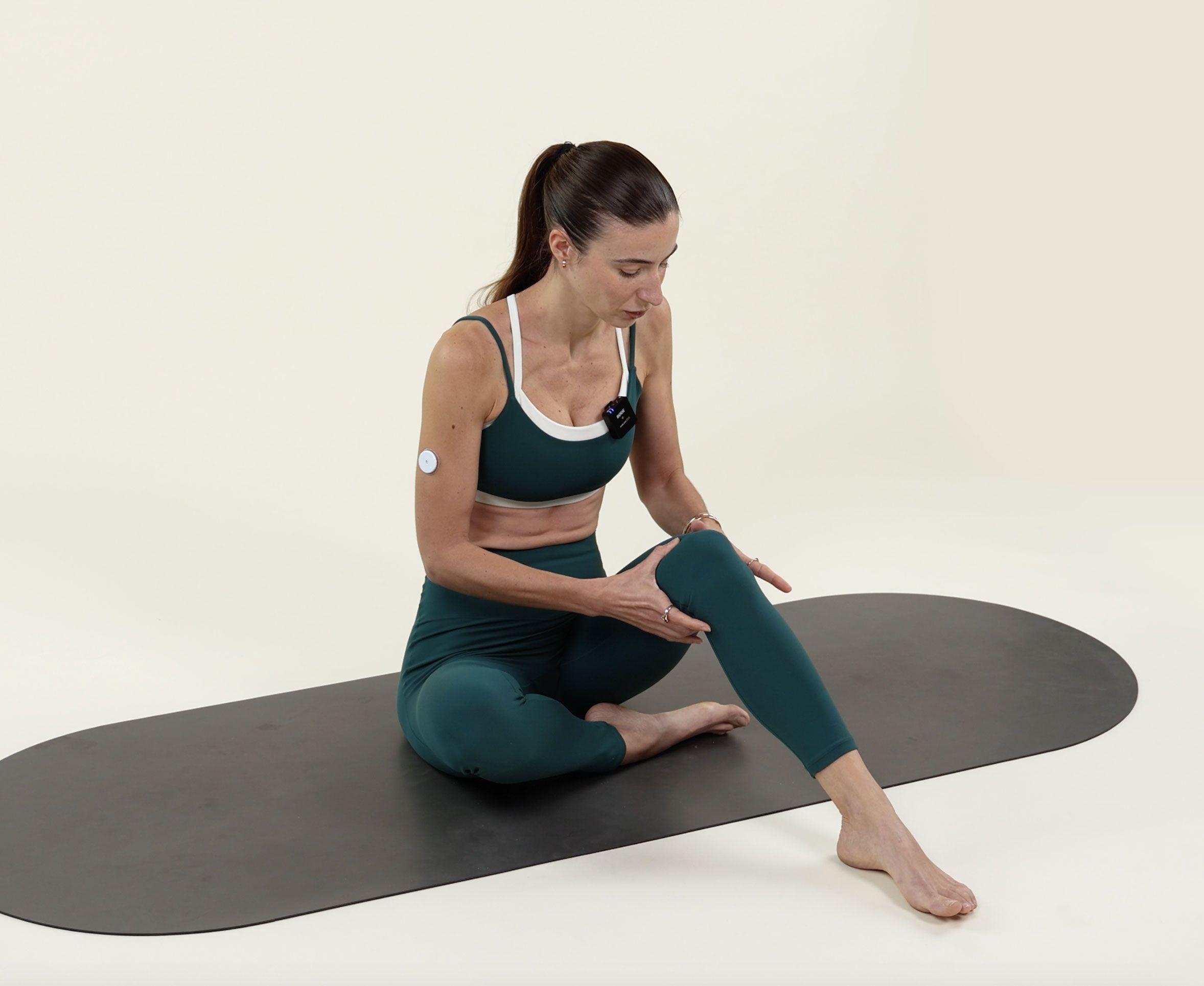
It opens by activating the lymphatic stations
The first few minutes are not a generic warm-up. They open the six lymphatic stations, the points where lymph is filtered before it moves on.
This is what puts the body in a state to drain while you train rather than afterwards. And it is the main reason the session can be short: what in an ordinary workout would be time spent getting warm is already productive work here.
In a fifteen-minute gym session, five minutes go before you have done anything useful. Here, fifteen minutes means fifteen minutes.
Every movement is paired with prescribed breathing
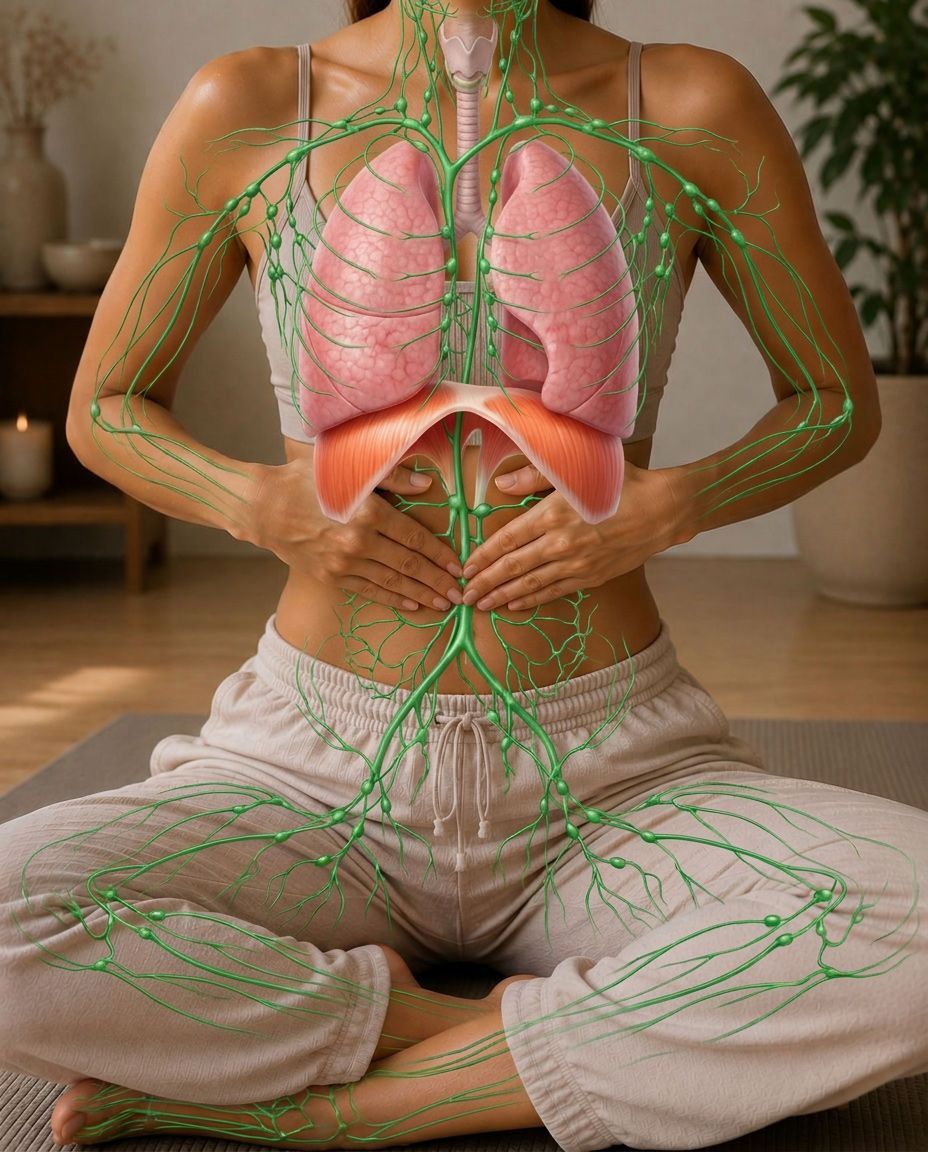
In Pilates Linfodrenante® I tell you exactly when to inhale and when to exhale, exercise by exercise. That is not a stylistic choice.
The thoracic duct, the largest lymphatic vessel in the body, passes through the diaphragm. Every deep breath pumps it, drawing lymph up from the lower body.
Which means every single repetition does two jobs at once: it contracts the muscle and it pumps the lymph. That is why the density of these fifteen minutes is higher than in a conventional workout of the same length, where the breath is not coordinated with anything.
The sequences alternate standing work with inversions
Part of the work is done with the feet higher than the pelvis, to help venous and lymphatic return. Gravity works with you rather than against you.
In a short session that counts for a lot, because you get a drainage effect without having to pay for it in time.
No loading, so no inflammation to clear afterwards
Heavy loads raise body temperature and create acute inflammation, which the body then has to deal with. Pilates Linfodrenante® works with body weight and controlled contractions.
For a daily session this is decisive: you can do it every day without accumulating stress, which would be impossible with intense training.
And here is the real advantage: you can do it every day
Put those four things together and you get the effect that matters most.
A low-impact fifteen-minute session is one you can repeat every day. An intense hour and a half is not, and in practice nobody does.
Now compare the two, remembering that drainage switches on rather than accumulating.
An hour and a half, twice a week: the lymphatic pump comes on two days out of seven. On the other five, fluid sits.
Fifteen minutes a day: it comes on seven days out of seven. Drainage never stops.
The weekly total in the second scenario is lower. The result on bloating and fluid retention is considerably better.
For drainage, frequency matters more than intensity. That is not a motivational slogan: it follows from the fact that the lymphatic system only moves when you move it.
What about the 150 minutes a week guideline?
If you are in the UK you will have this figure in your head, and it deserves a straight answer rather than being quietly ignored.
The NHS recommends at least 150 minutes of moderate activity a week. Fifteen minutes a day comes to 105. Below the line.
So let me be clear about what this method is and is not.
Pilates Linfodrenante® is not a substitute for cardiovascular activity. Those guidelines exist for heart and metabolic health, and they are good guidelines. Nothing in this article argues against them.
What Pilates Linfodrenante® does is a different job: it activates lymphatic drainage, builds and maintains deep muscle, and improves posture. Those are the things it is built for, and for those things the fifteen minutes is genuinely enough.
The two fit together easily, and in fact the programmes already assume it. Walking is the companion piece. Walking is the single best cardiovascular activity for anyone dealing with fluid retention, because the muscles under your foot act as a pump that pushes lymph upwards with every step, which running loses because the impact is too fast.
Fifteen minutes of Pilates Linfodrenante® plus a decent daily walk comfortably clears 150 minutes, and the two work on completely different systems.
Anyone selling you fifteen minutes a day as your entire movement requirement is overselling. What I am telling you is narrower and more useful: for drainage, tone and posture, fifteen minutes done daily beats ninety minutes done twice.
The second thing that made the difference for Selvaggia
There is another element in her message, and it is what makes everything else possible:
“For someone like me, who needs the routine to be exactly the same every day to feel calm, I can’t tell you how much it has helped me mentally.”
Exactly the same every day.
In the fitness world that sentence sounds like a flaw. You are told to vary things, surprise the body, change the stimulus.
For consistency it is the opposite, and since we have just established that consistency is the deciding factor here, that matters.
Every time you have to decide something, you get one more chance not to do it. Which session today. What time. Before or after dinner. Do I feel up to it. Every decision is a point at which the day can take it away from you.
An identical routine removes all of those decisions at once. You stop deciding and start executing. What was a daily choice to be renegotiated becomes something you simply do, like brushing your teeth.
How to build a routine that does not break
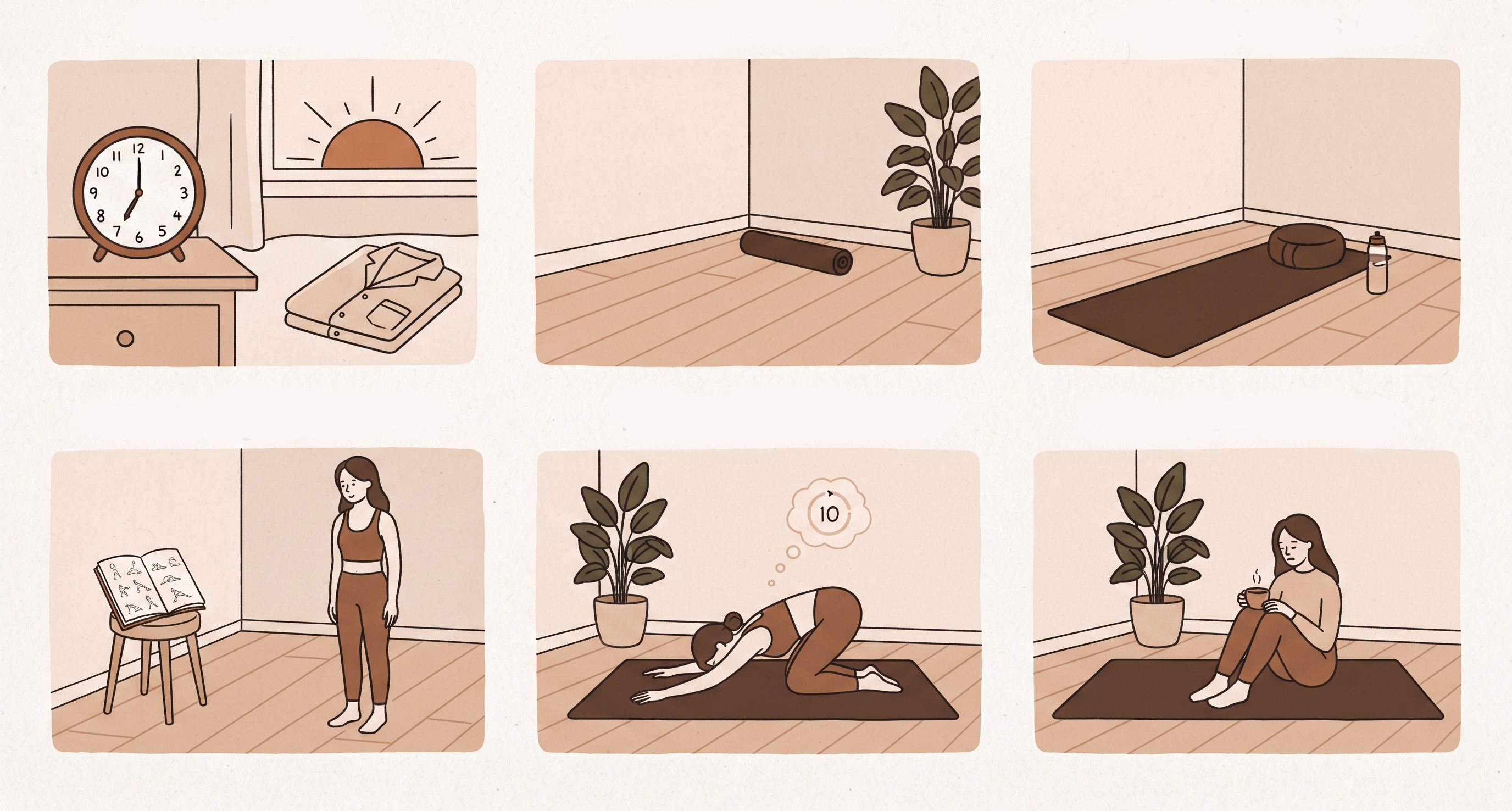
If your problem is not starting but continuing, here is what works in practice.
- Same time, every day. Not “sometime today”. A specific time. An activity with no time attached is the first thing to go.
- Same place. The same corner of the same room. After a while, walking into that room is half the job done.
- Mat always out, if you can. It sounds trivial. It is not. Unrolling the mat is the first micro-obstacle of the day.
- Do not choose the session on the morning itself. Follow a structured programme. Choosing uses energy you need elsewhere.
- Shrink the ask until you can hold it. If fifteen minutes is too much today, do ten. A short session you actually do beats a perfect one you postpone.
- Accept the bad days. Missing one day breaks nothing. What breaks a routine is missing three in a row and then deciding to start again on Monday.
The rest of her routine
On food, in her words: “Nothing particularly drastic, quite the opposite. I’ve cut down and in some cases completely cut out refined sugars, the packaged snacks, certain biscuits at breakfast.”
No diet. She removed one category of food, with particular attention to breakfast, which is the meal where most sugar is concentrated and the one that sets how your blood sugar behaves for the hours that follow.
She adds three things: she does not drink alcohol at all, does not smoke, and has one coffee a day, on which she says she is very strict.
The coffee deserves a line. Excess caffeine raises cortisol, and chronically high cortisol encourages fluid retention and fat storage. If you train, eat well and see no results, four coffees a day is a variable almost nobody considers.
And then the most underrated part of all:
“I’ve paid a lot of attention to what they call sleep hygiene: my 8 hours and more are non-negotiable and they have to be good quality.”
Non-negotiable. Like a work commitment.
When you sleep badly, cortisol stays high all day instead of falling as it should. And high cortisol slows gut motility, increases fluid retention and encourages fat storage. You can train well and eat well and see far smaller results simply because you sleep six hours.
The 4 things to take from Selvaggia’s story

The question is not whether fifteen minutes is enough, but fifteen minutes of what.
Drainage switches on rather than accumulating, so unlike hypertrophy it does not need volume.

An Express session is not a session cut short
It is built so all fifteen minutes are productive, starting with lymphatic activation instead of a generic warm-up.

The real advantage is that you can repeat it daily.
With no loading you do not accumulate stress, so the lymphatic pump comes on seven days out of seven instead of two.

An identical routine is an advantage, not a limitation.
It removes decisions, and every decision is a chance not to do it.
Where to start
If your obstacle is time, the programme is Pilates Linfodrenante® Express: fifteen minutes a day, the same ones that worked for Selvaggia.
If you have never done Pilates, start with Pilates Linfodrenante® Beginners: two months to build the foundations.
If you want the full programme, Pilates Linfodrenante® over 9 months.
And for the evening, try Light Legs in 7 minutes: legs up the wall before sleep, helping both drainage and sleep.
Frequently asked questions
Is 15 minutes of Pilates a day enough?
For the goals of this method, yes. Lymphatic drainage is activated through muscle contraction and diaphragmatic breathing, and it works like a switch rather than an accumulation: once the pump is on, turning it on again tomorrow is worth more than continuing longer today.
The Express session is also built to waste no time on a warm-up, because it opens by activating the lymphatic stations.
For different goals, such as hypertrophy, fifteen minutes is not enough, because that mechanism does need volume.
Why is 15 minutes of Pilates Linfodrenante® worth more than 15 minutes of another workout?
Three reasons. There is no generic warm-up: the first minutes are already useful work because they activate drainage.
Every repetition does two jobs at once, contracting the muscle and pumping lymph, because the breathing is prescribed movement by movement.
And part of the sequence is done in inversion, producing a drainage effect without costing time.
Does 15 minutes a day meet the NHS 150 minutes a week guideline?
Not on its own: fifteen minutes a day comes to 105 minutes. Pilates Linfodrenante® is not a substitute for cardiovascular activity, and it is not designed to be.
It works on lymphatic drainage, deep muscle and posture. Pairing it with a daily walk clears the guideline comfortably, and walking is also the best cardiovascular activity for anyone dealing with fluid retention, because the muscles in the foot pump lymph upwards with every step.
Is 15 minutes every day better than an hour twice a week?
For drainage, yes, even though the weekly total is lower. With two sessions a week the lymphatic pump comes on two days out of seven and fluid sits on the other five; with daily practice drainage never stops. For pure strength the answer would be the other way round.
Can you train every day without overdoing it?
Yes, because Pilates Linfodrenante® is low impact and uses no heavy loading, so it does not create the acute inflammation and temperature rise that make recovery days necessary.
It is precisely that characteristic which makes daily frequency possible, and daily frequency is what the drainage result depends on.
How do you become consistent with exercise?
By reducing the number of decisions. Same time, same place, mat already out, a structured programme rather than choosing each day.
Every decision removed is one less chance to skip. And if the planned session is too long for the day you have, shorten it rather than cancelling it.
How much does sleep affect results?
Considerably more than most people think. Sleeping badly keeps cortisol chronically high, and high cortisol slows gut motility, increases fluid retention and encourages fat storage.
You can train consistently, eat well, and see far smaller results than you deserve simply because you sleep six hours instead of eight.
If you have always told yourself fifteen minutes is too little, the right question is fifteen minutes of what.
