'%3e%3cpath%20d='M35.2503%208.65939C36.0457%208.65939%2036.7039%208.7528%2037.2687%208.98881V13.6849C36.4731%2013.498%2036.0507%2013.4488%2035.2503%2013.4488C30.8894%2013.4488%2028.4978%2015.9369%2028.4978%2021.3854V30.8265H23.3855V8.94459H28.4978V12.4654C29.4849%2010.4444%2032.343%208.65939%2035.2503%208.65939ZM55.7923%208.93966H60.9047V30.8217H55.7923V27.8614C54.432%2030.0693%2051.569%2031.3823%2049.0401%2031.3823C42.3809%2031.3823%2037.8284%2026.0764%2037.8284%2019.8757C37.8284%2013.675%2042.376%208.36927%2049.0401%208.36927C51.5738%208.36927%2054.432%209.68217%2055.7923%2011.89V8.92981V8.93966ZM55.7923%2019.8807C55.7923%2016.1239%2053.2586%2012.9325%2049.32%2012.9325C45.3814%2012.9325%2042.9407%2016.1239%2042.9407%2019.8807C42.9407%2023.6374%2045.4749%2026.8337%2049.32%2026.8337C53.1651%2026.8337%2055.7923%2023.6424%2055.7923%2019.8807ZM158.729%2019.8807C158.729%2026.0814%20154.182%2031.3871%20147.517%2031.3871C144.983%2031.3871%20142.125%2030.0742%20140.766%2027.8664V41.8167H135.652V8.94459H140.766V11.9048C142.125%209.69691%20144.988%208.38401%20147.517%208.38401C154.177%208.38401%20158.729%2013.6897%20158.729%2019.8904V19.8807ZM153.617%2019.8807C153.617%2016.1239%20151.083%2012.9325%20147.237%2012.9325C143.393%2012.9325%20140.766%2016.1239%20140.766%2019.8807C140.766%2023.6374%20143.299%2026.8337%20147.237%2026.8337C151.177%2026.8337%20153.617%2023.6424%20153.617%2019.8807ZM85.8911%208.39875C79.8804%208.39875%2074.9892%2013.2964%2074.9892%2019.3152V30.8364H80.0422V19.3152C80.0422%2016.0845%2082.6649%2013.4587%2085.8911%2013.4587C89.1174%2013.4587%2091.7401%2016.0845%2091.7401%2019.3152V30.8364H96.7935V19.3152C96.7935%2013.2964%2091.9019%208.39875%2085.8911%208.39875ZM120.744%208.39875C114.733%208.39875%20109.842%2013.2964%20109.842%2019.3152V30.8364H114.895V19.3152C114.895%2016.0845%20117.517%2013.4587%20120.744%2013.4587C123.97%2013.4587%20126.593%2016.0845%20126.593%2019.3152V30.8364H131.645V19.3152C131.645%2013.2964%20126.754%208.39875%20120.744%208.39875ZM182.095%208.39875C176.084%208.39875%20171.193%2013.2964%20171.193%2019.3152V30.8364H176.247V19.3152C176.247%2016.0845%20178.869%2013.4587%20182.095%2013.4587C185.322%2013.4587%20187.944%2016.0845%20187.944%2019.3152V30.8364H192.997V19.3152C192.997%2013.2964%20188.106%208.39875%20182.095%208.39875ZM65.4864%2030.8265H70.5988V8.94459H65.4864V30.8265ZM68.0453%200C66.3067%200%2064.8971%201.41126%2064.8971%203.152C64.8971%204.89272%2066.3067%206.30396%2068.0453%206.30396C69.7834%206.30396%2071.193%204.89272%2071.193%203.152C71.193%201.41126%2069.7834%200%2068.0453%200ZM100.751%2030.8265H105.864V8.94459H100.751V30.8265ZM103.31%200C101.571%200%20100.162%201.41126%20100.162%203.152C100.162%204.89272%20101.571%206.30396%20103.31%206.30396C105.048%206.30396%20106.458%204.89272%20106.458%203.152C106.458%201.41126%20105.048%200%20103.31%200ZM162.103%2030.8265H167.215V8.94459H162.103V30.8265ZM164.662%200C162.923%200%20161.513%201.41126%20161.513%203.152C161.513%204.89272%20162.923%206.30396%20164.662%206.30396C166.4%206.30396%20167.81%204.89272%20167.81%203.152C167.81%201.41126%20166.4%200%20164.662%200ZM214.197%2025.7568C210.966%2025.7568%20208.334%2023.126%20208.334%2019.8856C208.334%2016.645%20210.966%2014.0143%20214.197%2014.0143V8.94459C210.161%208.94459%20206.639%2011.1525%20204.749%2014.4175L202.166%2018.907V0.398301H197.054V30.8265H202.166V24.8766C202.166%2022.0836%20203.01%2021.4689%20203.32%2021.3558C203.394%2021.6951%20203.625%2022.6195%20203.63%2022.6195C204.847%2027.3303%20209.115%2030.8265%20214.197%2030.8265H216V25.7568H214.197ZM19.5699%208.94947H17.2077C14.0107%208.94947%209.95432%2010.2624%209.95432%2010.2624L10.853%208.94947C11.9334%207.25304%2012.5669%205.23692%2012.5669%203.07824V0.358962H7.50382V3.07824C7.50382%206.31381%204.8765%208.94947%201.64515%208.94947H0V14.0192H1.64515C4.97961%2014.0192%208.91324%2012.7161%208.91324%2012.7161L7.99981%2014.0192C6.9194%2015.7157%206.28592%2017.7318%206.28592%2019.8904C6.28592%2025.924%2011.187%2030.8265%2017.2126%2030.8265V25.7568C13.9812%2025.7568%2011.349%2023.126%2011.349%2019.8856C11.349%2016.645%2013.9812%2014.0143%2017.2126%2014.0143H19.5747V8.94459L19.5699%208.94947Z'%20fill='currentColor'/%3e%3c/g%3e%3cdefs%3e%3cclipPath%20id='clip0_346_1106'%3e%3crect%20width='216'%20height='42'%20fill='white'/%3e%3c/clipPath%3e%3c/defs%3e%3c/svg%3e)
How to find out if you have lipedema and how to treat it
Good morning everyone!
I'm Carlotta Gagna, founder of Traininpink, and today I'm talking to you about an important topic that affects many women: lipedema.
Let's look together at what it is, what the main symptoms are and how we can address this condition to improve well-being and quality of life.
What is lipedema?
Lipedema is a condition that mainly affects women and is characterized by an abnormal - and often painful - accumulation of fat localized on the legs, thighs and buttocks, and sometimes the arms.
The areas affected by lipedema are often sensitive and tend to bruise easily. Over time, lipedema can cause fluid retention in the affected parts, resulting in a medical condition called lymphedema (below we will look together at the difference between lipedema and lymphedema).
Sometimes lipedema is confused with weight gain, obesity or cellulite, or it is thought to be caused by a lack of physical exercise, when in reality it is an entirely different condition and independent of these factors: for these reasons, diagnosis is often complex.
Finally, there is no consensus on the causes and treatment within the scientific community - however, there are new promising studies that can point to a path (and a hope) for women affected by lipedema, which we will look at together in this article.
Symptoms of lipedema
Lipedema occurs because of the way fat (adipose tissue) and its supporting connective tissues are distributed under the skin. Normally, fat is distributed in our body unevenly in the legs and buttocks, rather than in a symmetrical and regular way.
In the case of a woman affected by lipedema, however:
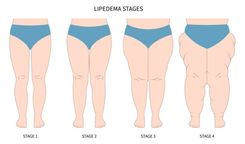
- the legs appear very swollen in a perfectly symmetrical way - the swelling can occur from the hips down to the ankles and the legs, depending on the stage of lipedema, can appear "column-shaped" (they do not follow the natural contours of the legs - see the image below);
- the affected areas appear "spongy" and cold;
- bruising and varicose veins are easily found in the affected areas;
- the legs and affected areas are very sensitive (even painful) to the touch and to pressure.
Causes of lipedema
Unlike normal fat accumulation dynamics (i.e., an increase in fat is generally observed as weight increases and vice versa), lipedema can affect people who are overweight, normal weight or even underweight - for this reason, your current weight and/or BMI is not predictive of lipedema.
At present, the causes of lipedema are not yet clear, although it is hypothesized that it may be related to female hormones (and, in fact, it is extremely rare in men).
What we know is that: genetics may play a role, as you have a greater risk of developing lipedema if other women in your family are affected by it; and - lipedema can develop - or worsen - during puberty, when you are pregnant, after a trauma and/or during menopause.
Diagnosis of lipedema
If you are at risk of lipedema - or if you believe you have symptoms attributable to lipedema - it is important to consult a doctor. The most qualified figure to diagnose lipedema is a vascular medicine specialist (even better if specialized in lipedema!).
Differences between lipedema and lymphedema
While lipedema is a chronic and progressive condition characterized by an abnormal accumulation of fat, lymphedema instead involves an abnormal accumulation of fluids in the lymphatic system and therefore relates primarily to lymphatic circulation.
The two conditions can coexist and, frequently, lipedema can also cause lymphedema: this is because the abnormal fat accumulations interfere with proper lymphatic circulation, thereby creating abnormal fluid accumulations.
Treatment of lipedema
Unlike fat that accumulates when weight is gained, fat in the areas affected by lipedema usually does not decrease by following a traditional diet or training.
Although at present there is no definitive cure for lipedema outside of surgical removal (liposuction), recent and promising studies indicate that the following lifestyle adjustments, taken together, can significantly improve it:
- Anti-inflammatory diet: without necessarily resorting to a ketogenic diet - recommended by many professionals as suitable for lipedema - a diet with a lower carbohydrate intake and, above all, with a reduced intake of processed foods, seed oils and sugars can help improve the appearance of lipedema. In particular, the diet for lipedema should minimize glucose fluctuations (glycemic spikes) after meals and be as sustainable as possible since they need to be maintained in the long term (for this reason a ketogenic diet may not be the suitable solution in the long term);
- Compression: the use of graduated compression garments helps manage the appearance and sensitivity of the areas affected by lipedema;
- Lymphatic drainage massages: help improve mobility, the appearance of lipedema and move fluids away from the affected area;
- Training: low-impact exercises aimed at improving lymphatic circulation.
With regard to training in particular, at Traininpink, we have created the exclusive Lymphatic Drainage Pilates™️ specifically to help women affected by lipedema and lymphedema with training tailored to their needs.
As the name suggests, Lymphatic Drainage Pilates™️ improves circulation and helps improve the appearance of lipedema and lymphedema, with proven effectiveness tested on more than 11,000 women.
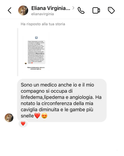
If you have lipedema, lymphedema or if you have circulation/swelling problems, try Lymphatic Drainage Pilates™️ free for 7 days.
You can cancel whenever you want and we guarantee results: if after 30 days you are not satisfied, we will give you a full refund.
Start today and find out why everyone is talking about Traininpink and Lymphatic Drainage Pilates™️
A big hug and until next time!
Carlotta