

Conscious breathing: how to practice it correctly
Good morning everyone!
I'm Carlotta Gagna, founder of Traininpink, and today I want to talk to you about a topic that might seem trivial and obvious, but is not at all: the importance of breathing in the correct way.
Breathing correctly is something we know how to do from birth, but over time, many people tend to forget the most effective way to breathe.
Let's look together at the best way to do it to feel more relaxed, but also to promote better overall health.
Chest breathing or diaphragmatic breathing?
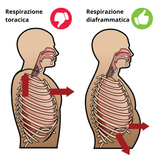
As we have already mentioned, not all ways of breathing offer the same benefits. There are two main types of breathing: chest and diaphragmatic, each with different characteristics and impacts on our body.
Understanding these differences is essential for improving the quality of breathing and making the most of its benefits.
In this chapter we will explore together the peculiarities of both.
Chest breathing
Chest breathing, also known as upper breathing, mainly activates the intercostal muscles and those of the chest. This type of breathing leads to a superficial expansion of the rib cage, making it less effective at absorbing oxygen.
It is often associated with situations of stress or anxiety, as it activates the sympathetic nervous system, responsible for the acute stress reaction, which increases heart rate and prepares the body to face emergency situations.
This activation, if frequent, can lead to an increase in muscle tension and heart rate, creating a state of continuous alertness even when not necessary.
Chest breathing can therefore be useful in moments of need, such as during intense physical activity, but it does not represent the ideal mode to use in daily life, as it limits the full use of lung capacity.
Diaphragmatic breathing
Diaphragmatic breathing, on the contrary, directly involves the diaphragm, allowing a more complete expansion of the lungs and ensuring optimal respiratory efficiency.
This type of breathing is directly linked to the activation of the parasympathetic nervous system, which promotes relaxation and recovery, helping to maintain a state of calm and emotional stability.
Breathing in this way improves lung capacity, promotes better oxygenation of the blood and reduces the load on the heart, naturally lowering the heart rate.
Furthermore, thanks to the connection between the diaphragm and the internal organs, it can contribute to improving digestion.
Through the mouth or the nose?
Another important distinction to understand is that between breathing through the mouth and breathing through the nose, as these two modes have very different effects on our body.
Let's look together, in detail, at what the differences are.
Mouth breathing
Breathing through the mouth can seem natural, especially in situations of intense physical exertion or stress.
However, over time, this habit can prove to be less effective than nasal breathing: when we breathe through the mouth, air enters and exits quickly, without passing through the filtering, warming and humidifying process of the nasal cavities.
This leads to a reduction in efficiency in the ability to oxygenate the blood, as the lungs are unable to fully absorb the available oxygen.
Furthermore, breathing through the mouth can cause greater dryness of the mouth and throat, increasing the risk of respiratory infections, as the internal mucous membranes are not sufficiently hydrated, making the respiratory system more vulnerable to viruses and bacteria.
Respirazione attraverso il naso
On the contrary, breathing through the nose is the most natural and healthy mode for our body.
Our nasal cavities have the natural function of filtering, warming and humidifying the air before it reaches the lungs. This process protects the respiratory system from impurities, dust and pathogens, reducing the risk of infections and irritations.
Furthermore, breathing through the nose promotes deeper and more diaphragmatic breathing, allowing the lungs to expand fully and absorb a greater amount of oxygen.
Practicing conscious nasal breathing, especially during physical activity and in daily life, is essential for supporting our overall well-being and promoting a greater connection between mind and body.
How can Pilates help you breathe correctly?
Pilates, with its targeted exercises, is the discipline that most emphasizes the connection between body and mind, and is therefore the ideal approach for learning to practice diaphragmatic breathing.
Through the coordination of every movement with the breath, Pilates helps us gradually develop a deep and diaphragmatic breathing, essential for increasing our lung capacity and breathing in a more effective and conscious way.
When practiced regularly, it stimulates the complete expansion of the diaphragm, promoting better oxygenation and reduction of stress: this is why at the end of every Pilates session we always feel more relaxed and focused, ready to better manage daily challenges.
It is also true, however, that at the beginning it can seem difficult to understand how to breathe correctly during training.
For this reason, during our Pilates sessions, I commit to guiding you step by step in conscious and controlled breathing: for each exercise I explain how to inhale through the nose and exhale through the mouth, helping you to gradually associate this process with every movement and providing guidance on timing.
With time, practice and consistency, this connection between breath and movement will become natural, and will transform into a good habit in everyday life as well, offering lasting benefits for our overall well-being.
Conclusion
Pilates is not simply a workout capable of improving our posture and strength, but it also educates us to develop a conscious breathing that is beneficial for our general health.
By integrating this practice into our daily life, we can achieve greater harmony between mind and body, reducing stress and improving the quality of our life.
Discover how powerful learning to breathe in the right way can be.
Try Traininpink free for 7 days and start feeling stronger and more aware every day!
A big hug and until next time!
Carlotta